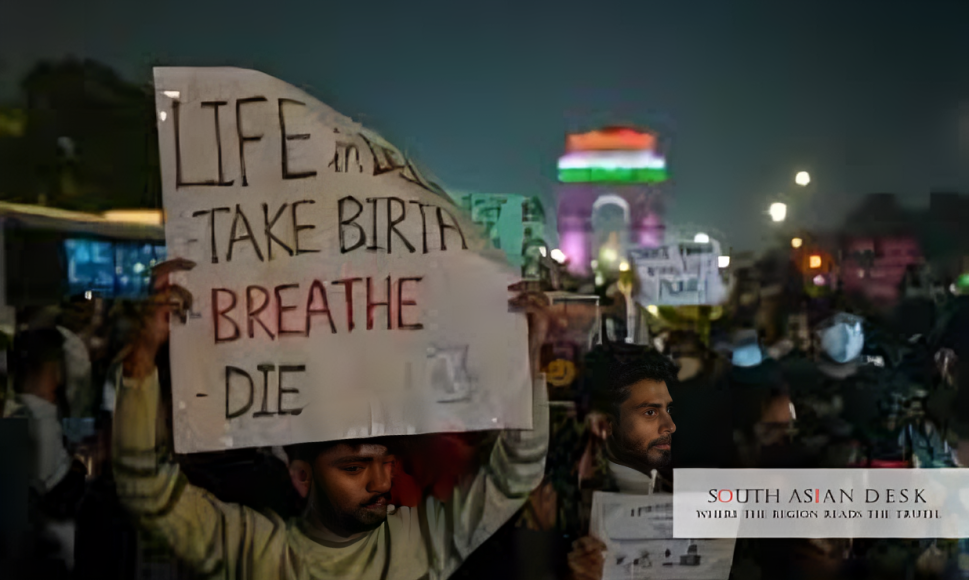
Delhi AQI remained in the very poor category at 397 early Monday, amid low winds and persistent smog from farm fires. A group of citizens protesting the toxic air at India Gate on Sunday evening clashed with police, stunning officers by deploying chilli spray during removal efforts.
Delhi‘s air pollution crisis extends beyond its borders, mirroring seasonal smog challenges across South Asia where shared agricultural practices and wind patterns amplify transboundary health risks for millions in neighbouring regions.
Persistent Smog Grips Capital Making Delhi AQI Poorer
Delhi recorded an overall AQI of 397 at 6am on Monday, according to Central Pollution Control Board (CPCB) data. This placed the city firmly in the very poor category. Low wind speeds and dropping temperatures worsened the conditions.
Out of 39 monitoring stations, 20 reported AQI levels above 400. These fell into the severe zone. The remaining 19 stations ranged between 300 and 400, also very poor. The highest readings came from Vivek Vihar and Rohini, both at 458. Jahangirpuri followed at 455. Wazirpur clocked 448, while Delhi Technological University (DTU) hit 444.
This marked the 18th near-continuous day of very poor air since November 6. Three severe days occurred between November 11 and 13. Factors included winter onset and farm fires post-Diwali in October. On Sunday at 4pm, the 24-hour average AQI stood at 391, still very poor. Saturday’s figure at the same time was 370. Friday recorded 364. All per CPCB records. Thick smog blanketed the city from early hours. Visibility dropped sharply.
Health Alerts Mount
The ongoing toxic air has sparked widespread health issues. Residents report more respiratory problems. Ocular irritation has risen. Pulmonary conditions affect vulnerable groups. Doctors note increased hospital visits. Experts warn of long-term risks from fine particulate matter.
These concerns prompted emergency measures. The government activated stage 4 of the Graded Response Action Plan (GRAP) under stage 3 protocols. This addresses the very poor AQI. GRAP stage Delhi restrictions include curbs on construction and vehicle entry. Industries face shutdowns in high-pollution zones. Enforcement teams monitor compliance. Violations draw fines. Public awareness campaigns urge mask use and indoor stays.
Delhi Pollution Protest Escalates
Citizens gathered at India Gate on Sunday evening to highlight the air crisis. The Delhi pollution protest focused on health impacts and government response. The group near C-Hexagon raised slogans. They demanded cleaner air and stricter enforcement. Organisers stated their position clearly. “When the state makes the air itself poisonous, it becomes necessary for people to unite and raise their voices for their own survival.”
Police approached the demonstrators. Officers explained the location blocked emergency access. Ambulances and medical staff needed clear paths. Protesters refused to shift. Tensions built quickly. The situation turned into a scuffle. Some demonstrators used chilli spray on police personnel.
Chilli Spray India Gate Incident Unfolds
The chilli spray India Gate event caught authorities off guard. Officers managing the crowd faced direct sprays to eyes and faces. Deputy Commissioner of Police (New Delhi) Devesh Kumar Mahla described it as unprecedented. “This was very unusual. For the first time, protestors used pepper spray on officers managing traffic and law and order.”
Several officers required treatment. They received care at Ram Manohar Lohia (RML) Hospital. Mahla confirmed legal proceedings. “A few of our officers were sprayed in the eyes and face and are currently receiving treatment at RML Hospital. Legal action is being taken in this regard.” Senior police noted the rarity. They had warned of potential escalation. Efforts to de-escalate failed.
The protest dispersed after the clash. No arrests reported immediately. Authorities vowed action against those involved. Investigations continue.
Broader Context of Air Woes
Delhi’s struggle reflects annual patterns. Stubble burning in nearby states contributes heavily. Punjab and Haryana fields ignite post-harvest. Vehicular emissions add to the mix. Industrial output persists despite curbs.
Winter inversion traps pollutants. Calm winds prevent dispersion. Meteorological forecasts predict no quick relief. Temperatures dip further this week. Schools advise online classes in affected areas. Offices promote work-from-home.
GRAP Measures in Action
GRAP stage Delhi protocols ramp up scrutiny. Stage 3 bans diesel generators above 500 kVA. Stage 4 adds bans on non-essential trucks. Entry for trucks from outside Delhi halts after 8pm. Exemptions apply for essentials.
Construction halts on non-critical projects. Dust control mandates tighten. The Commission for Air Quality Management oversees implementation. Daily reviews guide adjustments. Fines for violations reach thousands of rupees. Spot checks increase.
Community Response Grows
Residents voice frustration online and in streets. Petitions circulate for regional cooperation. Environmental groups call for crop residue alternatives. Subsidies for machinery gain traction. Youth lead awareness drives. Social media amplifies calls for change. The India Gate gathering drew dozens. Similar events occurred in past winters. Police prepare for more assemblies. Permits require advance notice.
Impacts on Daily Life
Commuters face reduced visibility. Traffic snarls worsen. Parents limit outdoor play for children. Elderly stay indoors. Hospitals stock extra oxygen. Emergency lines see spikes. Economic costs mount. Productivity dips in polluted days. Tourism feels the pinch. Visitors cancel plans.
Regional Parallels
Cities like Lahore and Dhaka report similar AQI spikes. Shared monsoon retreats stir dust. Cross-border talks on pollution control resume. Data sharing aids forecasts. South Asian nations eye joint strategies. Satellite monitoring tracks fire hotspots. Delhi’s case sets precedents. Policy shifts influence neighbours.
Expert Views on Crisis
Health officials stress precautions. N95 masks recommended outdoors. Ventilation tips circulate. Air purifiers sell out. Long-term solutions focus on electrification. Public transport expands. Research links pollution to chronic diseases. Studies urge urgency.
Background
Delhi’s AQI has hovered in the very poor range since early November 2025. Farm fires in northern India, combined with seasonal weather shifts, drive the surge. Previous winters saw similar peaks, leading to repeated GRAP activations. The current episode began post-Diwali, with stubble burning as a key trigger. Monitoring stations track hourly changes, guiding public alerts.
What’s Next
Forecasts indicate Delhi AQI very poor conditions may persist through the week, with GRAP measures under review daily. Further protests could emerge if air quality worsens, prompting tighter security at public sites.
Published in SouthAsianDesk, November 24th, 2025
Follow SouthAsianDesk on X, Instagram, and Facebook for insights on business and current affairs from across South Asia.