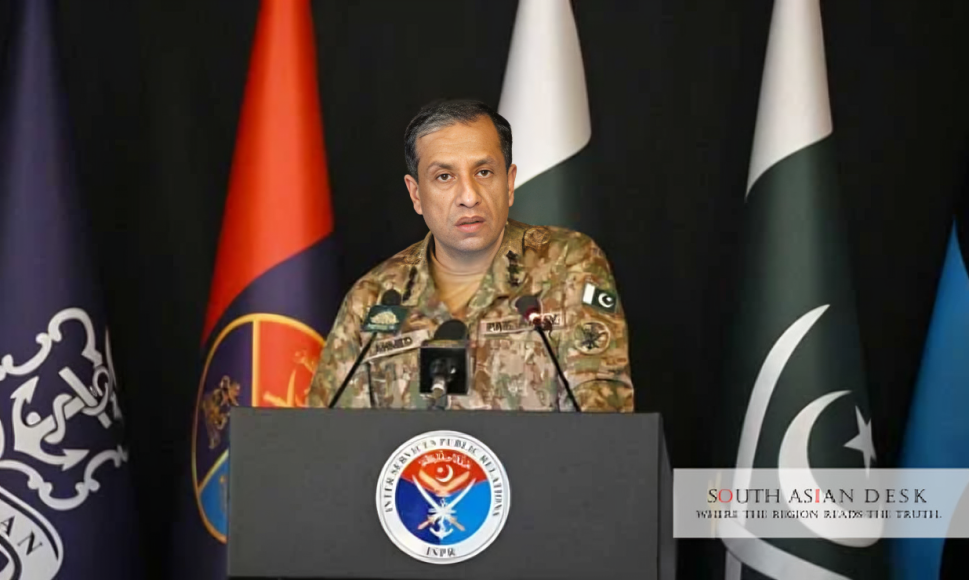
Director General Inter-Services Public Relations (DG ISPR) Lieutenant General Ahmed Sharif Chaudhry categorically denied reports of any secret agreement permitting US drone operations into Afghanistan from Pakistani territory. The statement came during a briefing to journalists at ISPR headquarters in Rawalpindi. Chaudhry dismissed the claims as baseless propaganda propagated by Taliban spokesman Zabihullah Mujahid. No formal complaint on the matter has reached Islamabad from Kabul, he added. This rejection underscores Pakistan’s firm stance on sovereignty as cross-border security challenges intensify.
The denial addresses a surge in Afghan accusations linking Pakistan to recent US intelligence activities in the region. Mujahid had claimed American drones routinely violated Afghan airspace via Pakistan, prompting formal protests to Islamabad. Chaudhry countered that such assertions lack evidence and serve to deflect from Kabul’s failure to curb terrorism originating from Afghan soil.
Lt Gen Chaudhry Rejects Taliban Drone Claims
Lieutenant General Ahmed Sharif Chaudhry, as DG ISPR, led the briefing to clarify Pakistan’s position ahead of the next round of bilateral talks in Istanbul on November 6, 2025. These discussions follow last month’s six-day negotiations mediated by Turkiye and Qatar, which aimed to reinforce a ceasefire and establish mechanisms against cross-border attacks.
Chaudhry emphasised that Pakistan has received no official grievance from the Taliban regime regarding drone incursions. “Pakistan has no agreement with the United States, and no formal complaint about drones has been received from the Taliban regime,” he stated. This direct rebuttal highlights the absence of any covert arrangement for US strikes.
The claims emerged amid heightened scrutiny of US activities post-2021 withdrawal from Afghanistan. Afghan officials alleged that drones launched from Pakistani bases targeted Taliban positions, but Chaudhry labelled these as “fake news” from Afghan and Indian media outlets. He reiterated: “Pakistan has not given permission to the US or any other country to use its territory for attacks inside Afghanistan. These claims are baseless propaganda.”
Data from recent operations bolsters Pakistan’s independent counterterrorism efforts. Over the past three to four months, Pakistani forces eliminated 112 foreign militants during infiltration attempts along the border. In broader actions against the banned Tehreek-i-Taliban Pakistan (TTP), 1,667 terrorists have been neutralised. During recent border clashes, 206 Afghan Taliban fighters and 112 TTP members were killed.
Approximately 60 per cent of those killed while attempting infiltration were Afghan nationals, indicating deepening ties between TTP and local Afghan elements. Chaudhry described the TTP not as a standalone group but as a branch sworn to the Taliban’s emir, with evidence of Taliban protection for TTP fighters in populated areas.
Pakistan No Deal US Strikes Afghanistan 2025
Pakistan’s rejection of any deal for US strikes in Afghanistan 2025 reinforces its policy of non-alignment in regional conflicts. The DG ISPR’s briefing occurs against a backdrop of strained Pakistan-Afghan relations, where Islamabad prioritises verifiable actions from Kabul to dismantle terrorist networks.
The one-point agenda for upcoming talks remains non-negotiable: Afghan soil must cease serving as a launchpad for attacks on Pakistan. “The conditions that Afghan Taliban keep putting forward are meaningless; what matters is the end of terrorism,” Chaudhry said. Preconditions from the Taliban, such as ending alleged support for the Islamic State-Khorasan Province (ISKP), were dismissed as irrelevant without concrete steps like arresting TTP leaders or disrupting supply lines.
This stance matters deeply in South Asia, where porous borders fuel instability across Pakistan, Afghanistan, and beyond. Persistent cross-border terrorism has displaced communities, strained economies, and complicated diplomatic ties. Pakistan’s operations have prevented potential escalations that could draw in India or other powers, maintaining a fragile balance. The denial of US involvement signals Islamabad’s intent to handle security autonomously, avoiding perceptions of foreign dependency that could inflame domestic politics or invite retaliation from non-state actors.
Historical context reveals the sensitivity of drone operations in the region. Since the early 2000s, US-led strikes targeted militants in Pakistan’s tribal areas, drawing criticism for civilian casualties and sovereignty breaches. Post-withdrawal, any hint of resumed cooperation risks reigniting debates. Chaudhry’s clarification aims to quash such narratives, affirming Pakistan’s sovereignty in 2025.
Background: Escalating Tensions and Ceasefire Efforts
The current impasse traces to the Doha agreement’s aftermath, where ceasefire commitments faltered amid TTP resurgence. Pakistan accuses the Taliban of harbouring TTP cadres, with evidence from captured operatives showing logistical support from Afghan territory. In response, Islamabad has intensified border fencing and intelligence-sharing, though implementation lags.
Recent clashes underscore the volatility. In the last month alone, Pakistani troops repelled multiple incursions, killing dozens. The 112 foreign militants neutralised include Afghan nationals integrated into TTP ranks, blurring distinctions between groups. This integration poses a direct threat to South Asian security, as attacks spill over into urban centres like Peshawar and Quetta.
The Istanbul process, revived last month, tests the Taliban’s sincerity. Mediated talks established a monitoring mechanism, but progress stalls on enforcement. Mullah Haibatullah, Taliban leader, consulted negotiators in Kandahar, yet no breakthroughs on hideout dismantlement have emerged. Pakistan views these dialogues as a credibility benchmark for Kabul.
Broader regional dynamics amplify concerns. India’s alleged “false flag” plans in the Arabian Sea, as warned by Chaudhry, could exploit the drone controversy to isolate Pakistan internationally. The military released a video confession from detained Sindh fisherman Ijaz Mallah, coerced by India’s Research and Analysis Wing for sabotage, linking it to disrupted terror networks.
On the humanitarian front, Pakistan hosts over four million Afghan refugees, underscoring its stake in stability. Any US drone operations, if real, would complicate repatriation efforts and fuel anti-Western sentiment.
DG ISPR Denies US Drone Operations: Implications for Diplomacy
The denial also intersects with global peacekeeping roles. Chaudhry noted that decisions on contributing to a proposed Gaza stabilisation force rest with the government and parliament, amid opposition calls for UN oversight.
In economic terms, border security affects trade routes. Poppy cultivation in Khyber, linked to TTP funding, disrupts legitimate commerce worth billions in PKR annually. Enhanced vigilance has curbed smuggling, but sustained peace requires Afghan cooperation.
What’s Next: Istanbul Talks and Beyond
As delegations prepare for Istanbul, expectations centre on actionable commitments. Pakistan seeks evidence of TTP arrests and network disruptions. Failure could prompt escalated responses, including hot pursuits, altering the 2025 security landscape.
The DG ISPR denies US drone operations stance will shape narratives in coming weeks. If Taliban claims persist without proof, it may erode trust further, pushing South Asia toward prolonged uncertainty. Yet, successful talks could herald a new era of cooperation, safeguarding borders and fostering development.
In conclusion, Lt Gen Chaudhry rejects Taliban drone claims, affirming Pakistan no deal US strikes Afghanistan 2025. This position safeguards national interests while urging regional accountability.
Published in SouthAsianDesk, November 4th, 2025
Follow SouthAsianDesk on X, Instagram, and Facebook for insights on business and current affairs from across South Asia.