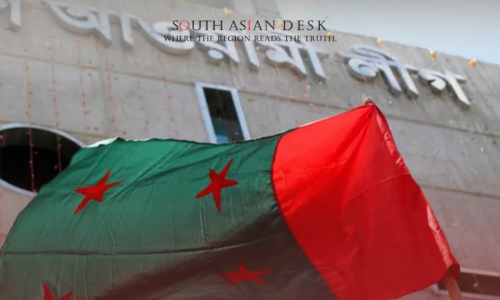
Election Commission of Bangladesh confirms Awami League cannot contest elections unless its ban under the Anti-Terrorism Act is lifted, impacting the 2026 polls.
On Tuesday, 13 May 2025, in Dhaka, Bangladesh’s Election Commission clarified that the Awami League’s suspension under the Anti-Terrorism Act bars it from polls until lifted, citing ongoing trials for protest-related violence.
The Election Commission of Bangladesh’s suspension of the Awami League reshapes South Asia’s political landscape, potentially destabilising Bangladesh’s democracy and affecting regional allies like India, which expressed concerns over democratic freedoms.
Election Commission of Bangladesh Awami League Suspension: Details
The Bangladesh’s Election Commission, led by Chief Election Commissioner AMM Nasir Uddin, stated that the Awami League, led by former Prime Minister Sheikh Hasina, cannot participate in the upcoming February 2026 general elections unless the government or judiciary lifts its ban. According to the Election Commission, “The League’s registration remains suspended until the International Crimes Tribunal (ICT) concludes its proceedings.” The ban, enacted on Saturday, 10 May 2025, under the Anti-Terrorism Act, followed protests demanding accountability for over 1,400 deaths during the 2024 student-led uprising that ousted Hasina.
EC Secretary Akhtar Ahmed explained, “With the home ministry’s ban on all activities of the League and its affiliates, the Election Commission has decided to suspend the party’s registration.” This disqualifies the party, which ruled for over 20 years, from contesting elections or engaging in political activities, including rallies, media appearances, or online campaigns, until the ICT trials conclude.
Reasons for the Awami League Ban
The interim government, led by Nobel laureate Muhammad Yunus, banned the League on 10 May 2025, citing national security concerns after amending the Anti-Terrorism Act to target political entities. The decision followed allegations of mass human rights violations during Hasina’s 16-year rule, including the violent suppression of protests from July to August 2024, which resulted in 834 to 1,400 deaths, according to UN reports. The Awami League’s student wing, Bangladesh Chhatra League, was banned in October 2024 as a “terrorist organisation” for its role in protest violence.
The party rejected the ban as “illegitimate” via its official Facebook page, stating, “All decisions of the illegal government are illegal.” Hasina, in exile in India since Monday, 5 August 2024, faces charges of murder and crimes against humanity.
Regional and International Reactions
India expressed concern on Tuesday, 13 May 2025, with Foreign Ministry spokesperson Randhir Jaiswal stating, “The ban on the Awami League without due process is a concerning development for democratic freedoms.” The US urged respect for freedoms of expression and assembly, with State Department deputy spokesperson Tommy Pigott saying, “We support fair and transparent legal processes for all.” The Bangladesh Nationalist Party (BNP) and the student-led National Citizen Party have demanded early elections, though the latter insists on reforms first.
Impact on Bangladesh’s 2026 Elections
The suspension disrupts Bangladesh’s two-party system, which was historically dominated by the League and BNP. Chief Election Commissioner Nasir Uddin noted on Monday, 30 December 2024, in Chittagong, that the Awami League could participate unless explicitly banned by the government or judiciary, but current restrictions make this unlikely. The EC is updating voter lists and aims for elections by June 2026, with reforms to ensure independence from external pressures.
The ban has sparked fears of political polarisation, with analysts warning of a democratic backslide if the League remains excluded. The National Citizen Party’s Nahid Islam welcomed the ban, while BNP leader Khaleda Zia, back in Dhaka since April 2025, pushes for inclusive polls. The interim government’s focus on reforms may delay elections, complicating the Awami League’s return.
Background
Founded in 1949, the Awami League led Bangladesh’s independence in 1971 and governed from 2009 to 2024 under Hasina, accused of authoritarianism. The 2024 uprising, sparked by anti-quota protests, ended her rule, leading to the interim government and the party’s ban. The ICT is probing protest-related deaths, with trials ongoing.
What’s Next
As Bangladesh prepares for the 2026 elections, the Election Commission Bangladesh Awami League suspension will shape political dynamics, with the ICT’s trial outcomes determining the party’s electoral fate.
Published in SouthAsianDesk, September 4th, 2025
Follow SouthAsianDesk on X, Instagram, and Facebook for insights on business and current affairs from across South Asia.