The European Union commits to deploying a large-scale EU observer mission team to ensure transparency in Bangladesh’s landmark 2026 vote, amid efforts to restore democratic trust following years of contested polls.
EU Prepares Major Deployment for Bangladesh 2026 Election Observers
European Union Ambassador to Bangladesh Michael Miller announced on Monday, that the EU plans to send a substantial election observer mission to monitor Bangladesh’s 2026 parliamentary elections. The mission, expected to include 150 to 200 observers, marks the bloc’s first full-fledged deployment since 2008. This follows an exploratory assessment by EU experts in September 2025 and aligns with ongoing preparations by the Bangladesh Election Commission (EC) for polls tentatively set for early February 2026.
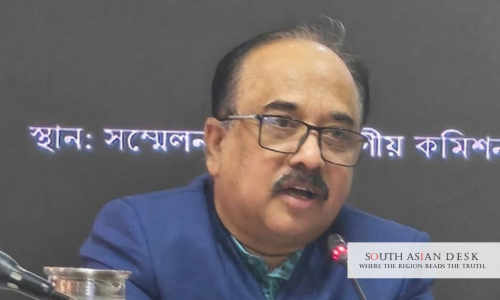
Miller made the remarks after meeting Chief Election Commissioner AMM Nasir Uddin in Dhaka. The announcement underscores the EU’s support for timely, participatory elections in the nation of 170 million, where a generation of voters has yet to participate fully due to past irregularities. The mission will cover both the general election and a concurrent referendum on the July National Charter, a document aimed at guiding post-uprising reforms.
EC Senior Secretary Akhtar Ahmed confirmed the EU’s interest during a September 29, 2025, briefing, noting that a tripartite memorandum of understanding (MoU) with the EC and Ministry of Foreign Affairs is under review. “The EU delegation has submitted a draft MoU, which we will examine before signing,” Ahmed stated. This pact will outline observer access to polling stations and vote counting, essential for the mission’s effectiveness.
The EU’s involvement addresses logistical hurdles in what Miller described as “the biggest democratic exercise anywhere in the world in 2026.” With 127.7 million eligible voters, 64.8 million men, 62.9 million women, and 1,234 third-gender individuals, the EC has published a final voter list and extended preparations for expatriate voting, a first for Bangladesh. Civic education campaigns target first-time voters, many sidelined by fears of violence or perceived unfairness in prior elections.
Michael Miller EU Bangladesh Polls: Focus on Risk Mitigation and Voter Readiness
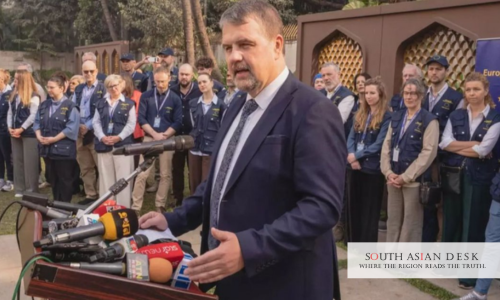
Miller, speaking to reporters, highlighted the EU’s confidence in the EC’s professionalism. “The European Union recognises the commitment and the professionalism of the Bangladesh Election Commission and its capacity to run well-prepared elections,” he said. “This is a sign of our confidence in the election process and our support for elections in this wonderfully diverse country.”
During a recent mock exercise with the EC, Miller observed preparations for simultaneous voting and referendum processes. “You have a huge country with a huge population and it is the first time for many of your citizens to go to the polls for a number of reasons,” he noted. “So there is a job now of civic voter education that has to be completed. That will imply popular debate, it will imply the government, it will imply the Election Commission going and telling your ordinary voters what it means to take part in an election.”
The ambassador emphasised discussions with stakeholders on security and participation. “What we are discussing with all of the Bangladeshi stakeholders involved in the vote is how do you mitigate the risks and how do you ensure that the elections are smooth and participatory. That’s what we want to see,” Miller added. He praised the EC’s foresight on potential delays, including extended voting hours to accommodate queues in a nation where past polls saw low turnout due to boycotts and unrest.
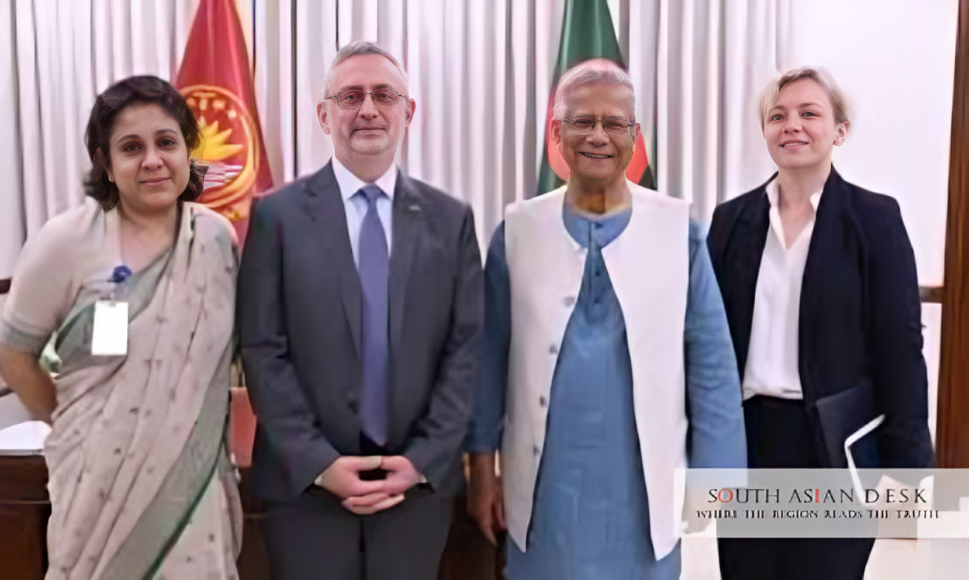
In an earlier October 28, 2025, meeting with Chief Adviser Muhammad Yunus, Miller reiterated the mission’s scope. Some observers will arrive six weeks prior for long-term monitoring, others a week before polling day. “This would be the first time since 2008 that the EU is sending such a full-fledged election observer team to Bangladesh,” he told Yunus, according to the Chief Adviser’s press wing. The EU also pledged €4 million in August 2025 for voter education and domestic observer training, implemented via the European Partnership for Democracy.
A September 2025 EU expert team, led by senior election specialist Riccardo Chellery, assessed the environment from September 18 to October 7. Their report, submitted to EU headquarters, recommended the deployment, citing improved conditions post the July 2024 uprising that ousted the previous government. The team queried access protocols, which the EC affirmed for transparency.
EU Large Election Mission Bangladesh: Boosting Regional Democratic Standards
This EU large election mission Bangladesh initiative extends beyond observation to capacity building. In August 2025, Miller announced technical experts would evaluate deployment feasibility, focusing on institutional independence. “Our focus, both on the conduct of elections and in other areas of our work in Bangladesh, will be on ensuring the independence, efficiency, and accountability of the institutions here,” he said.
The mission aligns with EU foreign policy principles, as outlined in a November 4, 2025, Joint Commission meeting statement from the European External Action Service (EEAS). “The EU and Bangladesh discussed the situation of democracy, the rule of law and good governance, including the importance of deep structural reforms that would prepare the ground for elections in Bangladesh, to be conducted according to international standards and best practices for genuine democratic elections,” the statement read.
For South Asia, the EU observer mission Bangladesh election holds broader implications. Bangladesh’s polls, as the region’s largest single-day democratic event, could set precedents for neighbours like India and Pakistan, where electoral integrity faces scrutiny. Success here might counter global democratic backsliding trends, as Miller noted: “What I want to pass as a message is it is a moment for this country to show that it is bucking the trend on democratic backsliding.” Enhanced EU-Bangladesh ties, including a Partnership and Cooperation Agreement under negotiation, hinge on credible polls, potentially unlocking trade and migration pacts.
The International Republican Institute’s (IRI) November 2025 pre-election assessment echoed this, urging neutrality and reform implementation. IRI met 59 stakeholders, including EC officials, and recommended securing the environment for peaceful participation. With 21 meetings, the mission stressed the Interim Government’s role in advancing the National Consensus Commission’s agenda.
Logistically, the EC plans for 42,000 polling stations nationwide, with digital voter verification to curb fraud. Expatriate voting via postal or embassy ballots adds 3 million potential participants, per EC data. Security measures include RAB dissolution oversight and anti-trafficking collaborations discussed in Miller’s Yunus meeting.
Background
Bangladesh’s electoral history includes EU missions in 2001 and 2008, but the 2023 polls drew criticism for opposition boycotts and violence, leading to no full EU deployment. The 2024 uprising, sparked by student protests, ended Sheikh Hasina’s 15-year rule and installed an Interim Government under Yunus. This paved the way for reforms via the July Charter, ratified in a planned referendum. Past elections averaged 40-50% turnout; the EC targets 70% for 2026 through education drives funded partly by EU grants.
The EU’s €4 million package, announced August 19, 2025, supports citizen observation and media training, building on €181.6 million in prior democracy aid since 2006. A 2024 EU High Representative statement post-uprising called for “an orderly and peaceful transition towards a democratically elected government,” setting the stage for this mission.
What’s Next
The EC awaits a formal election schedule, expected by December 2025, to finalise the MoU. EU observers’ arrival in January 2026 will coincide with intensified civic campaigns. Stakeholders, including the BNP and civil society, push for pre-poll reforms like judicial independence. Success could solidify Bangladesh’s democratic reset, with EU reports influencing regional aid flows. The EU observer mission Bangladesh election remains pivotal for inclusive participation.
Published in SouthAsianDesk, December 2nd, 2025
Follow SouthAsianDesk on X, Instagram, and Facebook for insights on business and current affairs from across South Asia.