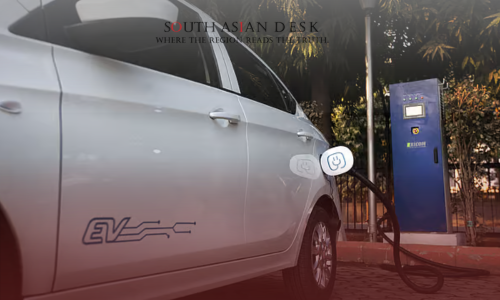
India’s EV sector faces production cuts due to rare earth shortages triggered by China’s export curbs.
On Thursday, August 28, 2025, India’s EV sector reported significant production disruptions due to rare earth shortages, caused by China’s export restrictions since April, impacting manufacturers like Bajaj Auto in India.
The rare earth shortages threatening India’s EV sector could hinder South Asia’s clean energy transition, affecting economic growth and regional competitiveness in the global electric vehicle market.
Rare Earth Shortages Disrupt EV Sector
India’s burgeoning EV sector is facing a severe setback as rare earth shortages, stemming from China’s export restrictions imposed on Thursday, April 4, 2025, disrupt production. The restrictions, a response to US tariffs, have halted shipments of critical rare earth magnets, essential for electric vehicle (EV) motors. Bajaj Auto, a leading manufacturer, reported a 47% production drop for its Chetak electric scooter in July 2025, producing only 10,824 units compared to 20,384 the previous year. The curbs have caused industry-wide concern, with no shipments reaching India since April.
Impact on Production and Sales
The shortage has significantly affected India’s EV sector, particularly two-wheeler manufacturers. Bajaj Auto’s executive director, Rakesh Sharma, noted that the company redesigned motors to use lighter rare earth magnets, recovering 50% of planned July output and aiming for 60% in August and September. Other manufacturers, including TVS Motor, Mahindra, Hyundai, and Kia, face similar risks, with inventories depleting rapidly. The Federation of Automobile Dealers Association (FADA) president, Vigneshwar Chittur Selvakumar, expressed deep concern, stating that the shortages could drastically impact the automobile sector, which controls 80% of vehicle sales.
Broader Industry Challenges
Rare earth magnets, made from elements like neodymium and dysprosium, are critical for Permanent Magnet Synchronous Motors (PMSMs) used in EVs, which require approximately 0.8 kg per vehicle compared to 0.1 kg for internal combustion engine (ICE) vehicles. The EV sector’s reliance on these magnets makes it particularly vulnerable. Aman Bir Singh, an EV consultant, highlighted that while ICE and hybrid vehicles use smaller quantities, the current shortage disproportionately affects EVs. The television industry, reliant on rare earth magnets for speakers, is also impacted, with manufacturers like Videotex facing supply chain challenges.
India’s EV Market Growth at Risk
India’s EV sector has seen robust growth, with sales surpassing 2 million units in 2024, a 24% increase from 1.6 million in 2023, driven by 1.2 million two-wheeler sales. Electric car sales also rose, with over 100,000 units sold in the financial year ending March 31, 2025. However, the rare earth shortages threaten this momentum. Nilanjan Banik, an economics professor at Mahindra University, noted that companies fear acknowledging the crisis publicly to avoid losing customers and share value. China may address India’s rare earth needs following diplomatic talks, but no concrete resolution has been confirmed.
Efforts to Mitigate Shortages
To counter the crisis, Indian manufacturers are exploring alternatives. Some are importing fully assembled motors from China or adopting magnet-free technologies like induction motors, though these involve trade-offs in efficiency. The government is pushing for domestic production, with Heavy Industries Minister HD Kumaraswamy proposing INR 1,345 crore in subsidies for rare earth magnet manufacturing. India, holding the world’s fifth-largest rare earth reserves at 6.9 million tonnes, produced only 2,900 tonnes in 2023 due to limited refining capacity.
Background
China’s export restrictions on seven rare earth elements—samarium, gadolinium, terbium, dysprosium, lutetium, scandium, and yttrium—began on April 4, 2025, following US President Donald Trump’s 54% tariffs on Chinese goods. China, controlling over 90% of global rare earth processing, requires Indian manufacturers to obtain export licenses, causing delays of up to 45 days. India’s EV sector, aiming for 30% of vehicle sales by 2030, faces a critical challenge as it relies heavily on Chinese imports, with 53,748 metric tons of rare earth magnets imported in FY25.
What’s Next
India’s EV sector is likely to pursue alternative supply chains and domestic production to reduce reliance on China. The success of these efforts will determine whether the sector can sustain its growth trajectory amidst ongoing rare earth shortages.
Published in SouthAsianDesk, August 28th, 2025
Follow SouthAsianDesk on X, Instagram, and Facebook for insights on business and current affairs from across South Asia.