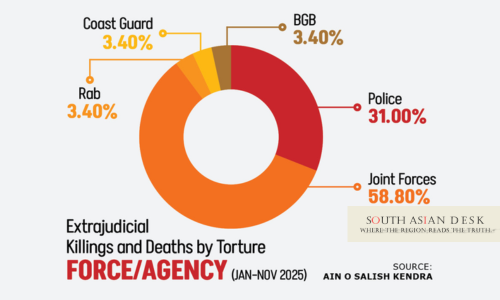
Extrajudicial killings Bangladesh persist into 2025, with 29 victims recorded between January and November. Ain o Salish Kendra (ASK) documented the cases, including deaths from torture in custody. The interim government, led by Muhammad Yunus since August 2024, pledged reforms but faces criticism for inaction. Human Rights Watch and the UN highlight hundreds of past abuses, including 1,400 protest deaths in 2024. Families demand investigations into recent incidents, such as those in Brahmanbaria. On Human Rights Day, activists call for accountability to break the cycle of violence.
These extrajudicial killings in Bangladesh erode trust in state institutions and signal risks for South Asia’s fragile democracies. Bangladesh’s transition post-Hasina exposes how impunity fuels instability, mirroring patterns in Pakistan and India, where custodial abuses spark protests. With elections slated for February 2026, unchecked violations could inflame ethnic tensions in the Chittagong Hill Tracts and urban unrest in Dhaka. Regional bodies like SAARC closely watch, as reforms here could serve as a model for accountability amid rising authoritarian backslides.
Custodial Torture Bangladesh 2025: 28 Prison Deaths Logged
Custodial torture in Bangladesh 2025 claims 28 convicts and 55 under-trial prisoners, per ASK data up to November. Prisons Directorate officials attribute most to illness, denying systematic abuse. Yet rights monitors link deaths to beatings and neglect.
In Brahmanbaria, Hazrat Ali, 30, died on 7 December 2024 after detention during a joint force raid. His body showed bruises. Officer-in-charge Morshedul Alam cited a robbery probe but offered no details on custody conditions. Md Abdullah from Salimganj union suffered fatal injuries post-torture by locals and was handed over to the police on 23 September 2024. Sub-Inspector Md Mohim Uddin faces arrest for his role.
ASK coordinator Badiul Alam Majumdar noted patterns. “Torture remains rampant in police stations and prisons.” The group recorded 83 torture complaints in 2025, up from 72 in 2024. Victims include opposition figures and minorities.
Assistant Inspector General Jannat-Ul Forhad from the Prisons Directorate stated that 90 prisoners died of illness in 11 months. “No prisoner faced torture.” Police headquarters’ AHM Sahadat Hossain countered rights reports. He classified some deaths as suicides or mob beatings, with probes ongoing into seven cases: two mob killings, three suicides, and two heart attacks.
The interim government disbanded the Rapid Action Battalion (RAB) in February 2025, as per recommendations from the national commission. RAB accounted for hundreds of past extrajudicial killings. Yet, police and the Detective Branch continue these patterns, according to Human Rights Watch.
Bangladesh Human Rights Violations: Legacy of 1,400 Protest Deaths
Bangladesh human rights violations span enforced disappearances, torture, and killings, with roots in the Awami League era. A UN report from February 2025 detailed 1,400 deaths during July-August 2024 protests, mainly from security force shootings. Children comprised 12-13 per cent of victims.
The International Crimes Tribunal convicted former Prime Minister Sheikh Hasina and Home Minister Asaduzzaman Khan Kamal of crimes against humanity on 17 November 2025, sentencing them in absentia to death. Human Rights Watch welcomed accountability but flagged fair trial flaws, including the denial of counsel.
UN High Commissioner Volker Türk urged probes. “Testimonies paint a picture of rampant state violence and targeted killings.” The report cited deliberate executions, like student Abu Sayed, shot at close range on 16 July 2024. Forensic analysis confirmed shotgun pellets from 14 metres.
Post-Hasina, retributive violence killed over 200, targeting Awami League supporters, Hindus, and Ahmadis. Chittagong Hill Tracts saw ethnic clashes in September 2025, with military fire on Jumma protesters. Indigenous activist Nabayan Chakma Milon died in custody earlier, highlighting ongoing land grabs and sexual violence.
The Yunus administration acceded to the UN Convention on Enforced Disappearances in August 2024. A commission received 1,850 complaints, estimating over 300 presumed killed in custody. Yet arbitrary arrests persist, with 19 charged for flag desecration.
Extrajudicial Deaths Interim Government: Impunity Persists
Extrajudicial deaths in the interim government total 29 in 2025, per ASK, despite reform pledges. Activists blame the lack of transparency. Families often learn of detentions through rumours, which can delay interventions.
Nur Khan Liton of ASK warned of alarming continuity. “Perpetrators remain in power. No accountability means justice stays elusive.” Tawohidul Haque, a rights lawyer, stressed family rights. “Inform relatives of arrests. Allow verification to ensure detainees live unharmed.”
The government signed a three-year UN memorandum in July 2025 for a Dhaka mission to bolster protections. It dropped politically motivated cases and released thousands of detainees from the 2024 protests. Yet, reprisal violence and secret detentions persist, according to HRW’s January 2025 report.
Odhikar documented 40 extrajudicial victims in 2025, including crossfire euphemisms for executions. No security personnel faced charges. The commission on disappearances released “Unfolding the Truth” in October 2025, detailing torture cells like “Ayna Ghor.”
Police investigation committees exist, but they yield few convictions. In 2025, only two officers faced trial for 2024 abuses. HRW recommends special procedures visits, including rapporteurs on executions and torture.
Background: From the Hasina Era to Yunus Transition
Extrajudicial killings surged under Hasina from 2009 to 2024, with over 3,500 disappearances. RAB’s crossfires killed 300 in 2019 alone. US sanctions in 2021 temporarily curbed some abuses.
The 2024 quota protests ignited the Monsoon Revolution, toppling Hasina on 5 August. Yunus assumed power, vowing to end impunity. Six commissions formed in February 2025 to overhaul police, justice, and elections.
Past UN visits, such as Michelle Bachelet’s in 2022, have demanded independent probes. Odhikar’s 2013 report on killings led to harassment of its leaders. The ICT, used for the 1971 war crimes, now prosecutes the 2024 events but retains death penalties, breaching international law.
Economic fallout adds strain. Following the revolution, over 150 journalists lost their accreditations. Banks had probed the finances of 50 media figures by January 2025.
What’s Next in Extrajudicial Killings Bangladesh
The interim government is considering constitutional amendments through commissions. Elections loom in February 2026. HRW urges a UN Human Rights Council resolution in March 2026 for sustained monitoring.
Unions demand RAB-style disbandments for other units. Victims seek reparations. The UN appeals for fair trials and command accountability.
Extrajudicial killings in Bangladesh test the promise of a rights-respecting future. Vigilance ensures words turn to action.
Published in SouthAsianDesk, December 10th, 2025
Follow SouthAsianDesk on X, Instagram, and Facebook for insights on business and current affairs from across South Asia.