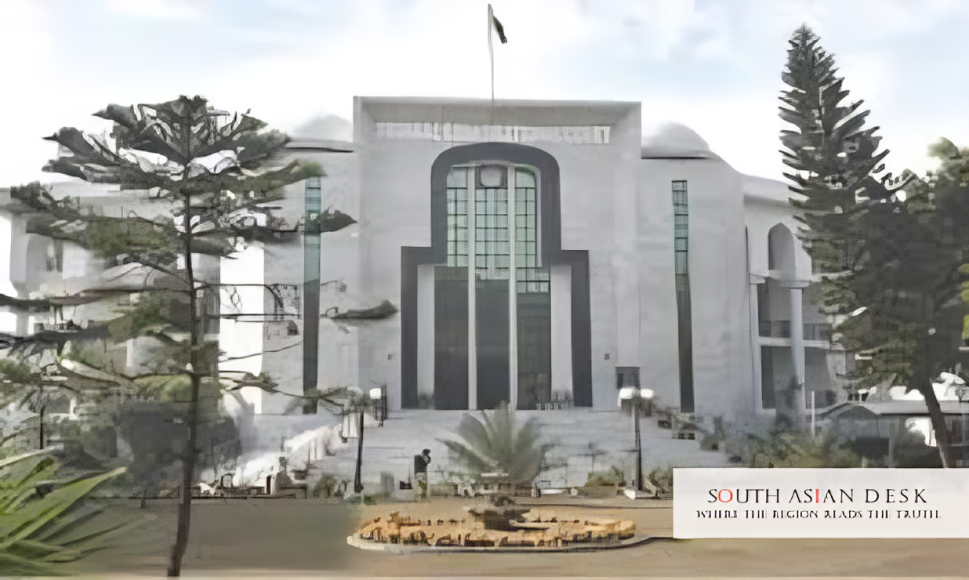
Islamabad: The Federal Constitutional Court Pakistan commenced operations at its new premises on Constitution Avenue on Monday, January 12, 2026, with Chief Justice Aminuddin Khan presiding over the inauguration and a bench hearing petitions challenging the super tax imposition. The event attended by key officials signals a shift in handling constitutional matters.
The establishment of the Federal Constitutional Court Pakistan represents a key reform under the 27th Constitutional Amendment, aimed at streamlining constitutional adjudication and reducing the Supreme Court’s caseload. This move addresses longstanding concerns over judicial efficiency in South Asia’s largest Muslim-majority nation, where constitutional disputes often intersect with economic policies affecting regional stability.
FCC First Case: Super Tax Petitions Pakistan
A three-judge bench of the Federal Constitutional Court Pakistan, led by Chief Justice Aminuddin Khan and including Justices Syed Hasan Azhar Rizvi and Arshad Hussain, resumed hearings on challenges to Section 4B of the Income Tax Ordinance 2001. The super tax petitions Pakistan target the levy introduced via the Finance Act 2015 for rehabilitating temporarily displaced persons.
During the session in Courtroom No. 1, lawyer Rashid Anwar argued on behalf of petitioners, highlighting procedural issues. The Federal Board of Revenue (FBR) representative informed the court that PKR 114 billion had been collected under the provision from 2015 to 2020, exceeding the PKR 80 billion estimated for rehabilitation. The federation reportedly spent PKR 117 billion on the effort.
Chief Justice Aminuddin Khan noted facility shortcomings in the new setup but assured prompt resolutions. No video-link options exist yet, though future implementation remains possible.
The super tax petitions Pakistan stem from high court rulings in Sindh, Lahore, and Islamabad, which the FBR appealed. Petitioners claim the tax discriminates against high-income entities and violates constitutional principles.
Pakistan Judiciary Updates: Operational Shift and Case Transfers
Recent Pakistan judiciary updates include the transfer of 22,910 cases from the Supreme Court to the Federal Constitutional Court Pakistan. The court, with a sanctioned strength of 13 judges, operates from a renovated building formerly housing the Federal Shariat Court.
The shift followed a temporary stint at the Islamabad High Court after resistance from Federal Shariat Court judges. Seven courtrooms are planned, but only three on the first floor function currently, equipped with modern audio systems.
Lawyers raised concerns over inadequate amenities, including no bar room or canteen. Advocate Tallat Abbas Khan stated that lawyers must cross to the Supreme Court for rest, anticipating higher footfall as the Federal Constitutional Court Pakistan becomes the apex body for constitutional issues.
In a related development, Chief Justice of Pakistan Yahya Afridi inaugurated a Litigant Facilitation Centre at the Supreme Court on the same day, focusing on procedural guidance for litigants.
The Federal Constitutional Court Pakistan’s composition includes Chief Justice Aminuddin Khan as its inaugural head, sworn in on November 14, 2025, by President Asif Ali Zardari. Justices Rizvi, Farooq, Najafi, and Agha have joined, with more appointments expected.
This reform aligns with the 27th Amendment’s goal to enhance federal-provincial balance in judicial matters, potentially influencing South Asian legal frameworks amid Pakistan’s economic challenges.
Background
The Federal Constitutional Court Pakistan emerged from the 27th Constitutional Amendment, enacted on November 13, 2025, to create a dedicated body for constitutional interpretation. This addresses overload at the Supreme Court, where constitutional benches handled similar matters previously.
Super tax petitions Pakistan originated in 2015, targeting a one-time levy on incomes above PKR 500 million at 4% for banks and 3% for others. High courts ruled against it in parts, prompting FBR appeals now before the Federal Constitutional Court Pakistan.
Pakistan judiciary updates reflect broader reforms, including the amendment’s emphasis on judicial independence and efficiency. The court’s relocation to the old Federal Shariat Court building was announced officially on its website, effective January 12, 2026.
What’s Next
Hearings on super tax petitions Pakistan resume on January 13, 2026, with potential decisions impacting fiscal policy. The Federal Constitutional Court Pakistan plans facility upgrades, including video-links, to handle increasing caseloads efficiently.
Published in SouthAsianDesk, January 13th, 2026
Follow SouthAsianDesk on X, Instagram and Facebook for insights on business and current affairs from across South Asia.