The US seeks market access for GM crops in India as trade tensions rise with 50 per cent tariffs. Farmers fear losses from imports that could undercut non-GM exports. Government remains cautious on approvals.
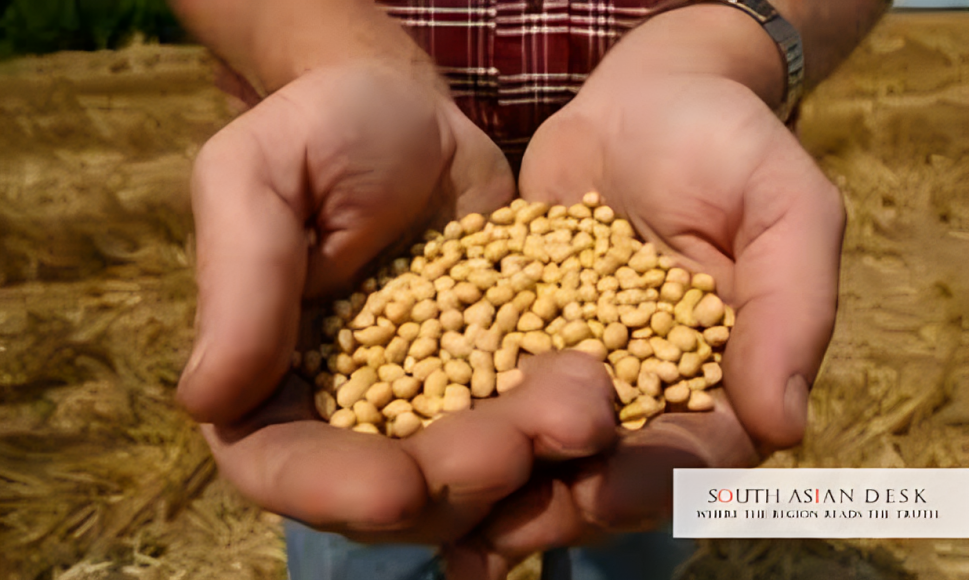
The United States is pressing India to open its markets to genetically modified (GM) soya and corn exports. This push comes amid ongoing trade negotiations strained by US-imposed 50 per cent tariffs on Indian goods in 2025. Indian farmers express wariness over potential impacts on their livelihoods and export markets. The development highlights tensions in US-India GM trade, with Washington aiming to redirect surplus production after reduced sales to China.
Agriculture accounts for 18 per cent of India’s GDP and supports 46 per cent of its population. Any shift in policy on GM crops in India could affect regional food security and trade dynamics in South Asia, where non-GM products hold a premium in global markets. Farmers in neighbouring countries like Pakistan and Bangladesh watch closely, as similar pressures could emerge.
US India GM Trade Dynamics
The US produced 119.05 million metric tonnes of soya beans in recent years, representing 28 per cent of global output, according to USDA data. India, in contrast, produced 13.05 million tonnes, with Madhya Pradesh contributing over half. US officials view India as a key alternative market following China’s scaled-back purchases due to bilateral trade wars.
In the 2025 National Trade Estimate Report, the US Trade Representative highlighted India’s de facto moratorium on GM crop approvals since 2010 as a barrier. The report notes high tariffs, including 50 per cent on corn, and requirements for non-GM certificates on 24 products, including grains and oilseeds. These measures are seen as not science-based and violating WTO obligations under the SPS Agreement.
Suman Sahai, founder of Gene Campaign, stated: “Trump has to sell this soya and corn so as not to annoy his big political base of the soya [and] corn farmers.”
US-India bilateral trade in food and agriculture reached $8.6 billion in 2024, per the USDA Foreign Agricultural Service reports. However, India’s import policies for GM soya and GM corn remain restrictive to protect domestic non-GM niches.
Farmer Concerns Over GM Crops in India
Indian farmers report challenges from weather and market forces. Excessive rains destroyed crops in 2025, leading to low yields. Prakash Patel, a corn farmer in Madhya Pradesh, said: “The traders set the prices at their will, as the government does not buy from us. We are unable to even recover the production cost… The profit is a distant dream for us, and we still have to pay the loans we took to buy our farming materials.”
Hemant Jain, a corn exporter, added: “The soya and corn from India have a major demand in the international market due to their non-GM quality… The import of GM material would create a doubt of adulteration in the minds of foreign buyers, who might be reluctant to buy from us.”
Indra Shekhar Singh, an independent agrarian analyst, warned: “The US is trying to find an alternative market to China, but Indian farmers can’t win against the US government’s subsidised agri-commodities. They would capture the complete market in a few years, leaving our farmers in deep poverty and helplessness.”
Typical Indian farms span about 2 hectares, supporting families of five to seven. US farmers benefit from larger plots and subsidies, creating an uneven field in potential US-India GM trade.
Regulatory Framework for GM Soya India and GM Corn India
India’s Genetic Engineering Appraisal Committee oversees GM approvals. The Food Safety and Standards Authority requires GEAC clearance for imports. As of December 2024, full regulations for GE foods remain pending.
The US report criticises opaque processes and political influences in India’s biotech regulations. For distiller’s dried grains with solubles, a corn-derived feed, over 11 applications await GEAC decision.
A senior scientist working with the Indian government on GM technology noted: “The GM technology is insect-resistant, and it would help to reduce the need for spraying insecticides and lower costs for farmers. Besides, production also increases massively in the GM technique that helps farmers to minimise their losses.”
However, Kawaljeet Bhatia, a poultry feed supplier, suggested: “A handful of exporters receive a premium price, as they claim to export organic products. They want that status to continue as it benefits them. It is just a matter of time before we have to switch to GM for increased productivity… [Suggesting] the government develop its own GM seeds, instead of importing them.”
India produces 42 million tonnes of corn annually, with 20 per cent used for ethanol. Self-sufficiency in corn contrasts with soya oil imports due to processing gaps.
Background
India’s caution stems from past events. The 2020-21 farmers’ protests against three farm laws led to their withdrawal, underscoring political sensitivity. US tariffs in 2025 have hit Indian exporters, straining relations.
The Supreme Court has called for a national GM crop policy, as noted in 2025 discussions. This could shape future imports of GM soya India and GM corn India.
Global context includes US production dominance. Brazil leads soya output, but the US seeks diversification. India’s non-GM status aids exports to Europe and Asia, where premiums apply.
Sibaji Pratim Basu, an independent political commentator, observed: “There are already hiccups in India-US relations due to tariffs that have badly hit several businesses in India dependent on the US market. The government is definitely concerned about its vote bank before taking any decision.”
What’s Next
Bilateral talks continue via the Trade Policy Forum. US presses for alignment with international standards like Codex Alimentarius. India may consider limited quotas for industrial uses, such as ethanol from GM corn, but resists food chain entry.
Nirbhay Singh, a soya farmer, highlighted potential yields: “A farmer in India typically produces about 1 metric tonne of soya beans in 0.40 hectares (1 acre). But GM soya bean yield can go up to 3 metric tonnes over the same land area.”
Experts urge domestic GM development to boost productivity without reliance on imports. As negotiations progress, the outcome will influence GM crops in India and the broader US-India GM trade.
Published in SouthAsianDesk, December 23rd, 2025
Follow SouthAsianDesk on X, Instagram and Facebook for insights on business and current affairs from across South Asia.