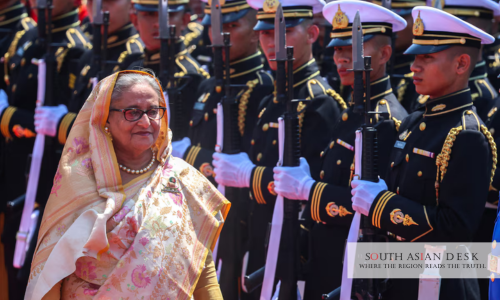
Exiled former Prime Minister Sheikh Hasina calls for a mass voter boycott in response to her Awami League being barred from the Bangladesh election. The move threatens the legitimacy of the February 2026 polls. She issued the call on Wednesday via emailed responses to Reuters. This comes amid rising tensions in Dhaka.
The statement highlights the controversy surrounding the 2026 Bangladesh election. It highlights risks to the democratic transition in a nation emerging from last year’s uprising. South Asia watches closely. Low turnout could undermine the interim government’s reforms. Neighbouring India hosts Hasina. Regional trade ties hinge on stable governance in Dhaka.
Hasina Warns Against Party Ban in Pointed Critique
Sheikh Hasina calls for a mass voter boycott to protest what she terms an unjust exclusion. “The ban on the Awami League is not only unjust, it is self-defeating,” she told Reuters. Her words target the interim administration under Muhammad Yunus.
Hasina, who fled to India in August 2024, rejects the charges fuelling the ban. She faces war crimes probes linked to protest crackdowns. “These proceedings are a politically motivated charade,” she said. “They’ve been brought by kangaroo courts, with guilty verdicts a foregone conclusion.”
The Awami League’s ban from the Bangladesh election stems from actions last spring. The Election Commission suspended the party’s registration on 13 May 2025. Officials cited violations during Hasina’s tenure. The interim government followed with a complete halt to activities. It invoked national security and ongoing investigations.
Hasina warns against party ban as a threat to inclusivity. “The next government must have electoral legitimacy,” she stated. “Millions of people support the Awami League, so as things stand, they will not vote.” Bangladesh has 126 million registered voters. Awami League backers form a core bloc.
She urges supporters to abstain rather than back rivals. “We are not asking Awami League voters to support other parties,” Hasina said. “We still hope common sense will prevail and we will be allowed to contest the election ourselves.” Her plea aims to pressure Dhaka ahead of the vote.
Interim Government Digs in on Exclusion
The Yunus administration shows no sign of relenting. Press Secretary Shafiqul Alam addressed reporters on October 25, 2025, at the July Memorial Monument in Magura. He ruled out Awami League involvement. “There is no possibility of the Awami League contesting the national election scheduled for February 2026,” Alam declared, per local media reports.
Alam’s words contradict earlier signals from Yunus. Last month, Yunus spoke to international outlets during the UN General Assembly in New York. “They [Awami League] remain valid as a party, but activities for the time being are suspended,” he said. “Anytime it will be open.” Pressed on resumption, Yunus added, “That’s a possibility.”
The shift fuels the controversy surrounding the 2026 Bangladesh election. Critics see it as hardening lines. The government points to post-uprising violence against Awami League members. Yet streets have stabilised since clashes in early October 2025 over a state reform charter.
Yunus took power after student-led protests toppled Hasina. The uprising claimed up to 1,400 lives from 15 July to 5 August 2024, per a UN report. His team pledges reforms before polls. But barring the Awami League raises fears of one-sided races. The Bangladesh Nationalist Party eyes victory. It boycotted the 2024 vote under Hasina.
Voter Boycott Risks and Regional Ripples
Sheikh Hasina’s call for a mass voter boycott could slash turnout. Analysts predict chaos if millions stay home. The Awami League’s being barred from the Bangladesh election leaves a vacuum. Hasina warns against party ban as a recipe for instability. “You cannot disenfranchise millions of people if you want a political system that works,” she noted.
Data underscores the stakes. Awami League won 222 of 299 seats in 2024 despite opposition abstention. Now reversed, the dynamic shifts. Expatriates, numbering 15 million, recently gained voting rights. Yet boycott calls may deter them, too.
In South Asia, the fallout spreads. India, Hasina’s refuge, balances ties with Dhaka. Trade volumes hit USD 16 billion last year. Pakistan watches for migration flows. The Bangladesh 2026 election controversy tests the interim setup. Success demands broad buy-in.
Hasina vows no return without legitimacy. “I would of course love to go home, so long as the government there was legitimate,” she said. “It’s really not about me or my family.” Her son, Sajeeb Wazed Joy, echoed calls for inclusion last week. He urged lifting the ban for stability.
Protests followed the May suspension. The 2025 Awami League ban protests drew thousands under the banner of the National Anti-Fascist Unity. Clashes eased, but resentment lingers. Hasina denies personal blame for the 2024 bloodshed. She blames security forces acting independently.
Background: From Uprising to Uncertainty
Hasina’s family history shapes the narrative. Her father, Sheikh Mujibur Rahman, led the independence movement in 1971. A 1975 coup killed him and three of his brothers. Hasina rebuilt the Awami League into a powerhouse. She governed for 15 years until her ouster.
The July Revolution began over job quotas. It swelled into demands for her exit. Troops fired on crowds. Hasina fled by helicopter. Yunus, Nobel laureate, stepped in. His council includes student leaders and civil society figures.
Reforms target corruption and quotas. A new charter signed in October 2025 outlines changes. Yet the Awami League’s being barred from the Bangladesh election overshadows progress. Hasina warns against party ban as a betrayal of revolution ideals.
What’s Next: Polls on the Brink
Talks could reopen doors. Yunus faces internal rifts. Some advisers push dialogue. The Election Commission holds final say on registration. A court challenge looms. Sheikh Hasina calls for a mass voter boycott unless the decision is reversed.
Dhaka monitors turnout thresholds. International observers will arrive soon. The BNP prepares campaigns. If abstentions increase, the results will face global scrutiny. Bangladesh seeks a credible vote to anchor recovery.
Sheikh Hasina calls for a mass voter boycott, which stands as a gauntlet. It tests the fragile path to polls. Millions await resolution.
Published in SouthAsianDesk, October 29th, 2025
Follow SouthAsianDesk on X, Instagram, and Facebook for insights on business and current affairs from across South Asia.