OCHA’s vital funding aids the WHO in Afghanistan in addressing critical healthcare gaps for millions amid a deepening crisis. The World Health Organization (WHO) in Afghanistan received critical support from the United Nations Office for the Coordination of Humanitarian Affairs (OCHA) on Monday, August 18, 2025, to bolster health services for 9.3 million people, addressing urgent needs amid funding shortfalls and rising disease outbreaks. The initiative targets vulnerable groups, including women and children, in underserved areas.
Why This Matters for South Asia
Afghanistan’s healthcare crisis, exacerbated by a 13% funding rate for the 2025 Humanitarian Needs and Response Plan (HNRP), impacts South Asia’s stability. With 22.9 million Afghans needing aid, regional neighbours like Pakistan and India face potential refugee inflows and health security risks, necessitating robust international support.
Strengthening Health Services in Crisis
OCHA’s support, valued at USD 279.7 million, aims to sustain WHO Afghanistan’s operations, targeting 14.3 million people requiring healthcare in 2025. According to OCHA’s announcement on X on Tuesday, January 14, 2025, the funds prioritise maternal and reproductive health, vaccinations, and treatment for communicable diseases like measles and dengue. By May 2025, 420 health facilities had closed, leaving three million without care, per OCHA’s May 2025 Humanitarian Update.
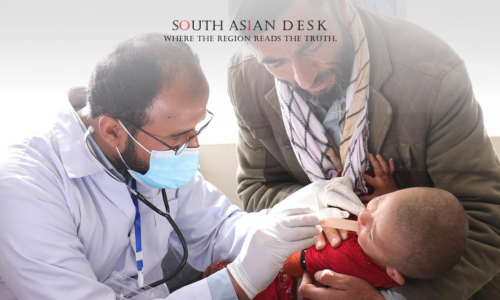
Dr. Edwin Ceniza Salvador, WHO’s representative in Afghanistan, stated on Monday, March 17, 2025, “These closures represent mothers unable to give birth safely, children missing lifesaving vaccinations, and communities unprotected from disease outbreaks.” The funding supports 566 outpatient consultations at Torkham’s Omari camp and 1,079 primary care cases at Islam Qala, focusing on respiratory illnesses and trauma.
Addressing Gaps in Support for Returnees
WHO Afghanistan’s efforts target returnees, with 106,109 individuals returning from Iran and Pakistan between July 31 and August 15, 2025. Critical shortages at border points, including essential medicines and female healthcare workers, have been flagged. At Spin Boldak and Milak crossings, 8,683 consultations and 22,711 polio vaccinations were administered, yet isolation spaces and mental health services remain limited, per WHO’s August 25, 2025, report.
OCHA’s Role in Mitigating Funding Crisis
OCHA’s contribution addresses a severe funding gap, with only USD 322.4 million received against the HNRP’s USD 2.42 billion requirement by March 2025. The suspension of US aid, previously 47% of Afghanistan’s humanitarian funding, has forced closures of 220 health facilities by June 2025, impacting 1.8 million people. OCHA’s reprioritisation targets 145 priority districts, ensuring health services reach 12.5 million people.
A Japanese donation of USD 1.5 million to UNFPA, announced on Tuesday, January 14, 2025, complements OCHA’s efforts, supporting 60,000 women and children. OCHA’s coordination ensures integrated responses, though 68% of humanitarian partners have reduced operations, per its April 2025 report.
Background
Afghanistan’s healthcare system has faced collapse since the Taliban’s 2021 takeover, compounded by the US aid suspension in February 2025. In 2024, US contributions of USD 735.7 million supported 20.4 million Afghans. Ongoing health emergencies, including 16,000 suspected measles cases in early 2025, highlight the need for sustained support. The HNRP, launched in January 2025, aims to address food, water, and health needs for 22.9 million people.
What’s Next
WHO Afghanistan, with OCHA’s support, plans to expand mobile clinics and vaccination drives by December 2025 to curb outbreaks. Continued international funding and regional cooperation will be critical to sustaining health services and preventing a broader humanitarian crisis in South Asia.
Published in SouthAsianDesk, August 26th, 2025
Follow SouthAsianDesk on X, Instagram, and Facebook for insights on business and current affairs from across South Asia.