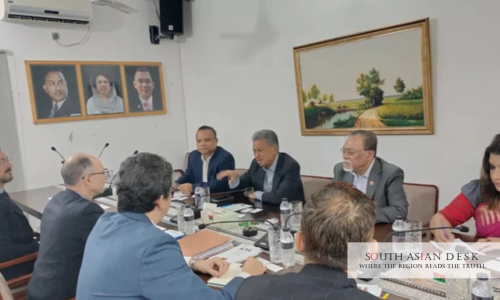
An IMF team meets BNP leaders, led by Resident Representative Jayendu De, in Dhaka on Monday, August 25, 2025, at 4:35 PM. The meeting at the BNP chairperson’s office in Gulshan addressed Bangladesh’s IMF financial reforms, the IMF’s social sector reforms in Bangladesh, and the BNP’s discussions with the IMF regarding VAT. It lasted about one hour and aimed to align opposition views with the government’s reform agenda under the ongoing $4.7 billion IMF programme.
This encounter highlights the International Monetary Fund’s push for broad-based support in Bangladesh, a fast-growing yet vulnerable economy in South Asia. With foreign reserves dipping below $20 billion and inflation hovering at 9.4% in early 2025, reforms are vital to avert a regional ripple effect. Neighboring countries like India and Pakistan closely watch, as Bangladesh’s textile exports and remittance inflows significantly influence South Asian trade balances. Failure here could strain cross-border investments and heighten geopolitical tensions over resource sharing in the Bay of Bengal.
IMF Team Meets BNP Bangladesh in Key Engagement
The IMF team meets BNP Bangladesh, marking a rare direct outreach to the main opposition amid the $4.7 billion Extended Credit Facility (ECF), Extended Fund Facility (EFF), and Resilience and Sustainability Facility (RSF) arrangements approved in 2023. Bangladesh secured the initial tranche of $977 million that year, with subsequent reviews unlocking further funds. By mid-2025, the programme had disbursed $2.9 billion, supporting efforts to stabilise the taka and curb non-performing loans in banks.
Senior BNP figures, including members of the standing committee, attended the session. BNP Media Cell member Shayrul Kabir Khan confirmed the venue and timing but provided no details on outcomes. The discussion was built on prior IMF missions, such as the April 2025 visit led by Chris Papageorgiou, which emphasised institutional strengthening.
This step reflects the IMF’s inclusive approach following the 2024 political upheaval, during which the BNP played a pivotal role in the mass uprising that led to the establishment of the interim government. Engaging opposition ensures reforms withstand electoral transitions, expected in early 2026.
Bangladesh IMF Financial Reforms Take Centre Stage
Bangladesh’s IMF financial reforms dominated the agenda, focusing on cleaning up the banking sector and promoting fiscal discipline. The IMF has urged robust asset quality reviews for systemic banks, aiming to reduce non-performing loans to below 10% by 2026. Official data from the Bangladesh Bank shows that non-performing loans increased to 11.7% in Q2 2025, up from 9.1% in 2024, amid governance lapses exposed in recent audits.
The programme mandates forward-looking bank restructuring and enhanced risk-based supervision. IMF staff reports note that institutional reforms at the Bangladesh Bank, including greater independence, are essential for long-term stability. During the combined third and fourth reviews in May 2025, staff reached an agreement on policies to boost tax revenues and exchange rate flexibility.
These measures aim to rebuild trust in the financial system, which handles $50 billion in annual remittances. Without them, credit growth could stagnate at 8%, hampering GDP expansion projected at 3.8% for 2025.
IMF Social Sector Reforms Bangladesh: Safeguarding the Poor
IMF social sector reforms in Bangladesh emerged as a priority, with emphasis on protecting vulnerable groups amid subsidy cuts. The IMF advocates reallocating resources to safety nets, aiming to target 20 million beneficiaries by 2026. Government data indicate that social spending rose to 2.5% of GDP in FY2025, up from 1.8% before the programme, with funding expanded to cover stipends for women and the elderly.
Climate resilience is a key concern, given Bangladesh’s vulnerability to floods that affect approximately 10 million people annually. The RSF component, worth $1 billion, supports green infrastructure and disaster response. IMF officials emphasize the importance of efficient spending to achieve the UN Sustainable Development Goals, including reducing poverty to below 15% by 2030.
BNP leaders reportedly sought assurances on the equitable implementation of their 2030 vision, aligning with party pledges for inclusive growth.
BNP IMF VAT Discussions Signal Tax Overhaul
BNP IMF VAT discussions centered on broadening the tax base without overburdening low-income households. The National Board of Revenue (NBR) plans to increase VAT coverage to 60% of GDP by 2027, from its current 45%, through simplified rates and digital compliance. IMF projections indicate that this could add BDT 500 billion ($4.2 billion) in annual revenues.
The opposition raised concerns over regressive impacts, proposing exemptions for essentials like rice and medicine. This aligns with IMF recommendations for progressive taxation, with a top rate of 45% for high earners. Recent NBR data reveal revenue collection at 8.5% of GDP in FY2025, below the 10% target, underscoring the urgency.
These talks could foster cross-party consensus, vital as Bangladesh approaches LDC graduation in 2026, risking $3 billion in lost trade preferences.
Background: IMF’s Long-Term Stake in Bangladesh
Bangladesh joined the IMF in 1972, but the current programme addresses post-pandemic shocks, including the fallout of the Ukraine war on imports. Reserves fell to $21.8 billion by March 2025, covering three months of imports. The EFF targets external vulnerabilities, while ECF focuses on fiscal consolidation.
Key milestones include the December 2023 board approval of the first review, the release of $468 million, and the June 2025 completion of the third and fourth reviews, which augment access by $1.2 billion. IMF staff praise progress but warn of risks from political uncertainty and climate events.
The BNP’s involvement stems from its Vision 2030, which emphasizes double-digit growth through diversified exports beyond RMG, accounting for 84% of shipments worth $45 billion annually.
What’s Next for Reforms
Upcoming IMF missions in December 2025 will assess eligibility for the fifth tranche, potentially amounting to $700 million. Parallel to this, the interim government prepares for polls, where reform continuity will be a campaign issue. Enhanced private sector engagement, as seen in the November 2025 BGMEA meeting, could accelerate implementation.
Analysts expect VAT legislation to be implemented by the first quarter of 2026, alongside social protection pilots in flood-prone areas.
The IMF team meets with BNP Bangladesh, underscoring a collaborative path forward that potentially unlocks sustainable growth for South Asia’s rising star.
Published in SouthAsianDesk, November 9th, 2025
Follow SouthAsianDesk on X, Instagram, and Facebook for insights on business and current affairs from across South Asia.