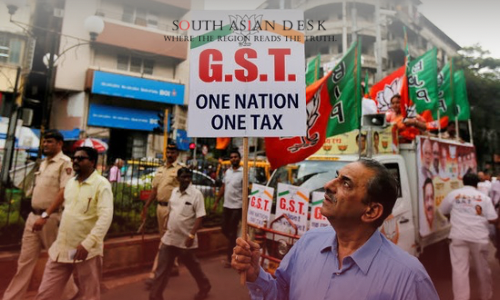
India’s Goods and Services Tax collection reached INR 1.86 trillion in August 2025, reflecting economic resilience. India GST collection reached INR 1.86 trillion (£15.6 billion) in Goods and Services Tax (GST) in August 2025, a 6.5% increase year-on-year, the government announced on Monday, September 1, 2025, showcasing robust economic activity and improved compliance across the nation.
Why it Matters
The sustained growth in India’s GST collection underscores the country’s economic stability and the effectiveness of its tax reforms, impacting fiscal policies and development initiatives across South Asia.
India GST Collection Performance in August
India’s GST collection for August 2025 stood at INR 1.86 trillion, marking a 6.5% rise compared to August 2024, according to an official statement from the Ministry of Finance. This growth reflects the increasing formalisation of the economy, bolstered by digital compliance measures and stricter enforcement. The collection, equivalent to approximately £15.6 billion at an exchange rate of £1 = INR 119, follows a consistent trend of monthly revenues exceeding INR 1.8 trillion for several months this year.
Key Drivers of GST Growth
Several factors contributed to the robust GST collection in August 2025. India GST collection rose to ₹1.86 lakh crore, a 6.5% year-on-year increase, reflecting strong economic momentum and improved tax compliance The Economic TimesThe Economic Times. Digital reforms—including mandatory e-invoicing for businesses above ₹5 crore and AI-powered risk detection tools—have enhanced enforcement and reduced evasion AInvestResearchGate. Although IGST from imports grew significantly in July, with a 9.5% increase to ₹52,712 crore, specific data for August imports has not yet been published
State-Wise Contributions
Maharashtra led the states in GST collections in August 2025, collecting ₹28,900 crore, followed by Karnataka with ₹14,204 crore, Tamil Nadu with ₹11,057 crore, and Uttar Pradesh with ₹9,086 crore—while Gujarat and Haryana also remained among the top contributors. States like Bihar and Andhra Pradesh had shown impressive growth rates of 16 percent and 14 percent year-on-year in July 2025, respectively. However, state-wise GST data for August is not yet available. The consistent performance of key states underscores the broad-based economic activity driving India’s GST revenues.
Background
Introduced on July 1, 2017, GST replaced multiple indirect taxes, creating a unified tax system to enhance transparency and ease of doing business. The system, managed by the GST Council, has evolved with technology-driven compliance measures, such as e-invoicing and return mismatch alerts. In the financial year 2024–25, India’s gross GST collections reached a record INR 22.08 trillion, reflecting a 9.4% year-on-year growth. The highest monthly collection was recorded in April 2025 at INR 2.37 trillion, driven by strong industrial output and consumption.
Economic Implications
The steady rise in GST revenue supports India’s fiscal consolidation efforts, funding critical sectors like healthcare, education, and infrastructure. According to the interim Budget 2024–25, GST contributes 18 paise to every rupee of government revenue, highlighting its significance. The proposed merger of the 12% and 18% GST slabs into a single 15% rate, expected to be discussed at the 56th GST Council meeting in early September 2025, could further simplify the tax structure, though it may require pricing adjustments in key sectors.
Looking Ahead
As India’s GST collection continues to grow, the upcoming GST Council meeting on September 3 or 4, 2025, in New Delhi will be pivotal. Discussions on slab rationalisation and expanding the GST base to include petroleum and digital assets could reshape the tax landscape. Sustained growth in India’s GST collection will likely bolster economic stability and support developmental initiatives across the region.
Published in SouthAsianDesk, September 1st, 2025
Follow SouthAsianDesk on X, Instagram, and Facebook for insights on business and current affairs from across South Asia.