On Tuesday, August 5, 2025, India is balancing US and faced escalating US tariffs, prompting New Delhi to strengthen ties with China and Russia, as Prime Minister Narendra Modi prepares for a key summit in Beijing. The shift, driven by Trump’s 50% tariffs, challenges India’s strategic autonomy.
Why It Matters for South Asia
India’s balancing act between the US, China, and Russia, amid Trump’s tariffs, could reshape South Asian geopolitics, impacting trade worth INR 7.2 trillion (USD 86.51 billion) and regional alliances like the Quad, while straining relations with Bangladesh and Pakistan.
India is Balancing US, China, and Russia
India’s foreign policy is under strain as US President Donald Trump imposed 50% tariffs on Indian goods, effective August 27, 2025, citing India’s USD 52 billion in Russian oil imports. Indian External Affairs Minister S Jaishankar on X stated: “We were asked to buy Russian oil to stabilise global markets.” The tariffs, following a 25% levy announced on July 30, 2025, target India’s exports, including textiles and pharmaceuticals, which constitute 87% of its USD 86.51 billion trade with the US.
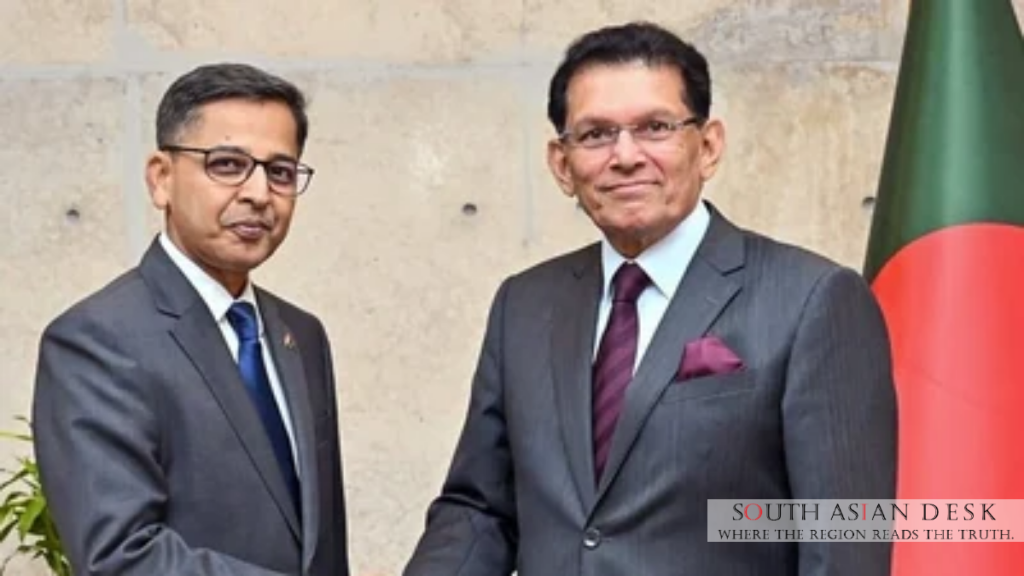
New Delhi’s response includes high-level diplomacy. Modi’s planned meeting with Chinese President Xi Jinping at the Shanghai Cooperation Organisation (SCO) summit in Tianjin on Sunday, August 31, 2025, marks his first China visit since 2018. Chinese Foreign Ministry on X: “We welcome PM Modi for a summit of solidarity and cooperation.” India has also deepened ties with Russia, with Foreign Minister Jaishankar visiting Moscow on August 15, 2025, to secure energy supplies.
Trump’s Tariff Strategy and India’s Response
Trump’s tariffs aim to pressure India into reducing Russian oil purchases, which account for 35% of India’s imports, up from 0.2% pre-2022. US Treasury Secretary Scott Bessent told CNBC on August 26, 2025: “India’s profiteering from Russian oil undermines global stability.” India, however, defends its purchases as critical for energy security, with 1.6 million barrels daily imported in 2025, per the US Energy Information Administration. New Delhi argues the US and EU also trade with Russia, with EU-Russia trade at EUR 67.5 billion in 2024.
India’s talks with China, including Foreign Minister Wang Yi’s visit to New Delhi on August 19, 2025, signal a pragmatic thaw. Agreements to resume direct flights and open Tibetan pilgrimage sites reflect warming ties, despite ongoing border disputes since the 2020 Galwan clash.
Regional Implications of India’s Hedging
India’s multi-alignment, balancing the US-led Quad (with Japan, Australia) and the China-Russia-led SCO, is tested. Sumit Ganguly of Stanford’s Hoover Institution noted: “India deepens Russia ties to avoid a Moscow-Beijing axis.” The tariffs strain US-India ties, built over 25 years as a counterweight to China, with USD 2.5 billion in US investments like Micron’s Gujarat chip plant at risk. Bangladesh, facing India’s Rohingya expulsions, and Pakistan, bolstered by US ties, add complexity.
Economic Fallout for India
The 50% tariffs threaten India’s export-driven sectors. The Confederation of Indian Industry estimates a 30% drop in textile orders from Tiruppur and Surat. Economists warn of a 0.5% GDP growth reduction if tariffs persist. India’s USD 68.7 billion trade with Russia, versus USD 78.1 billion EU-Russia trade, underscores its strategic defiance. Indian Ministry of Commerce: “We are exploring alternative markets to offset US tariff impacts.”
Background
India’s foreign policy of strategic autonomy, outlined in Jaishankar’s 2020 book The India Way, seeks leverage through multi-alignment. The Quad strengthens Indo-Pacific security, while the SCO and I2U2 (India, Israel, UAE, US) diversify partnerships. Trump’s tariffs, part of his “America First” policy, contrast with prior US administrations’ support for India as a China counterweight, risking a G2 US-China order that marginalises New Delhi.
What’s Next
India’s SCO summit participation and ongoing US trade talks, stalled over agricultural market access, will shape its next moves. A potential Russia-India-China (RIC) trilateral revival, proposed by Russia’s Sergey Lavrov, could counter US pressure. India balancing US, China, Russia under Trump remains a critical foreign policy challenge.
Published in SouthAsianDesk, August 30th, 2025
Follow SouthAsianDesk on X, Instagram, and Facebook for insights on business and current affairs from across South Asia.