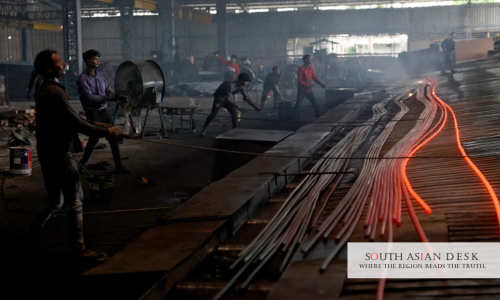
India manufacturing PMI activity weakened in December 2025, with the HSBC PMI falling to 55.0 from 56.6 in November. This marked the slowest growth in two years, driven by softer new orders and output expansion. Factories reported reduced international sales and limited job creation, though the sector remained in expansion territory above 50.
The decline in India manufacturing PMI highlights broader economic challenges in South Asia, where India’s role as a key exporter influences regional trade flows. Neighbouring countries like Pakistan and Bangladesh rely on Indian goods, and a slowdown could pressure supply chains and cross-border investments.
December 2025 HSBC PMI Breakdown
The HSBC PMI for December 2025 showed new business intakes rising at the weakest rate since December 2023. Output levels expanded at the slowest pace since October 2022. International orders increased to the least extent in 14 months, with demand mainly from Asia, Europe, and the Middle East.
Companies scaled back purchases, leading to the least pronounced rise in buying levels in two years. Employment grew marginally, the lowest in the 22-month job creation streak starting March 2024. Outstanding business volumes rose only slightly, close to stagnation.
Input inventories increased sharply, but finished product stocks fell solidly, the joint-fastest drop in eight months. Firms used recent output to meet sales. Input costs rose due to higher prices for bamboo, chemicals, glass, leather, and packaging, but the inflation rate stayed below average and among 2025’s lowest.
Output prices increased at the softest pace in nine months. Manufacturers foresee output growth in 2026, but sentiment hit its lowest in nearly three-and-a-half years, citing advertising, demand trends, and new products as positives, alongside concerns over competition and uncertainty.
Pollyanna De Lima, Economics Associate Director at S&P Global Market Intelligence, stated: “Even with growth momentum easing, India’s manufacturing industry wrapped up 2025 in good shape. The sharp rise in new business intakes should keep companies busy as we head into the final fiscal quarter, and the lack of major inflationary pressures could continue to support demand.”
De Lima added: “We have seen a steady spell of softer growth in new export orders. In fact, the share of companies signalling higher international sales in December was about half of the average for 2025. The survey’s anecdotal evidence has also pointed to a narrower range of export destinations, with goods mainly heading to Asia, Europe and the Middle East. With Indian manufacturers facing less intense cost pressures than elsewhere, many will be hoping that competitive pricing can help bring in new business from other regions in the new year.”
Impact on South Asian Economies
The two-year low in India manufacturing PMI for December 2025 raises concerns for South Asia. India’s factories supply raw materials and finished goods to regional partners. A slowdown could reduce exports, affecting jobs in dependent sectors across the region.
For instance, Bangladesh’s garment industry sources fabrics from India, while Pakistan imports machinery. Reduced demand in India might lead to lower regional trade volumes. Analysts note that stable inflation in India’s HSBC PMI could aid recovery, but persistent weak orders risk spilling over.
Data from the flash HSBC PMI on 16 December 2025 initially showed 55.7, but the final figure adjusted to 55.0 after full surveys. This revision underscores the softening trend.
Employment trends in the HSBC PMI indicate caution among firms. With capacities under little pressure, job growth slowed. This could impact consumer spending in India, indirectly affecting South Asian remittances and trade.
Inflation remained muted, with input costs rising modestly. This aligns with global trends but provides room for policy easing if needed.
Background on India Manufacturing PMI
The HSBC PMI, compiled by S&P Global, surveys around 400 manufacturers on output, orders, employment, purchases, and prices. Readings above 50 signal expansion. India’s manufacturing has expanded since mid-2021, but the December 2025 two-year low suggests momentum loss.
Historically, the index averaged around 53. Factors like global demand, rupee fluctuations, and domestic policies influence it. In 2025, early months saw stronger readings, peaking mid-year before the December dip.
Compared to services, manufacturing lagged in the composite PMI. The sector contributes about 15% to India’s GDP, employing millions. Government initiatives like Make in India aim to boost it, but external pressures persist.
What’s Next for India Manufacturing PMI
Firms expect growth in 2026, driven by new inquiries and marketing. However, subdued sentiment signals risks. Monitoring January 2026 data will clarify if the December 2025 two-year low is a blip or trend.
Stable costs could support demand recovery. Policymakers may watch for stimulus needs. The India manufacturing PMI remains a key gauge for South Asian economic health.
Published in SouthAsianDesk, January 2nd, 2026
Follow SouthAsianDesk on X, Instagram and Facebook for insights on business and current affairs from across South Asia.