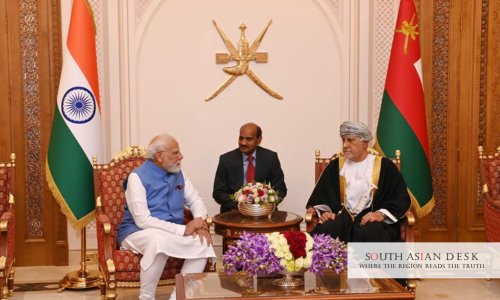
India and Oman signed the India Oman CEPA on Thursday, December 18, 2025, in Muscat. The agreement grants duty-free market access to 99% of Indian exports by value and deepens the Oman-India economic partnership.
Prime Minister Narendra Modi and Sultan Haitham bin Tarik witnessed the signing. Commerce and Industry Minister Piyush Goyal and Oman’s Minister of Commerce, Industry, and Investment Promotion Qais bin Mohammed Al Yousef formalized the India-Oman trade agreement.
The pact provides Oman with zero-duty access on 98.08% of tariff lines, covering 99.38% of India’s exports by value. India offers tariff liberalisation on 77.79% of its tariff lines, covering 94.81% of imports from Oman. Bilateral trade reached USD 10.613 billion in the 2024-25 fiscal year. Indian exports totaled USD 4.1 billion, while imports reached USD 6.5 billion, primarily comprising energy products.
Key Provisions of the India-Oman CEPA
The India-Omani free trade agreement eliminates tariffs on key Indian sectors. These include gems and jewellery, textiles, leather, footwear, sports goods, plastics, furniture, agricultural products, engineering goods, pharmaceuticals, medical devices, and automobiles. Oman grants immediate tariff elimination on 97.96% of tariff lines for Indian goods. The agreement addresses non-tariff barriers and streamlines customs procedures.
In services, Oman opens sectors such as computer-related, business, professional, audio-visual, research and development, education, and health services. It extends commitments in traditional medicine across all modes, benefiting India’s AYUSH and wellness industries.
The India-Omani CEPA enhances professional mobility. Oman increases the quota for intra-corporate transferees from 20% to 50%. It extends the stay for contractual service suppliers from 90 days to two years, renewable for an additional two years.
More liberal conditions apply for skilled professionals in accountancy, taxation, architecture, medicine, and allied fields. The pact allows 100% foreign direct investment by Indian companies in major Omani services sectors through commercial presence.
India excludes sensitive sectors, such as dairy, tea, coffee, rubber, tobacco, gold, silver bullion, certain jewelry, footwear, and metal scrap, to protect domestic interests. For Omani products of interest, India uses tariff-rate quotas. The agreement facilitates mutual recognition of Halal certification and accepts India’s NPOP for organic products. It strengthens cooperation on standards and conformity assessment.
Broader Impact on India-Omani Trade Agreement
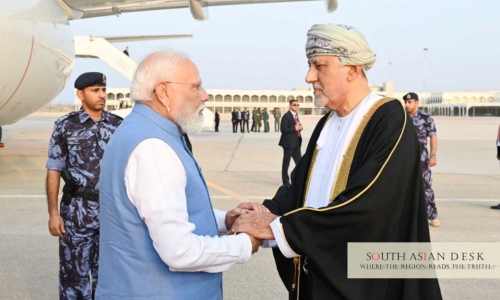
The Oman-India economic partnership strengthens through this deal. Oman serves as a gateway for Indian goods to the Gulf Cooperation Council, the Middle East, Africa, and West Asia. Over 6,000 Indian establishments operate in Oman. Nearly 700,000 Indians live there, remitting around USD 2 billion annually.
Cumulative Indian investment in Oman exceeds USD 675 million. FDI from Oman to India reaches USD 610 million from April 2000 to March 2025. Energy ties remain core. India imports crude oil, liquefied natural gas, fertilisers, chemicals, and petroleum products from Oman. The India-Oman CEPA secures these supply chains.
For South Asia, the pact diversifies India’s export markets amid global uncertainties. It supports micro, small, and medium enterprises, artisans, and women-led businesses in labour-intensive sectors. The agreement aligns with India’s Gulf strategy, following deals with the UAE and others. It reinforces energy security, logistics, and regional connectivity.
Oman gains better access to India’s market for petrochemicals, dates, and industrial inputs. The deal promotes joint ventures in renewable energy, technology, and manufacturing. Indian exporters in labour-intensive industries expect significant gains. Gems and jewellery firms anticipate reduced costs and higher competitiveness in the Omani market.
Pharmaceutical companies welcome easier entry for generics and medical devices. The automotive and engineering sectors look forward to expanded opportunities. The services liberalisation opens doors for Indian IT professionals, healthcare providers, and educators. Traditional medicine practitioners gain from Oman’s commitments in AYUSH-related areas.
Background to the India-Omani Free Trade Agreement
Negotiations for the India-Omani trade agreement began in November 2023. Five rounds of talks have concluded, with legal finalization expected in 2025.
This marks Oman’s first bilateral trade pact since its 2006 agreement with the United States. For India, it follows recent CEPAs with the UAE, Australia, EFTA nations, and the UK. The signing took place during Modi’s two-day visit to Muscat on December 17-18, 2025. It marked 70 years of diplomatic relations.
Business forums highlighted opportunities in the industries of tourism, energy, manufacturing, green energy, fintech, and agriculture. Leaders adopted a joint vision on maritime cooperation.
Historical ties between India and Oman date back centuries through trade routes. Modern relations have been strengthened through regular high-level exchanges. Oman remains a key partner in the Indian Ocean region. Both nations cooperate in defence, security, and counter-terrorism.
What’s Next for the India-Oman Economic Partnership
The India-Omani CEPA awaits ratification. It is likely to take effect in the first quarter of 2026.
Implementation committees will oversee phased tariff reductions and progress monitoring. Businesses prepare for new opportunities. The focus shifts to joint investments in green energy, solar parks, energy storage, smart grids, agri-tech, AI, and cybersecurity. Proposals include an India-Oman Agri Innovation Hub and Innovation Bridge.
Regular reviews will address emerging issues. Dispute settlement mechanisms ensure smooth execution. The pact lays the foundation for deeper integration. It positions the Oman-India economic partnership for sustained growth in the coming decades.
The India-Oman CEPA represents a balanced framework. It boosts competitiveness for exporters while safeguarding the sensitivities of both parties. Analysts predict bilateral trade could double within five years. Enhanced connectivity and people-to-people ties will support long-term gains.
Published in SouthAsianDesk, December 19th, 2025
Follow SouthAsianDesk on X, Instagram, and Facebook for insights on business and current affairs from across South Asia.