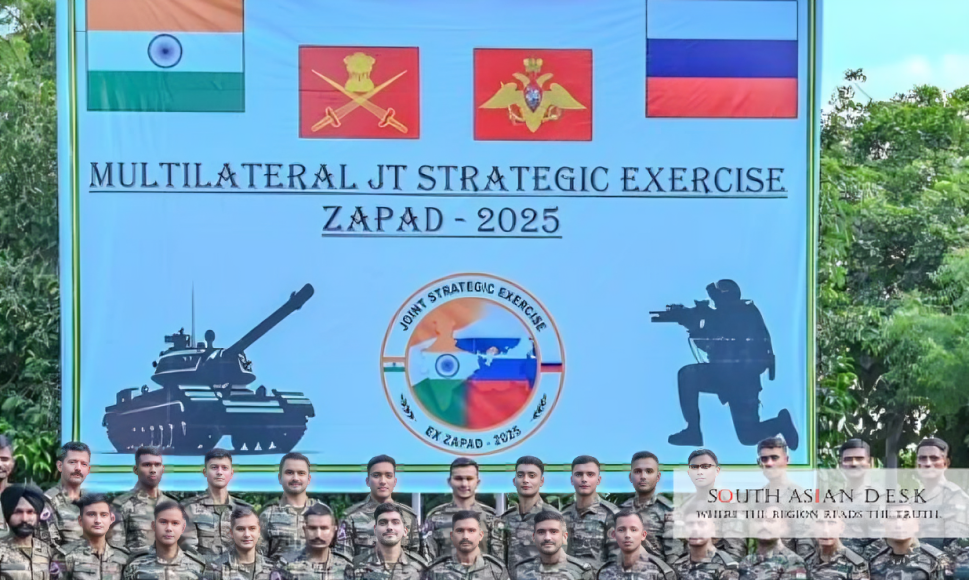
Indian troops join multinational drills, signalling continued military cooperation amid global tensions. India dispatched a 65-member contingent from its armed forces to participate in the Zapad 2025 exercises hosted by Russia and Belarus from 10 to 16 September, 2025, at the Mulino Training Ground in Nizhniy Novgorod, Russia, to bolster military cooperation and interoperability in conventional and counter-terrorism operations.
Why It Matters for South Asia
India’s involvement in these drills underscores its strategic balancing act in a multipolar world, where longstanding defence partnerships with Russia remain crucial for regional security. As South Asian nations like Bangladesh also joined, the exercises highlight evolving multilateral ties that could influence counter-terrorism efforts and arms diversification amid Western pressures.
India Russia Belarus Military Cooperation Takes Centre Stage
The participation of Indian forces in Zapad 2025 exemplifies deepening India Russia Belarus military cooperation, a relationship rooted in decades of defence exchanges. According to the Press Information Bureau (PIB) of India’s Ministry of Defence, the contingent’s deployment aims to enhance joint operational capabilities and foster mutual trust. This move comes as New Delhi continues to source a significant portion of its defence equipment from Moscow, despite efforts to diversify suppliers over the past two decades.
The exercises, which concluded on Tuesday, 16 September, 2025, involved reciprocal movements of units between Russia and Belarus, testing defensive readiness against potential invasions. Official figures indicate approximately 13,000 personnel from the host nations, supported by nuclear-capable assets, though analysts suggest the effective scale could reach 30,000 when including parallel events.
Zapad 2025 War Games Details and Multinational Scope
Zapad 2025 war games details reveal a comprehensive programme focused on tactical drills in open terrain, including joint planning and special arms training. The Indian group, comprising 57 personnel from the Indian Army—led by a battalion of the Kumaon Regiment—along with seven from the Indian Air Force and one from the Indian Navy, departed on Tuesday, 9 September, 2025. Their activities emphasised company-level operations, integrating emerging technologies in a multinational setting.
Beyond the hosts, the drills drew active contingents from Bangladesh, Burkina Faso, the Democratic Republic of Congo, Mali, India, Iran, Niger, and Tajikistan—over 20 nations in total. Observers included representatives from China, Pakistan, and even NATO members such as the United States and Turkey. For South Asia, Bangladesh’s involvement adds a layer of regional relevance, potentially paving the way for shared counter-terrorism tactics.
A key element of the Zapad 2025 war games details was the rehearsal of nuclear weapons employment, including practice with Russia’s Oreshnik missile system—a nuclear-capable asset set for delivery to Belarus by late 2025. Belarus’s Defence Ministry confirmed the inclusion of tactical nuclear deployment simulations, describing them as responses to perceived threats. Russian President Vladimir Putin, addressing the final phase on Tuesday, 16 September, 2025, stated, “Today we are conducting the final part of the Zapad 2025 strategic exercise,” while dressed in military uniform.
India’s Defence Ministry emphasised that such engagements are a continuation of longstanding traditions, not a geopolitical shift. As per a statement reported by TASS, the Russian state news agency, participation “will further deepen defence cooperation and strengthen the spirit of camaraderie between India and Russia.” This aligns with the PIB release, which noted the exercises as a platform for exchanging tactics in conventional warfare and counter-terrorism.
Historical Context of India Russia Belarus Military Cooperation
India Russia Belarus military cooperation traces back to the Cold War era, when the Soviet Union supplied most of New Delhi’s weapons. Even today, Russia remains a primary defence partner, with joint exercises like the 2021 Zapad iteration involving Indian troops in Russia’s Volgograd region. The current Zapad edition marks India’s first inclusion in the Russia-Belarus format, expanding trilateral dynamics.
Amid these drills, US observers attended after an invitation via the US Embassy in Minsk, confirming two defence attachés were present on Monday, 15 September, 2025. This occurred against a backdrop of strained US-India ties, exacerbated by 50 percent tariffs on Indian imports imposed by the Trump administration, citing New Delhi’s Russian oil purchases amid the Ukraine conflict.
Indian Prime Minister Narendra Modi addressed these frictions in a post on X, responding to US President Donald Trump: “India and the US are close friends and natural partners. I am confident that our trade negotiations will pave the way for unlocking the limitless potential of the India-US partnership.” Modi added, “Thank you, my friend, President Trump, for your phone call and warm greetings on my 75th birthday. Like you, I am also fully committed to taking the India-US Comprehensive and Global Partnership to new heights.”
Experts like Dr Rajneesh Kumar, Director General of the Indian International Trade Development Organisation’s Defence and Security wing, described the participation as an assertion of strategic autonomy: “India’s participation in the exercises is not a provocation. Actually India by doing so is simply asserting its independence of decision and continuity in defence cooperation with Russia.”
Background
The Zapad series, meaning “West” in Russian, has been a biennial fixture since 2009, simulating responses to Western aggression. The 2025 edition, scaled down from 2021’s 200,000 troops, reflects adjustments post-Ukraine invasion. Belarus hosted portions near Barysaw, while Russia’s Kaliningrad and Nizhniy Novgorod areas saw parallel activities. Invitations extended to all 56 OSCE states under the Vienna Document ensured transparency, with responses due by 20 August, 2025.
Iran’s role, as a strategic partner supplying drones to Russia, further internationalised the event, following a joint Caspian Sea drill earlier this year.
What’s Next for India Russia Belarus Military Cooperation
As Zapad 2025 wraps up, future iterations could see expanded India Russia Belarus military cooperation, potentially incorporating more South Asian partners. With ongoing US trade talks, New Delhi’s diplomatic tightrope will test its non-aligned stance, ensuring robust defence ties endure without alienating key allies.
Published in SouthAsianDesk, September 17th, 2025
Follow SouthAsianDesk on X, Instagram, and Facebook for insights on business and current affairs from across South Asia.