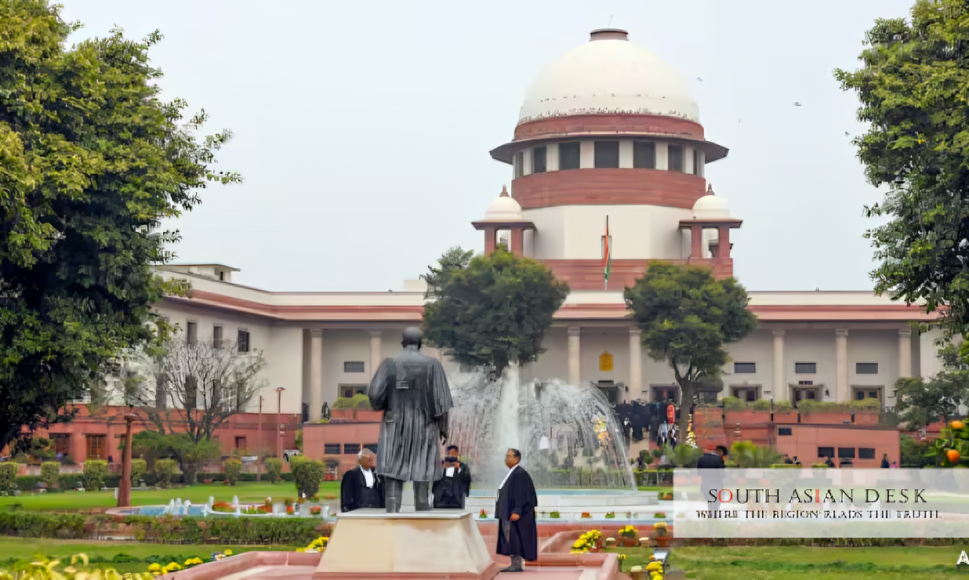
The Supreme Court of India has issued a nuanced interim order on the Waqf Amendment Act 2025, refusing a blanket stay while suspending select provisions to prevent potential misuse of authority.
India Supreme Court Waqf Ruling 2025: Key Developments
The Supreme Court of India, on Monday, September 15, 2025, delivered its interim ruling on petitions challenging the constitutional validity of the Waqf (Amendment) Act 2025. A bench comprising Chief Justice Bhushan R Gavai and Justice Augustine George Masih declined to stay the entire legislation, emphasising that such intervention is warranted only in the rarest of rare cases.
However, the court suspended specific provisions to safeguard against arbitrary exercises of power. The hearing took place in New Delhi, stemming from pleas filed shortly after the Act received presidential assent on April 5, 2025, and was notified on April 8, 2025. Petitioners, including Muslim organisations and individuals, argued that the Waqf Amendment Act 2025 infringes on religious freedoms under Articles 25 and 26 of the Constitution, while the Union government defended it as a measure for transparency and curbing encroachments on public land.
Chief Justice Gavai stated that legislation carries a presumption of constitutionality, and the court found no basis to halt the whole statute. The ruling addresses concerns over government overreach in waqf property management, a system rooted in Islamic tradition for charitable endowments.
Provisions Stayed in Waqf Amendment Act 2025 India
The India Supreme Court Waqf ruling 2025 holds significant implications for religious endowments in India, the world’s largest democracy with a substantial Muslim population. Waqf properties, estimated at over 8 lakh across the country, support mosques, schools, and welfare initiatives for minorities.
By partially staying the Waqf Amendment Act 2025, the court balances administrative reforms with protections for community autonomy, potentially averting disputes that could exacerbate communal tensions in South Asia’s diverse landscape. This decision underscores judicial oversight in legislative matters affecting minority rights, influencing similar endowment laws for other faiths and promoting equitable governance.
Suspension of District Collector’s Authority
Under the Waqf Amendment Act 2025 India, district collectors were empowered to investigate and determine if a claimed waqf property belongs to the government, with authority to alter revenue records accordingly. The Supreme Court has stayed this provision, ruling that such determinations must now undergo adjudication by waqf tribunals and high courts.
During ongoing proceedings, waqf boards are barred from creating third-party rights in disputed properties. This safeguard prevents hasty denotifications, particularly for longstanding waqfs recognised by courts, user practice, or deeds. According to the Union Ministry of Minority Affairs, the Act aimed to resolve encroachments, but the court prioritised due process to avoid “creeping acquisition” of community assets.
Stay on Five-Year Practice Requirement
A contentious clause in the Waqf Amendment Act 2025 India stipulated that only individuals practising Islam for at least five years could create a waqf via a formal deed. The India Supreme Court Waqf ruling 2025 suspended this until state governments frame rules for verifying religious adherence. Chief Justice Gavai noted that without a clear mechanism, the provision could lead to arbitrary enforcement. This interim measure addresses petitioners’ claims that it discriminates against converts and undermines waqf’s charitable essence, a pillar of Islamic practice.
Mandatory registration of waqf properties on the centralised UMEED portal remains unaffected, with a six-month deadline from June 6, 2025. Non-compliance may classify properties as disputed, but the court’s intervention ensures tribunal oversight.
Composition of Waqf Bodies Under Scrutiny
The Supreme Court directed that the Central Waqf Council should comprise no more than four non-Muslim members, while state waqf boards are limited to three. It suggested that chief executive officers of these boards should preferably be Muslims, aligning with the community’s management rights.
Solicitor General Tushar Mehta, representing the Centre, argued that the Waqf Amendment Act 2025 India promotes inclusivity without diluting religious oversight. Petitioners, led by senior advocates Kapil Sibal and Abhishek Manu Singhvi, contended that excessive non-Muslim representation interferes with Article 26 freedoms.
Earlier hearings on May 22, 2025, and August 22, 2025, highlighted debates on waqf-by-user claims, with the bench reserving orders after extensive arguments. The court rejected a stay request on August 22, stating judgment was already reserved.
Background
The Waqf Amendment Act 2025 India builds on the 1995 Act, introducing reforms like digitisation and eligibility criteria to enhance accountability. Passed by Lok Sabha on April 2, 2025 (288 votes in favour, 232 against) and Rajya Sabha shortly after (128 for, 95 against), it followed a joint parliamentary committee review.
Historical laws, from the Mussalman Waqf Act 1923 to the 1954 framework, mandated registration, yet implementation lagged, leading to disputes over 9 lakh acres of waqf land. The 2025 amendments prohibit waqfs on tribal lands to protect indigenous rights, a point supported by tribal organisations. Six BJP-ruled states intervened in favour, citing administrative burdens if struck down. Petitioners, including the All India Muslim Personal Law Board, view it as state overreach, while the government cites misuse cases, such as claims on pre-Islamic temples or government plots.
What’s Next for India Supreme Court Waqf ruling 2025
As the India Supreme Court Waqf ruling 2025 clarifies, parties retain the right to mount a full constitutional challenge to the Waqf Amendment Act 2025 India. Future hearings will examine the stayed provisions once rules are notified, potentially reshaping waqf governance for greater equity and transparency.
Published in SouthAsianDesk, September 15th, 2025
Follow SouthAsianDesk on X, Instagram, and Facebook for insights on business and current affairs from across South Asia.