India trade unions protest labour codes with renewed vigour after the government activated sweeping reforms on November 21, 2025. The ten-member Joint Platform of Central Trade Unions (JPC) announced nationwide demonstrations, including Labour codes protests Delhi November 26, to demand a full rollback. Protests target easier hiring and firing rules amid rising unemployment. Leaders cite betrayal of worker rights in a joint statement issued late Friday. The move affects millions in manufacturing and gig sectors.
These reforms strike at the heart of South Asia’s largest workforce, where labour unrest could ripple across borders, disrupting supply chains in textiles and IT that fuel regional trade. With India comprising over 60% of South Asia’s GDP, any escalation risks broader economic instability, pressuring neighbours like Bangladesh and Pakistan on shared migration and remittance flows.
Nationwide Strike Against Labour Reforms India Mobilises Workers
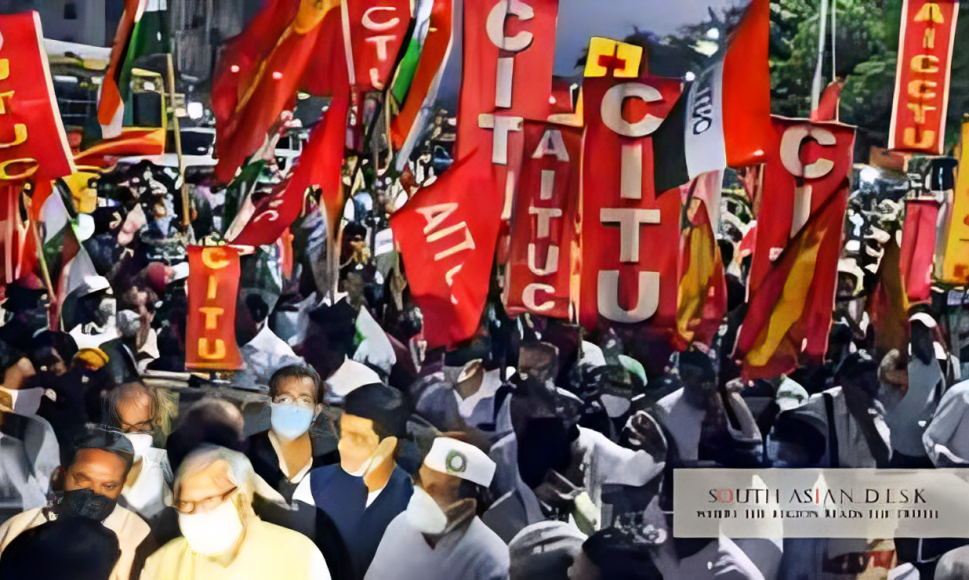
Workers across India prepare for a nationwide strike against labour reforms India on November 26, 2025. The JPC, comprising unions like the Centre of Indian Trade Unions (CITU) and All India Trade Union Congress (AITUC), labels the codes a “declaration of war on the working masses.” This follows spontaneous marches in cities like Bhubaneswar, where hundreds burned copies of the laws on November 22.
The codes consolidate 29 colonial-era statutes into four: Code on Wages, Industrial Relations Code, Code on Social Security, and Occupational Safety, Health and Working Conditions (OSHWC) Code. Government officials hail them as progressive, but unions argue they erode protections. Layoff thresholds rise from 100 to 300 workers without prior approval, easing corporate flexibility but slashing job security.
Union leaders met Finance Minister Nirmala Sitharaman on November 20, urging delay. Their plea ignored, the JPC escalated calls for action. “The arbitrary and undemocratic notification amounts to a declaration of war,” the joint statement reads. Protests expect participation from sectors like automobiles, banking, and construction, potentially halting operations in key industrial belts.
Delhi emerges as a focal point for Labour codes protests Delhi November 26, with rallies planned at Jantar Mantar. Similar actions target Mumbai, Kolkata, and Chennai. CITU vows “militant united struggle” to defy implementation. The union’s statement debunks government claims, noting no evidence links flexibility to job creation, citing Rajasthan’s 2014 experiment that spiked unemployment.
Trade Unions Demand Rollback Four Labour Codes Amid ‘Corporate Giveaway’
Trade unions demand rollback four labour codes, viewing them as a corporate giveaway that legalises exploitation. Fixed-term contracts now rival permanent roles without permanence guarantees, promoting casualisation. Daily shifts extend to 12 hours, up from eight, with women allowed night work, hailed by officials as empowerment but decried as unsafe without robust safeguards.
The Industrial Relations Code bans flash strikes and mandates 14-day notices, crippling collective bargaining. Social security promises falter: gig workers gain nominal coverage, but enforcement lacks timelines or funding. Minimum wages receive statutory nod, yet unions warn of reductions below living standards, excluding millions in unorganised sectors.
Prime Minister Narendra Modi praised the codes on November 21 as “one of the most comprehensive and progressive labour-oriented reforms since Independence.” He emphasised universal social security, timely wages, and safe workplaces to boost Ease of Doing Business. Labour Minister Mansukh Mandaviya echoed this, stating the laws formalise employment and align India globally. Consultations spanned three years with states, unions, and employers, he added, with draft rules published in most regions.
Yet unions counter that talks ignored core objections. The International Labour Conference, a tripartite forum, convened zero times in a decade. Parliamentary passage in 2020 occurred sans opposition input during COVID lockdowns. CITU’s statement slams self-certification for factories as deregulation, slashing inspections and fines for violations like delayed wages.
Data underscores tensions. India’s manufacturing contributes under 20% to its $4 trillion economy, lagging peers due to rigid laws per government data. Unemployment hovers at 8.1% in urban areas, per Centre for Monitoring Indian Economy, with 90% of 500 million workers informal. Unions fear codes accelerate this, pushing more into precarious gigs without benefits.
Protests build on a legacy of resistance. A July 9 general strike drew millions against similar policies. Past nationwide actions in 2020 and 2021 forced partial concessions. This round targets implementation, with sectoral unions like bank employees issuing notices.
Background: Evolution of India’s Labour Reforms
India’s labour framework traces to British-era laws from the 1930s, designed for factory discipline over rights. Post-Independence, acts like the Industrial Disputes Act 1947 balanced growth with protections. Globalisation in the 1990s sparked liberalisation demands, but unions stalled changes via strikes.
The four codes, approved in 2019-2020, consolidate rules for simplicity. Wages code mandates timely payments and gender parity. Social security extends to gig platforms, defining aggregators. OSHWC mandates health check-ups for over-40s and covers plantations. Industrial code introduces two-member tribunals for faster resolutions.
Government data claims 12 consultations since June 2024, plus tripartite meets. Yet JPC alleges tokenism, with rules framed unilaterally.
Implementation begins November 21, 2025, with states adapting rules. Non-compliant firms face penalties, but enforcement relies on “inspector-cum-facilitators”, a shift unions call toothless.
What’s Next: Escalation Risks in India Trade Unions Protest Labour Codes
As India trade unions protest labour codes intensify, disruptions loom. A successful November 26 action could prompt longer strikes, echoing 2020’s 21-day Bharat Bandh. Government eyes dialogue, but unions insist on repeal first.
Economic fallout mounts. Stock markets dipped 0.5% on November 22 amid unrest fears. Exporters warn of delays in apparel shipments to Europe. For South Asia, stalled Indian ports could hike costs in Nepal and Sri Lanka.
Leaders urge worker unity. CITU calls to “rise with full strength” on November 26, saluting spontaneous defiance. “The working class has defeated anti-worker policies before; it will do so again,” the statement concludes. Outcomes hinge on turnout, past strikes mobilised 25 crore workers. With inflation at 5.5% and jobs scarce, momentum builds for deeper confrontation.
This nationwide strike against labour reforms India tests Modi’s third-term agenda, where labour flexibility aids ‘Viksit Bharat’ by 2047. Trade unions demand rollback four labour codes to restore balance, but officials bet on growth dividends. Labour codes protests Delhi November 26 may tip the scales, reshaping worker-employer ties for decades.
Published in SouthAsianDesk, November 23rd, 2025
Follow SouthAsianDesk on X, Instagram, and Facebook for insights on business and current affairs from across South Asia.