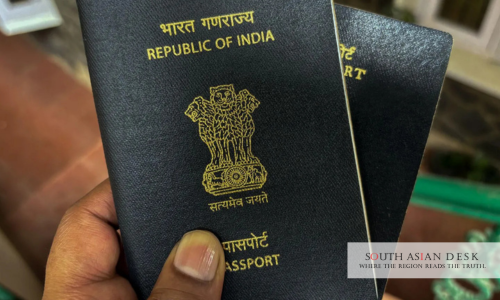
The Indian passport ranking saw its fall 2025 to 85th place in the Henley Passport Index, granting access to 57 destinations. Henley & Partners unveiled the October update on 14 October 2025. The decline reflects the loss of visa agreements and rising international caution. It affects business travellers and students from the world’s most populous nation.
The Indian passport ranking for fall 2025 carries weight in South Asia, where passports significantly influence migration flows and economic ties. India leads the region at 85th with 57 access points, surpassing Pakistan’s 103rd spot with 31. Yet it lags behind Bhutan’s stronger standing and underscores the global mobility challenges India shares with its neighbours, such as Bangladesh, at the 100th position. The drop in signals stalled progress despite GDP growth, prompting calls for unified South Asian visa pacts to ease intra-regional travel and remittances worth USD 100 billion annually.
Reasons for the Indian Passport Ranking Drop
Experts attribute the decline in India’s passport ranking in 2025 to multiple factors. The global average for visa-free destinations climbed to 109 in 2025 from 58 in 2006. India lost access to two nations since July, when it ranked 77th, dropping to 85th despite holding 57 destinations.
Achal Malhotra, a former Indian ambassador to Armenia, highlighted the pressures of migration. “Many countries are also becoming increasingly wary of immigrants. India has a high number of people migrating to other countries or overstaying their visas, and that interferes with the country’s reputation,” Malhotra said.
Passport security issues compound this. Authorities recorded 203 arrests for visa and passport fraud in 2024. Slow processing times and complex procedures deter partnerships. Bilateral ties and reciprocity govern visa policies, per the Ministry of External Affairs.
Economic stability also plays a role. Despite India’s USD 3.9 trillion economy, perceptions of political flux hinder gains. Smaller nations, such as Rwanda, which ranks 78th with 58 access points, outpace India through targeted diplomacy.
Henley Index India Decline in Context
The decline in the Henley index in India marks a reversal from recent gains. India ranked 80th in 2023 and 2024, with 60 and 62 destinations, respectively. It dipped to 90th in 2021 amid pandemic restrictions. The 2014 rank of 76th with 52 access points showed early promise, but 2015 brought a slide to 85th.
Methodology relies on International Air Transport Association data across 227 destinations. Scores tally visa-free and on-arrival entries. Singapore tops the list with 193, followed by South Korea in second place with 190, and Japan in third with 189.
In Asia, China surged from 94th in 2014 to 50th in 2025, with 82. The United States fell to 12th due to isolationist policies. Europe dominates the top 10, with France and Germany tied at fourth with 188 each.
South Asian peers fare worse. Sri Lanka ranks 98th with 41, but historically, it has been around 95th. Afghanistan trails near the bottom. The decline in the Henley index for India highlights regional vulnerabilities, where passports limit skilled worker outflows vital for USD 120 billion in remittances to Pakistan and Bangladesh combined.
Global Mobility Challenges India Faces
Global mobility challenges in India stem from historical baggage. Malhotra recalled the freer travel of the 1970s to Western nations. The 1980s Khalistan movement shifted perceptions, tightening European scrutiny. Post-9/11 security norms amplified this.
Overstays remain a flashpoint. The US reported 700,000 Indian visa overstays in 2023, per estimates. Canada cited similar issues in the 2024 immigration caps. These erode trust, stalling the expansion of e-visas.
India counters through diplomacy. As of February 2025, the Ministry of External Affairs notes that 26 countries offer visa-free entry, 40 provide on-arrival visas, and 58 grant e-visas. Officials update lists quarterly at mea.gov.in/VFFIN.htm.
Yet the formulation of visa policies rests with host nations. “The matter regarding providing visa-free entry/visa-on-arrival facility also depends on various factors, including bilateral relations and the principle of reciprocity,” stated Minister of State Kirti Vardhan Singh in a Lok Sabha reply.
Business implications loom large. Indian firms aim for USD 1 trillion in exports by 2030, but weak passports increase costs by 20 percent on visa fees and lead to delays. Students face hurdles; 1.3 million Indians studied abroad in 2024, often navigating lotteries like the US H-1 B visa.
Tourism suffers too. Outbound trips reached 30 million in 2024, but bureaucratic hurdles limit spontaneous travel. A stronger passport could unlock 20 more destinations, boosting sector revenues by INR 500 billion.
Background on Passport Power Metrics
Passport indices date back to 2006, when Henley launched its ranking. It evolved from Arton Capital’s tool, focusing on real-time IATA feeds. Critics question subjectivity, but it influences policy.
India’s journey reflects the gains of decolonisation eroded by geopolitics. Independence brought initial pacts, but Cold War alignments limited the scope. The 1990s liberalisation spurred demands for more unrestricted movement.
The government dismisses rankings as non-standard. “There is no widely accepted ranking system for passports at the global level that can be taken as a standard, in the absence of acceptable criteria to rank passports,” Singh affirmed in Rajya Sabha.
Efforts include 2023 agreements with Thailand and Indonesia for e-visas. The Passport Seva programme has digitized 90 percent of applications, reducing fraud by 15 percent.
Regional forums like SAARC discuss mobility, but progress stalls due to issues of reciprocity. Bhutan exemplifies success, ranking 87th with 55 access points through neutral diplomacy.
What’s Next for India’s Passport Diplomacy
India plans aggressive outreach. External Affairs Minister S Jaishankar pledged in July 2025 to secure 10 new visa waivers by 2026. Talks with Gulf states aim to ease labour migration for 9 million Indians abroad.
Digital tools, such as the Indian Visa Online portal, process approximately 5 million e-visas annually. Blockchain pilots for secure passports are set to launch in 2026.
Analysts predict modest gains. If overstays drop by 10 percent through awareness, rankings could rebound to 80th by 2027. South Asian cooperation, perhaps in the form of a subcontinental travel pact, offers leverage.
The Indian passport ranking fall 2025 exposes persistent global mobility challenges India must navigate to match its rising stature.
Published in SouthAsianDesk, November 1st, 2025
Follow SouthAsianDesk on X, Instagram, and Facebook for insights on business and current affairs from across South Asia.