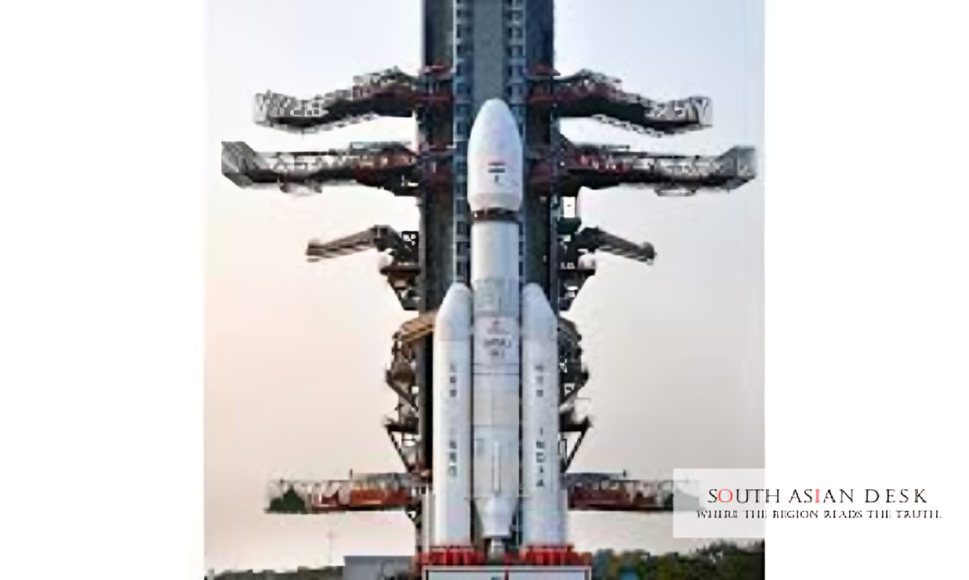
The Indian Space Research Organisation (ISRO) launches CMS-03, its heaviest communication satellite weighing 4,410 kg, from Sriharikota on November 2, 2025, at 5:26 pm IST via the LVM3-M5 rocket. This GSAT-7R Navy satellite LVM3 launch 2025 targets Geosynchronous Transfer Orbit to bolster India military comms satellite Sriharikota November operations over the Indian Ocean.
Why This Boosts South Asia’s Security Landscape
ISRO launches CMS-03 heaviest communication satellite at a pivotal moment for South Asia. Regional navies jostle for influence in contested waters like the Bay of Bengal and Arabian Sea. This India military comms satellite Sriharikota November enhances maritime domain awareness and secure links for Indian vessels. It counters threats from piracy to state actors, fostering stability. For neighbours like Pakistan and Bangladesh, it signals India’s resolve in joint exercises and humanitarian aid. The mission aligns with Aatmanirbhar Bharat, reducing reliance on foreign tech. Experts note it elevates India’s space diplomacy, potentially aiding SAARC-wide disaster response networks.
GSAT-7R Navy Satellite LVM3 Launch 2025: Mission Breakdown
The GSAT-7R Navy satellite LVM3 launch 2025 marks ISRO’s fifth operational flight of the Launch Vehicle Mark-3 (LVM3). The rocket stands 43.5 metres tall with a lift-off mass of 642 tonnes. It comprises two solid strap-on boosters, a liquid core stage, and a cryogenic upper stage. Each strap-on holds 204.5 tonnes of HTPB-based solid propellant.
Pre-launch checks began on October 26 at the Second Launch Pad, Satish Dhawan Space Centre. The vehicle rolled out for fuelling and integration. Flight sequence kicks off with strap-on ignition at T-0, reaching 62 km altitude in 131 seconds. Core stage separation follows at 305 seconds, 167 km up. The cryogenic stage burns for 644 seconds, injecting CMS-03 into orbit at 179 km altitude and 10.15 km/s velocity.
Live coverage streams on ISRO’s YouTube channel from 4:56 pm IST. This follows LVM3’s success with Chandrayaan-3 in 2023, proving reliability for heavy payloads.
Satellite Specifications and Indigenous Edge
CMS-03, dubbed GSAT-7R, tips the scales at 4,410 kg, eclipsing prior records. Built on ISRO’s I-3K bus, it packs multi-band transponders for voice, data, and video. These support high-bandwidth links across C, extended C, and Ku bands, covering the Indian Ocean Region plus landmass.
Indigenous components shine here. The satellite integrates home-grown cryocoolers and power systems tailored for naval needs. Orbit raises post-separation will position it at 36,000 km geostationary slot. Lifespan targets 15 years, ensuring long-term reliability.
The payload enables real-time tracking of assets, from frigates to submarines. Bandwidth surges to gigabits per second, dwarfing older systems.
India Military Comms Satellite Sriharikota November: Strategic Gains
This India military comms satellite Sriharikota November directly serves the Indian Navy. It weaves a secure network linking ships, aircraft, and command centres. In an era of hybrid threats, such connectivity proves vital for swift responses.
The Ministry of Defence highlights its role. “GSAT-7R represents Indian Navy’s determination to protect the nation’s maritime interests leveraging advanced technology through Aatmanirbharta.” This self-reliance cuts costs and boosts resilience against disruptions.
For South Asia, implications ripple outward. Enhanced Indian capabilities could stabilise trade routes, benefiting economies from Colombo to Karachi. Yet, it prompts neighbours to accelerate their space programmes, like Pakistan’s SUPARCO efforts.
ISRO Chairman S Somanath noted the mission’s precision. Pre-flight simulations confirmed 99.9% success odds. The team comprises 500 engineers, underscoring national talent.
Naval Operations Transformed
Imagine a destroyer in the Andaman Sea relaying intel instantly to Delhi. GSAT-7R makes this routine. It supports anti-submarine warfare and surveillance drones. Integration with INS Vikrant carrier group amplifies fleet cohesion.
Data from prior GSAT-7 shows 30% efficiency gains in ops. CMS-03 doubles that with wider coverage.
Background: ISRO’s Naval Space Legacy
ISRO’s tryst with military sats dates to 2013’s GSAT-7 launch. That bird revolutionised Navy comms, earning the moniker “navy in the sky”. GSAT-7R builds on it, adding quantum-resistant encryption hints.
LVM3 evolved from GSLV Mk III, debuting in 2014. Seven flawless flights include Aditya-L1 solar probe. Sriharikota, since 1971, hosts over 100 launches.
This GSAT-7R Navy satellite LVM3 launch 2025 fits India’s 2047 space vision: 100 sats by decade’s end.
What’s Next for ISRO’s Orbit Ambitions
Post-CMS-03, ISRO eyes NISAR Earth observer in July 2025 and Gaganyaan crewed flight in 2026. Navy plans two more comms sats by 2027.
Private firms like Skyroot join, diversifying launches.
ISRO Launches CMS-03 Heaviest Communication Satellite: A Maritime Milestone
As CMS-03 ascends, ISRO launches CMS-03 heaviest communication satellite, cementing India’s pole position in space-enabled defence. This GSAT-7R Navy satellite LVM3 launch 2025 not only secures seas but inspires a generation. South Asia watches, ready for collaborative skies.
Published in SouthAsianDesk, November 2nd, 2025
Follow SouthAsianDesk on X, Instagram, and Facebook for insights on business and current affairs from across South Asia.