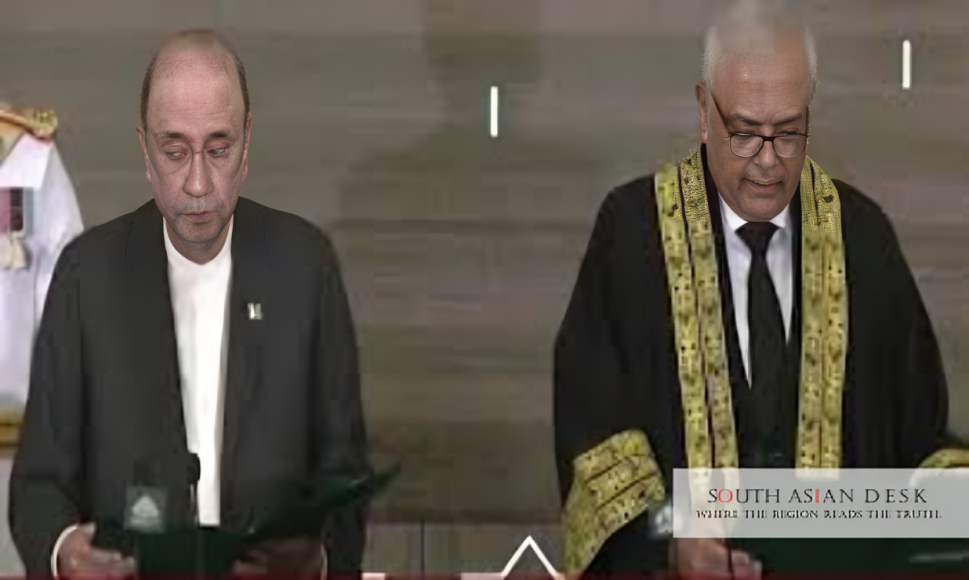
Justice Aminuddin Khan took the oath as the first chief justice of the Federal Constitutional Court (FCC) on Friday, November 14, 2025, at Aiwan-i-Sadr in Islamabad. President Asif Ali Zardari administered the oath at 10am, following the 27th Constitutional Amendment’s enactment. The event signals Pakistan FCC first chief justice appointment amid reforms to streamline judicial processes. Attendees included top military and political leaders.
This appointment bolsters Pakistan’s judicial architecture, a key player in South Asia’s democratic landscape. By offloading constitutional cases from the Supreme Court, the FCC could accelerate resolutions on federal-provincial tensions and human rights issues. Such efficiency may stabilise governance in a nation prone to political volatility, influencing neighbouring countries’ legal models and regional alliances.
Pakistan FCC First Chief Justice Appointment Ceremony Unfolds
The Justice Aminuddin oath FCC chief justice ceremony drew a high-profile gathering. Field Marshal Asim Munir, Chief of Army Staff, attended alongside General Sahir Shamshad Mirza, Chairman Joint Chiefs of Staff Committee. Supreme Court Chief Justice Yahya Afridi was present, as were Prime Minister Shehbaz Sharif, PPP Chairman Bilawal Bhutto-Zardari, and Deputy Prime Minister Ishaq Dar. National Assembly Speaker Ayaz Sadiq and Senate Chairman Yousuf Raza Gillani joined federal cabinet members.
The event shifted from the Federal Shariat Court building due to judges’ concerns over relocation to Islamabad High Court premises. Six other FCC judges, Justices Syed Hasan Azhar Rizvi, Aamer Farooq, Ali Baqar Najafi, Muhammad Karim Khan Agha, Rozi Khan Barrech, and Arshad Hussain Shah took oaths separately at the Islamabad High Court auditorium. Justice Musarrat Hilali declined her nomination citing health reasons.
President Zardari, invoking Clause 3 of Article 175A read with Article 175C of the Constitution, formalised the Pakistan FCC first chief justice appointment on November 13, 2025. The role activates upon oath, positioning Justice Aminuddin to lead a seven-judge bench initially, with potential expansion to 13 via parliamentary approval.
Government sources highlight the FCC’s mandate: exclusive jurisdiction over constitutional interpretation, intergovernmental disputes, and references from the president or parliament. This setup aims to clear the Supreme Court’s docket, which handles over 50,000 pending cases annually, per judicial data.
27th Amendment Federal Constitutional Court Inauguration Details
The 27th Amendment Federal Constitutional Court inauguration stems from a bill passed by both houses of parliament and signed into law on November 13, 2025. A minor revision prompted a Senate revisit, clearing the path for Friday’s proceedings. The amendment revives a 2006 Charter of Democracy pledge by PPP and PML-N to create a dedicated constitutional forum.
Key provisions include transferring suo motu powers and constitutional petitions from the Supreme Court to the FCC. Judges retire at 68, versus 65 for Supreme Court justices. Appointments rest with the president on prime minister’s advice, ensuring provincial balance: four from the Supreme Court and three from high courts.
The overhaul dissolves prior constitutional benches formed under the 26th Amendment. A new three-member committee led by the Chief Justice, with the senior-most judge and a nominee will assign cases by majority vote. This addresses criticisms of bench formation centralisation.
Official notifications from the Ministry of Law and Justice list the initial judges, underscoring the government’s commitment to judicial reform.
The amendment has sparked debate. Legal experts note it elevates the FCC’s status, with its chief justice potentially succeeding as Pakistan’s top judge post-Chief Justice Afridi’s term in 2028. Critics argue it dilutes Supreme Court authority, but proponents see it as enhancing efficiency.
Justice Aminuddin Khan Judicial Profile Highlights Expertise
Justice Aminuddin Khan’s ascent to the Justice Aminuddin oath FCC chief justice role caps a 40-year career rooted in constitutional law. Born in 1960 in Multan to a legal family, he began practice in 1984 under his father, Khan Sadiq Muhammad Ahsan. He secured a licence for lower courts in 1985.
Elevated to advocate of the Lahore High Court in 1987, he joined Zafar Law Chambers in Multan. By 2001, he enrolled as a Supreme Court advocate. Appointed to the Lahore High Court in 2011, he rose to the Supreme Court in 2019 via the Judicial Commission of Pakistan.
In November 2024, the JCP named him head of a seven-judge constitutional bench by a 7-5 vote, post-26th Amendment. He co-authored the Supreme Court (Practice and Procedure) Act 2023 committee, deciding case referrals alongside Chief Justice Afridi and Justice Mansoor Ali Shah.
His rulings span civil and constitutional domains. He dissented in the July 2024 reserved seats case, impacting parliamentary seats. As part of a nine-judge bench, he examined the presidential reference on Zulfikar Ali Bhutto’s 1979 execution. Justice Aminuddin endorsed civilian trials in military courts and backed executive picks in JCP meetings.
Colleagues praise his diligence in high-stakes petitions. During his Supreme Court tenure, he oversaw over 200 constitutional matters, per court records. His profile aligns with the FCC’s focus, promising rigorous adjudication.
Career Milestones Table
| Year | Milestone |
| 1984 | Begins legal practice in Multan |
| 1987 | Enrolled as Lahore High Court advocate |
| 2001 | Joins Supreme Court bar |
| 2011 | Appointed Lahore High Court judge |
| 2019 | Elevated to Supreme Court |
| 2024 | Heads constitutional bench |
| 2025 | Pakistan FCC first chief justice appointment |
This trajectory equips him to navigate the FCC’s inaugural challenges.
Background: Judicial Reforms in Pakistan
Pakistan’s judiciary has evolved through 27 amendments since 1973. The 18th Amendment in 2010 devolved powers to provinces, easing central overload. The 26th Amendment last year introduced constitutional benches, a precursor to the FCC.
The 27th Amendment Federal Constitutional Court inauguration addresses chronic delays: constitutional petitions averaged 18 months resolution pre-reform. It echoes global models like India’s constitutional benches, tailored to Pakistan’s federal structure.
Stakeholders, including bar councils, urged transparency in appointments. The process involved parliamentary consensus, reflecting cross-party support despite initial Senate hurdles.
What’s Next for the Federal Constitutional Court
The FCC faces immediate dockets: pending inter-provincial water disputes and election references. Justice Aminuddin plans quarterly reports on case disposal, targeting 90-day timelines.
Expansion to 13 judges requires legislation by mid-2026. Infrastructure shifts, like IHC co-location, demand PKR 500 million allocation. International observers anticipate appeals to the Supreme Court on FCC rulings, testing jurisdictional lines.
The Justice Aminuddin oath FCC chief justice era could redefine judicial precedents, fostering accountability in governance.
As Pakistan navigates this reform, the FCC under Justice Aminuddin Khan stands poised to fortify constitutional supremacy.
Published in SouthAsianDesk, November 14th, 2025
Follow SouthAsianDesk on X, Instagram, and Facebook for insights on business and current affairs from across South Asia.