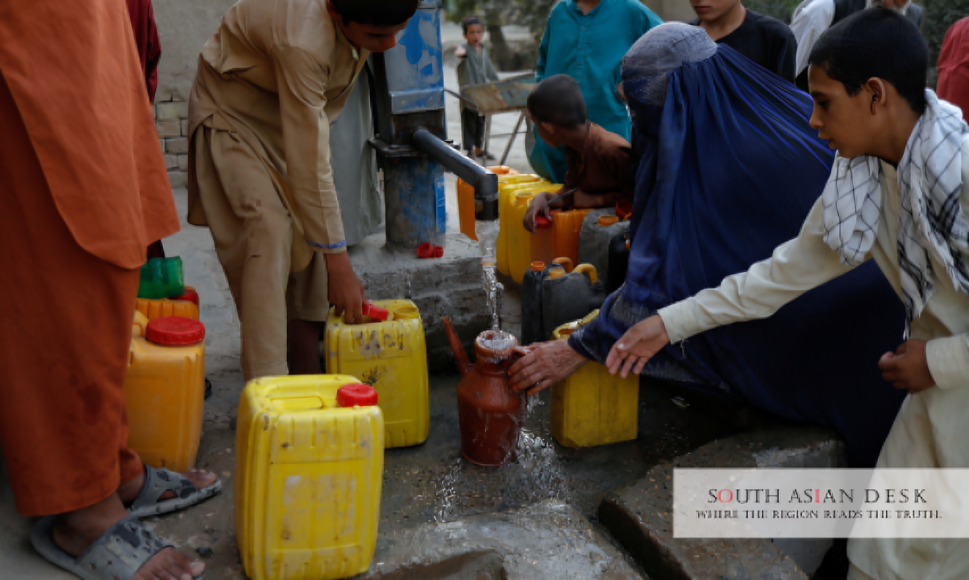
Kabul residents queue for water tankers under the midday sun. Pumps idle beside dry wells. The Afghan capital grapples with a deepening Kabul water crisis 2025. On Monday, August 25, 2025, at 4:35 PM, authorities reported irregular supplies in key districts. This shortage stems from aquifer depletion. Over-extraction exceeds recharge by 44 million cubic metres yearly. What drives this threat? And how soon will taps run dry?
The Kabul water crisis 2025 threatens 7 million lives in Afghanistan’s heart. Aquifer levels have fallen 25 to 30 metres in the past decade. Climate change cuts snowmelt from the Hindu Kush mountains. Rapid urban growth swells demand. Without action, experts predict depletion by 2030. This marks a pivotal challenge for South Asia. Water scarcity in Kabul could trigger migration waves into Pakistan and Iran. It strains shared rivers like the Kabul River, vital for downstream agriculture in India and beyond. Regional tensions over resources may rise. Aid blockades since 2021 worsen the plight. South Asian nations watch closely. A collapsed capital risks broader humanitarian fallout across borders.
Roots of the Kabul Water Crisis 2025
Kabul sits on an arid plain. Three main aquifers feed the city. Riverbed infiltration from the Kabul River recharges them. But extraction outpaces renewal. The Mercy Corps report from April 2025 details the imbalance. Annual drawdown hits 44 million cubic metres. Natural refill lags far behind.
Population boom fuels the surge. Kabul’s residents numbered 1.5 million in 2001. Now they top 7 million. Migration from rural drought zones adds pressure. Factories and greenhouses tap borewells unchecked. Over 100,000 illegal wells pierce the ground. Soviet-era pipes leak 40% of supplies.
Drought grips Afghanistan since 2021. Winters brought 40% to 60% of average snow in 2023-2024. The Hindu Kush thins under warming. Less melt means scant recharge. UNICEF notes this in its October 2024 alert. The agency ranks Afghanistan sixth on the Global Climate Risk Index.
In District 5, frustration boils. Naveed Rahman, a local father, waits hours for tankers. “Government-supplied water comes through the pipes only two to three times a week,” he said. “People struggle with shortages.” Supplies arrive via Chinese tricycles and old trucks. Costs double. Nazifa, another resident, pays AFN 1,000 for what cost AFN 500 a decade ago.
Health risks mount. Contaminated sources breed cholera. The UN Office for the Coordination of Humanitarian Affairs reports diarrhoea cases up 30% in 2025. Children suffer most. Nearly half of boreholes now run dry.
Aquifer Depletion Accelerates: 2030 Warning Looms
Experts sound alarms on Afghanistan Kabul aquifer depletion 2030 warning. The Mercy Corps analysis paints a stark picture. If trends hold, all aquifers empty by 2030. Kabul risks becoming the first modern capital without groundwater.
Dayne Curry, Mercy Corps country director for Afghanistan, urged global focus. “There should be a committed effort to document this better and to draw international attention,” Curry said in June 2025. The report calls for recharge boosts and aid revival. UNICEF echoes the cry. In its statement, the agency warned of full depletion by 2030. “Rapid urbanisation and climate impacts drive this,” it stated on October 29, 2024. The group demands urgent recharge projects. Without them, 2 million may flee, per UN refugee projections.
Data underscores the race. Aquifer drops averaged 2.5 to 3 metres yearly. Deep bowls hold less as levels sink. Sadid, a hydrologist cited in Al Jazeera, likened it to a draining vessel. “Groundwater capacity shrinks with each metre lost,” he explained.
Government efforts falter. The Taliban administration seeks northern imports via Panjshir and Sayad. Southern routes from Lalandar River offer hope. But funds dry up. US aid cuts slashed 80% of USAID flows in 2025. Only $8.4 million of $264 million reached UN water programmes early this year.
Hamidullah Yalani, former water supply head, outlined fixes. “Unless drinking water flows from the north through Panjshir and Sayad, and from the south via Lalandar, the issue persists,” Yalani said. “Rebuild infrastructure now.” Upgrades could pipe billions of litres yearly. Private firms exploit the gap. They drill deep and sell at markups. This drains public reserves faster. Regulation lags. Mercy Corps flags this as a key barrier.
Impacts Ripple Through Daily Life
The Kabul water crisis 2025 disrupts routines. Schools close early for shortages. Hospitals ration hygiene. Farmers near the city cut crops. Food prices climb 15% in 2025. Women bear the load. They trek kilometres for cans. Nazifa shared her burden. “We fill from tankers every 10 days,” she told reporters. Fatigue sets in. Children miss lessons to help.
Economic toll mounts. Water trucking costs AFN 500 million yearly citywide. That’s USD 6 million at current rates. Lost productivity hits harder. The World Bank estimates 5% GDP dip if depletion hits. In South Asia, parallels emerge. Delhi faces similar strain. Lahore rations supplies. Kabul’s fall could overload borders. Pakistan hosts 1.4 million Afghan refugees already. More waves test capacities.
Background: A Decade of Decline
The crisis brewed slowly. Post-2001 growth spiked demand. Aid projects dug wells without recharge plans. A KfW-funded Logar scheme promised 44 billion litres annually. But stalls hit it.
Drought cycles worsened from 2018. Taliban takeover froze $3 billion in assets. Sanctions block pipelines. UNAMA highlights stalled dams like Shahtoot. That project could serve 2 million if built. Historical data shows the slide. In 2015, levels held at 50 metres. By 2025, they hit 20 to 25 metres in core zones. Borehole failures doubled since 2020.
What’s Next for Kabul’s Thirsty Streets?
Solutions demand scale. Build Shahtoot Dam. Pipe from Panjshir. Enforce well permits. Recharge via artificial ponds. International donors must thaw funds.
UNICEF pushes community mapping. Track usage. Educate on conservation. Mercy Corps eyes pilots. Test greywater reuse. Taliban officials met donors in Doha last month. Pledges surfaced for USD 100 million in WASH aid. But delivery lags.
Residents like Mohammad Tawheed hold hope. “We have vast resources underground,” he said. “Manage them right, and shortages end.” Yet time ticks. The 2030 deadline nears. The Kabul water crisis tests resolve. Depletion edges closer. Action now averts catastrophe. South Asia stands ready to aid. But will the world respond?
Published in SouthAsianDesk, October 3rd, 2025
Follow SouthAsianDesk on X, Instagram, and Facebook for insights on business and current affairs from across South Asia.