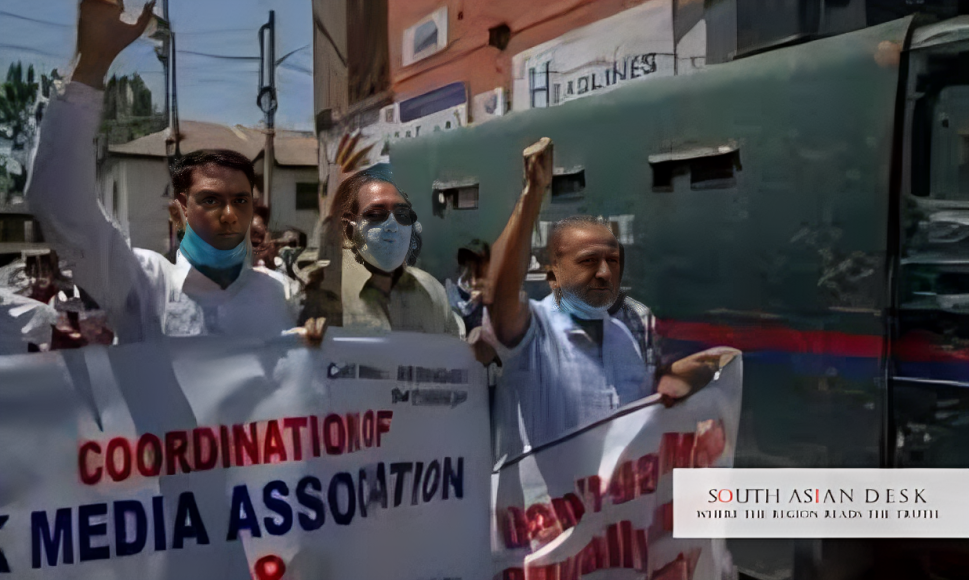
Police in Indian Kashmir summoned at least three journalists, demanding they sign a Kashmir journalists pledge not to disturb peace, after reports on mosque profiling. This occurred in Srinagar between 15 and 19 January 2026, raising alarms over press curbs in the disputed region.
Police actions against journalists in Indian Kashmir highlight escalating tensions in a region where media scrutiny has intensified since the 2019 revocation of autonomy. Such measures threaten journalistic independence, vital for transparency in South Asia’s volatile hotspots like Kashmir, where India and Pakistan’s claims fuel ongoing conflict.
Indian Kashmir Press Freedom Under Scrutiny
Authorities summoned Bashaarat Masood, assistant editor at The Indian Express, four times to Srinagar’s Cyber Police Station from 15 to 19 January 2026. On 16 January, police presented him before a magistrate and requested he sign a bond vowing not to disturb peace. Masood refused, stating he was unaware of any wrongdoing. The summons linked to his report on police distributing forms to mosques seeking budget details, funding sources, and management information.
Two other journalists faced similar calls. One, from a national daily, was travelling and did not attend. Another declined to appear without a written summons specifying reasons. Police cited preventive measures under Section 126 of the Bharatiya Nagarik Suraksha Sanhita 2023, claiming potential breach of public tranquillity.
The Press Club of Kashmir reported several members were summoned or advised to halt coverage of religious institution profiling. This follows a pattern where reporters endure hours of questioning without formal charges.
Kashmir Media Restrictions Escalate
Journalists in the region describe routine harassment over standard reporting. Anonymous sources noted police probe sources, editorial choices, and social media posts. Freelancers face heightened risks, often self-censoring to avoid reprisals like surveillance or no-fly lists.
Political leaders condemned the actions. Sajad Lone of the People’s Conference called it a “new low,” questioning police interference in fact-based stories. CPI(M) leader M.Y. Tarigami termed it an attempt to browbeat media into submission. The Editors Guild of India stated such summons amount to coercion, undermining democracy’s media pillar.
Since 2019, over 200 journalists in Jammu and Kashmir have faced summons, raids, or threats, per rights groups. The Committee to Protect Journalists labelled it a pattern of intimidation, with local reporters hit hardest before national ones.
Background
Kashmir’s media landscape shifted post-2019, when India revoked Article 370, imposing communication blackouts and restrictions on insurgency coverage. Profiling of mosques, revealed in January 2026, drew criticism for signalling distrust of Muslim institutions amid the anti-India insurgency since 1989, which claimed tens of thousands of lives. Violence has declined, but curbs persist, affecting Indian Kashmir press freedom.
What’s Next in Kashmir Journalists Pledge
Media bodies urge transparency and cessation of summons. If unchallenged, such Kashmir media restrictions could expand, stifling coverage of sensitive issues. Observers watch for potential legal challenges or international scrutiny on press freedom in the region.
The Kashmir journalists pledge controversy underscores the need for safeguards to protect reporting in conflict zones.
Published in SouthAsianDesk, January 22nd, 2026
Follow SouthAsianDesk on X, Instagram and Facebook for insights on business and current affairs from across South Asia.