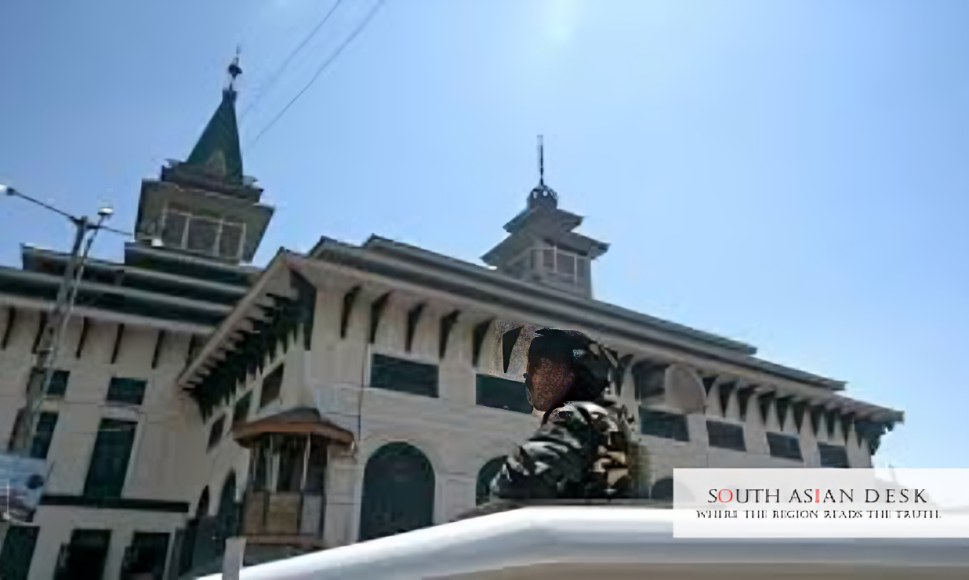
Police in Indian-administered Kashmir have initiated Kashmir mosque profiling by distributing forms to mosque committees, collecting extensive personal and institutional data. This exercise, which began earlier this month in Srinagar, seeks details on mosque sects, funding, and associated individuals’ contacts, finances, and relatives. Residents and religious leaders report heightened surveillance fears Kashmir amid ongoing tensions in the region.
The initiative raises alarms across South Asia, where Kashmir remains a flashpoint between India and Pakistan. Such measures could exacerbate communal divides and strain cross-border relations, especially given Pakistan’s condemnation of the practice as a violation of religious rights.
Details of the Profiling Exercise
Authorities distributed a four-page form titled “profiling of mosques” to mosque managing committees. The document requires information on the mosque’s ideological sect, founding year, funding sources, monthly expenditure, congregation capacity, and land ownership. It also demands personal details of imams, muezzins, and khatibs, including mobile numbers, emails, passports, Credit cards, bank accounts, relatives abroad, associated outfits, mobile phone models, and social media handles.
A similar form targets madrasa operators. Mosque data collection Kashmir has led to claims that the process treats religious sites as potential security threats. Hafiz Nasir Mir, an imam at Lal Bazar mosque, stated: “If this were just paperwork, the police would not have been asking for so many personal details again and again. They also want information about relatives who live outside Kashmir or even outside India. These are private family matters and not things meant for police records.”
Mohammad Nawaz Khan, son of a mosque committee head, added: “This is not a place where you can live in peace. Every now and then, we are asked to fill out one form or another. They are asking for unusually detailed information about religious institutions and those linked to them. I do not understand why the police need this much personal information. Keeping such detailed records is not safe for families like mine. In a conflict area like Kashmir, this can have serious consequences.”
Opposition from Religious and Political Groups
The Mutahida Majlis-e-Ulema (MMU), Kashmir’s largest Islamic religious umbrella body, issued a statement opposing India profiling Kashmir mosques. “The MMU has learnt that detailed multi-page forms are being distributed by the police seeking highly personal and sensitive information, including private identification details, family particulars, financial information, digital and social-media profiles, phone IMEI details, and other data of all those connected with running and management of mosques. Besides, the mosques’ ideological sect identification – Barelvi, Hanafi, Deobandi or Ahle-Hadith, is also being sought. Such an unprecedented and invasive data-collection exercise has caused widespread anxiety among religious institutions, imams khateebs, and the public in general,” the MMU said.
It described the exercise as a “complete violation” of fundamental rights and privacy under the Constitution. “Mosques are sacred institutions meant for worship, guidance and community service, and their internal religious affairs cannot be subjected to arbitrary surveillance and intrusive scrutiny. The nature and depth of information being sought goes far beyond any routine administrative requirement raising serious questions of intent, reflecting an attempt to control and regulate religious institutions through coercive means and checks.”
Former chief minister Mehbooba Mufti criticised the move as interference in religious affairs. “Mosques in Kashmir are profiled as crime sites. Like overground workers, imams and caretakers are summoned to police stations. This has created fear among worshippers and caretakers. It’s not only interference in religious affairs but also an attempt to divest Muslims of their faith,” she said. Mufti questioned why similar profiling does not apply to temples, gurdwaras, or churches.
The National Conference, the region’s governing party, called the exercise unwarranted. Spokesperson Imran Nabi Dar said: “The authorities have already carried out several surveys in the Kashmir valley. There is no need to conduct another one unnecessarily. We cannot stop the profiling ourselves because the police are not under our control, as Jammu and Kashmir is a union territory.”
Srinagar MP Aga Ruhullah Mehdi termed it an infringement of religious freedom guaranteed under the Constitution.
Defences and Justifications
J&K Waqf Board Chairperson Darakhshan Andrabi defended the process. “Verification of properties should not be viewed with suspicion. Just as land ownership in a household requires proper documents, religious properties like mosques, shrines, and gurdwaras also need verification. Imams, maulavis, and mosque committees need not to panic,” she said. Andrabi added there was no political agenda and that J&K leads in registering Waqf assets.
BJP spokesman Altaf Thakur supported mosque data collection Kashmir for accountability. “Past experience tells us that mosques were used in Kashmir by maulvis to ask people to come out and hold pro-Pakistan rallies. Though it was stopped in 2019, some elements still use mosques as a political platform and for propaganda. There is nothing wrong with finding out who funds mosques, the nature of the land they are built on, and the ideology they follow. We need to know what is taught in these mosques.”
Anonymous officials told PTI the exercise follows the busting of a “white collar” terror module last year. It aims to create a database for surveillance and investigative scrutiny, focusing on finances, funding sources, and any links to subversive activities.
Background
Kashmir mosque profiling occurs against the backdrop of the disputed Himalayan region’s history. India and Pakistan each control parts of Kashmir and have fought three wars over it since 1947. China holds a sliver. In 2019, Prime Minister Narendra Modi’s government revoked Article 370, stripping Jammu and Kashmir of partial autonomy and dividing it into union territories. This led to restrictions on religious freedoms, including closures of Srinagar’s Jamia Masjid for nearly two years and limits on Eid prayers. India cites these as temporary for law and order, countering alleged cross-border militancy from Pakistan, which denies military support.
An elected government formed in 2024, but executive powers rest with the New Delhi-appointed lieutenant governor. Surveillance fears Kashmir have intensified since 2019, with residents viewing India profiling Kashmir mosques as state overreach into Muslim-majority affairs.
What’s Next
The MMU urged the lieutenant governor to withdraw the exercise. Pakistan’s Foreign Office called for international intervention, labelling it institutionalised Islamophobia. Political parties demand clarification from Lieutenant Governor Manoj Sinha. If unchallenged, mosque data collection Kashmir could expand, prompting legal challenges or protests. Observers watch for responses from India’s central government or United Nations, given prior alarms over human rights in the region.
As Kashmir mosque profiling continues, it may deepen divisions and invite further scrutiny from South Asian stakeholders.
Published in SouthAsianDesk, January 20th, 2026
Follow SouthAsianDesk on X, Instagram and Facebook for insights on business and current affairs from across South Asia.