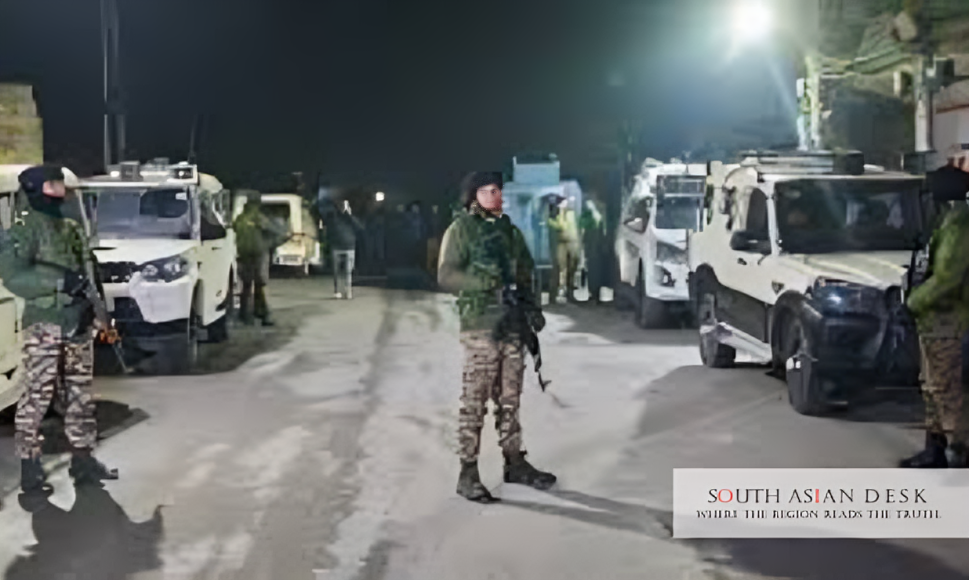
Police officials sift through debris at the Nowgam police station in Srinagar after a deadly explosion on November 14, 2025. The blast killed nine people and injured 32 others during a routine forensic check.
The Kashmir police station blast struck late on Friday night, killing nine and injuring 32 in Srinagar’s Nowgam area. It happened at 11:20 pm while forensic teams handled seized explosives. Authorities call it accidental. The incident ties to a probe into a Delhi car bomb attack. No terror involvement appears.
This Kashmir police station blast exposes the high risks security forces face in counter-terrorism efforts. In a region long scarred by conflict, such accidents amplify calls for better handling protocols. They remind South Asia of the fragile peace in Indian-administered Kashmir, where militancy lingers despite reduced violence. The event underscores vulnerabilities in investigations that span states and target cross-border threats. It could strain resources and public trust if safety lapses persist.
Srinagar Nowgam Explosion Casualties Mount Amid Rescue Efforts
Rescue teams worked through the night after the Kashmir police station blast. The explosion ripped through the Nowgam outpost south of Srinagar. It destroyed parts of the building and damaged nearby structures. Firefighters doused flames that followed the detonation.
Nine people died in the Srinagar Nowgam explosion casualties tally. Victims included three from the Forensic Science Laboratory. Two revenue department officials perished, one a Naib Tehsildar. Two police photographers lost their lives. A State Investigation Agency member and a tailor also died.
Injuries topped 32 in the Srinagar Nowgam explosion casualties count. Twenty-seven police personnel suffered wounds. Two more revenue officials needed treatment. Three civilians from adjacent areas sought medical aid. Hospitals in Srinagar admitted all. Five remained in critical condition by Saturday morning. Doctors reported burns and shrapnel injuries.
Eyewitnesses described a thunderous boom. “The ground shook,” said one local resident. Debris flew 100 metres. Body parts scattered across the site. Authorities sealed the area. They recovered eight bodies first. The ninth came later.
India Kashmir Accidental Blast Probe Launched by Top Officials
India launched an India Kashmir accidental blast probe hours after the event. Jammu and Kashmir Lieutenant Governor Manoj Sinha ordered the inquiry. It aims to pinpoint handling flaws. The focus falls on storage and sampling procedures.
J&K Director General of Police Nalin Prabhat addressed reporters in Srinagar. He confirmed the India Kashmir accidental blast probe details. “Unfortunately during this course, around 11.20 pm last night, an accidental explosion took place,” Prabhat said. “Any other speculation into the cause of this incident is unnecessary.”
The DGP outlined the sequence. Explosives arrived from Faridabad, Haryana. Police seized them earlier that week. The haul weighed 2,900 kg. It included ammonium nitrate and other volatile chemicals. Teams sampled portions for lab tests. The process spanned two days. Storage occurred in a secure open area.
Prabhat stressed caution in the India Kashmir accidental blast probe. “The FSL team was conducting the sampling process and its handling with utmost caution,” he noted. No sabotage signs emerged. Police dismissed claims from Pakistan-based groups like Jaish-e-Mohammed’s offshoot.
Union Home Ministry officials echoed the line. Joint Secretary Prashant Lokhande issued a statement. “The cause of the explosion is yet to be ascertained even though the recovered explosives were being forwarded for forensic examination per standard operating procedure,” Lokhande said. “Do not speculate about the reasons.”
The ministry detailed logistics in its release. Tata 407 mini trucks ferried the materials over two days. Air-tight containers protected the load. The road trip covered hundreds of kilometres. Processing happened under expert watch. Yet the volatile nature triggered the blast.
A senior government source added facts. “The explosives were being packed in small bags and were to be transported to Forensic Sciences Laboratory in Jammu when the accidental explosion occurred,” the source said. The probe will review transport and storage norms.
Link Kashmir Blast Delhi Car Bomb Investigation Emerges
The Kashmir police station blast links directly to a Delhi car bomb case. Authorities connected the dots through the Faridabad seizure. That raid targeted a “white-collar terror module.” Radicalised professionals and students featured in it. Foreign handlers from Pakistan allegedly guided them.
The Delhi car bomb exploded weeks earlier. It killed 12 in the capital. Investigators tied it to Jaish-e-Mohammed posters. Those warned of attacks on forces and outsiders. Nowgam station led the initial probe. It uncovered the explosive cache. Over 650 detentions followed the Delhi incident.
This link Kashmir blast Delhi car bomb tie raises stakes. The module spanned states. It exposed a network of educated recruits. Police described it as an “ecosystem” blending tech and ideology. The Srinagar Nowgam explosion casualties add tragedy to the chase.
Forensic teams now rebuild evidence. The blast destroyed samples. Reassembly could delay the broader India Kashmir accidental blast probe. Experts will analyse remnants for chemical traces. This step aids the link Kashmir blast Delhi car bomb thread.
Regional leaders mourned the losses. Jammu and Kashmir Chief Minister Omar Abdullah offered sympathies. “Extended heartfelt sympathies to the bereaved families and prayed for the swift recovery of all those injured,” he said. PDP chief Mehbooba Mufti highlighted risks. “This heartbreaking incident lays bare the risks and difficult conditions under which our police personnel serve,” Mufti stated.
Ladakh Lieutenant Governor Kavinder Gupta grieved too. “Deeply anguished by the tragic explosion at Nowgam Police Station in Srinagar,” Gupta wrote. People’s Conference President Sajad Lone called it “heartbreaking.”
Background: Kashmir’s History of Militancy and Security Challenges
Kashmir remains a flashpoint in South Asia. India and Pakistan claim the territory since 1947. Three wars erupted over it. Tensions simmer between New Delhi and Islamabad. Militant groups like Jaish-e-Mohammed fuel unrest.
Indian forces ramped up operations post-2019 changes. Article 370’s revocation altered the status. Violence dipped but incidents persist. The Delhi car bomb marked a spike. It prompted nationwide sweeps. The Nowgam outpost handled such leads.
Explosives handling poses perennial dangers. Past blasts hit armouries and checkpoints. This Kashmir police station blast fits a pattern of mishaps. It calls for upgraded training and gear. South Asian nations watch closely. Similar threats plague borders elsewhere.
The Srinagar Nowgam explosion casualties evoke memories of 1990s violence. Back then, bombs targeted stations routinely. Improved intel curbed that era. Yet accidents like this remind of human costs.
What’s Next: Enhanced Safety Measures in Wake of Kashmir Police Station Blast
Investigators expect initial India Kashmir accidental blast probe findings soon. Lieutenant Governor Sinha pushes for quick results. Reforms may follow. These could include remote sampling tech or specialised units.
Police vow tighter protocols. The link Kashmir blast Delhi car bomb case continues. Arrests mount. Courts will try suspects. Families of the Srinagar Nowgam explosion casualties seek justice and closure.
In the end, this Kashmir police station blast tests resilience. It spotlights dedication amid peril. As probes unfold, South Asia eyes steps to avert repeats. Security endures, but at a steep price.
Published in SouthAsianDesk, November 15th, 2025
Follow SouthAsianDesk on X, Instagram, and Facebook for insights on business and current affairs from across South Asia.