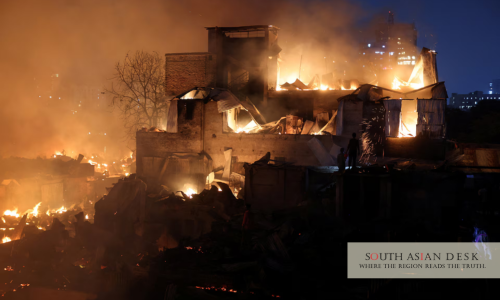
The Korail slum fire Dhaka 2025 erupted shortly after sunset on Tuesday, November 25, 2025, in the densely packed Korail area of Dhaka, Bangladesh. The fire, reported at 5:22 PM, destroyed nearly 1,500 homes and left thousands homeless, with no casualties reported. Firefighters from the Fire Service and Civil Defence battled the flames for over 16 hours before fully extinguishing them on Wednesday morning. Officials cited traffic congestion and narrow lanes as key challenges in the response.
Extent of Destruction in Korail Slum Fire, Dhaka 2025
Flames swept through rows of tin-roofed shanties in Korail, one of Dhaka’s oldest and most crowded slums. The blaze consumed an estimated 200 to 250 homes within the first few hours, plunging the 90-acre site into darkness after a power outage at 7:20 PM. By dawn on Wednesday, the toll rose to nearly 1,500 structures reduced to charred rubble. Korail spans 36.42 hectares across wards 19 and 20 of Dhaka North City Corporation, home to approximately 80,000 residents, many of whom are climate migrants from rural areas.
Witnesses described chaos as families fled with few belongings. Resident Amena Begum said, “Everything I had is gone. How will I survive now?” The Korail fire leaves thousands homeless, forcing survivors to seek shelter at the nearby Ershad Math field. Red Crescent volunteers provided first aid to those with minor injuries from smoke inhalation and falls during the evacuation. Water supply came from Korail Lake via extended hoses, supplemented by WASA tankers.
Fire Service and Civil Defence Director (Operation and Maintenance) Lt Col Mohammad Tajul Islam Chowdhury stated that units gradually contained the flames despite jammed approaches and hose disruptions. The operation involved 19 to 21 fire units sequentially deployed, with engines parked at a distance due to narrow alleys. The fire raged for more than five hours before initial control was achieved at 10:35 PM, but complete extinguishment did not occur until 9:30 AM on Wednesday, November 26, 2025.
Official Response to Massive Fire Destroys Korail Slum Homes
Bangladesh authorities mobilised swiftly after the alert. The Fire Service issued a confirmation statement around 5:30 PM on Tuesday. Chief Adviser Prof Muhammad Yunus expressed deep concern and sympathy in an official release from his press wing. He said, “The suffering of the families who lost their homes in the Korail fire is a shared pain for all of us.” Yunus directed immediate relief measures, including the distribution of temporary shelters and essentials.
Dhaka North City Corporation coordinated with national agencies for damage assessment. Fire Service spokesman Talha Bin Kashem noted that at least 16 fire engines were deployed to tackle the blaze, with delays from heavy traffic adding 35 minutes to the arrival time. No arrests or investigations into arson were announced, as the cause remains undetermined. Officials plan forensic investigations to identify ignition sources, which are common in such densely populated settlements.
The response highlights ongoing infrastructure gaps. Korail’s location, wedged between affluent Gulshan and Banani, underscores contrasts in urban planning. Firefighters dragged hoses through alleys, securing water amid the inferno that initially spiralled out of control.
Why the Korail Slum Fire Dhaka 2025 Matters
This incident exposes vulnerabilities in South Asia’s megacities, where rapid urbanisation outpaces safety measures. Dhaka’s slums house over 3 million people in fire-prone conditions, mirroring challenges in Mumbai, Karachi, and Delhi. Recurring blazes in Korail – at least five major ones since 2010 – signal systemic risks from overcrowding and poor wiring. The Korail slum fire in Dhaka, 2025, displaced thousands, straining resources in a nation already grappling with climate displacement.
Economically, the loss compounds poverty. Many residents work in nearby upscale areas as domestic help or labourers, earning daily wages. The massive fire destroys Korail slum homes, erasing livelihoods tied to informal setups. In broader terms, such events fuel migration debates and calls for resilient housing. South Asian governments face pressure to integrate slum upgrades into development goals, as seen in Bangladesh’s 2022 policy briefs on urban density. The blaze affects 80,000 in Korail alone, but echoes for millions region-wide.
Dhaka Korail Slum Blaze Aftermath: Human Toll
Survivors now confront the aftermath of the Dhaka Korail slum blaze with few options. Families like Marium’s, who salvaged only a freezer after 15 years in Korail, huddle in open fields. “We couldn’t save anything else. The only thing we managed to get out was the freezer; everything else was engulfed,” Marium said. Children and the elderly among the displaced require urgent medical checks, though no deaths occurred.
Aid groups stepped in overnight. Bangladesh Red Crescent treated minor burns and respiratory issues. UNICEF, active in slum education, pledged school continuity for affected children. The Korail fire leaves thousands homeless, with estimates suggesting 5,000 to 10,000 directly impacted based on household sizes of five to seven. Government teams distributed dry rations and blankets by Wednesday noon.
Narrow lanes and dense packing – 87,606 people per square kilometre per BUET’s 2022 brief – amplified the spread. The 2011 census logged 40,000 residents; recent growth pushes figures to 80,000. This density, without fire hydrants, turns minor sparks into catastrophes. Residents initially bucketed water from ponds, delaying professional aid.
Background: Korail’s History of Vulnerability
Korail, established in the 1970s, evolved from informal settlements into Dhaka’s largest slum. Spanning 99 acres, it shelters migrants drawn by garment jobs and services. Past fires, including a 2017 blaze that gutted 300 homes, prompted eviction threats but no lasting reforms. The site’s adjacency to high-rises highlights inequality: luxury towers overlook tin shacks.
Government data from the 2021 slum census shows Korail’s 10,000 homes lack basic sanitation for half its population. Fires recur due to open cooking and faulty electrics. The Korail slum fire in Dhaka, 2025, fits this pattern, destroying livelihoods in hours.
What’s Next for Korail Fire Victims
Relief efforts intensify as authorities eye relocation. Temporary camps at Ershad Math offer tarps and meals, but long-term housing remains uncertain. Prof Yunus’s team convenes on Thursday for a damage report, potentially allocating BDT 100 million in aid. Fire Service plans drills for slum access. The Korail slum fire in Dhaka, 2025, may spur policy shifts, like mandatory fire lanes in new developments. Residents demand probes into the causes to prevent repeats.
In the coming days, NGOs like BRAC will assess needs, focusing on women’s health and child nutrition. International donors, including the UN, monitor for escalation. Until rebuilt, the Korail fire leaves thousands homeless, testing Bangladesh’s social safety nets.
The Korail slum fire in Dhaka 2025 underscores the fragility of urban poor lives. Swift action now can rebuild more than homes.
Published in SouthAsianDesk, November 26th, 2025
Follow SouthAsianDesk on X, Instagram, and Facebook for insights on business and current affairs from across South Asia.