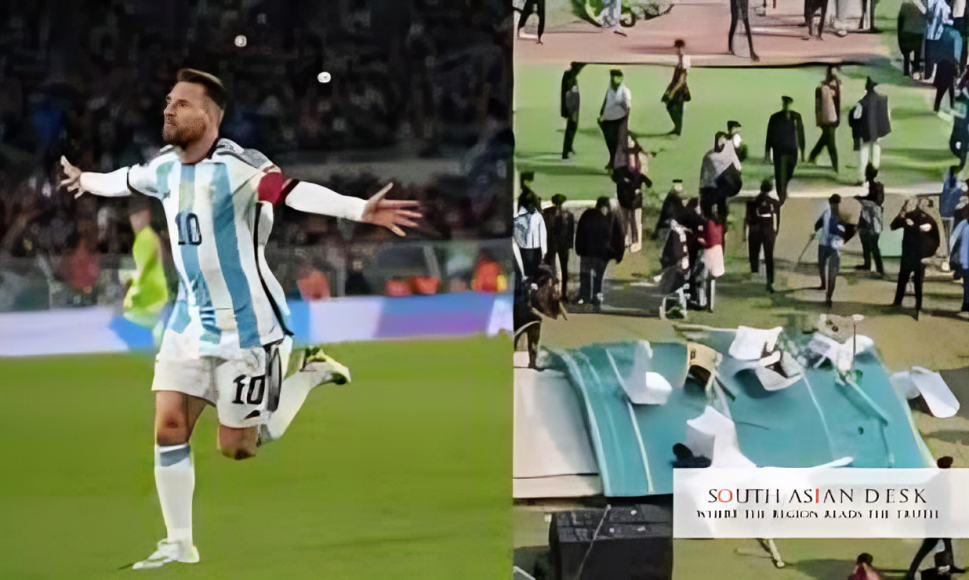
Lionel Messi India tour was eagerly awaited descended into disorder on Saturday when frustrated fans threw bottles and vandalised a stadium, forcing the football icon to cut short his appearance. Organisers face arrests amid pledges for refunds.
Kolkata police arrested the event’s chief organiser after thousands of ticket holders rioted over poor management. The incident at Vivekananda Yuva Bharati Krirangan stadium highlights security lapses in hosting global sports events in India.
In South Asia, where cricket dominates but football gains traction through stars like Messi, this chaos exposes vulnerabilities in event planning. It risks dampening enthusiasm for international collaborations, especially as India pushes to host more major tournaments. Political figures seized the moment, with opposition leaders criticising West Bengal’s administration for the lapse. The episode underscores the region’s passion for the sport, yet demands better infrastructure to match fan expectations.
Messi Kolkata Chaos Unfolds at Stadium
The Messi India tour kicked off with high promise on 13 December 2025. Lionel Messi, the 2022 World Cup winner, arrived in Kolkata alongside Inter Miami CF teammates Luis Suarez and Rodrigo De Paul. The GOAT India Tour aimed to celebrate football’s growth in the subcontinent through fan meets, exhibitions, and unveilings.
Earlier that day, Messi remotely inaugurated a 21-metre statue of himself in the city. Fans packed the 85,000-capacity VYBK stadium, having paid steep prices for tickets starting at INR 3,500 ($38.65). One supporter spent $130, exceeding half the average weekly income in India.
The schedule called for a 45-minute interaction. Messi appeared for just 20 minutes. Delays mounted as VIPs blocked access, and big screens failed to broadcast the event clearly. Anger boiled over. Supporters hurled plastic bottles and other objects onto the pitch. Groups invaded the field, ripping seats from stands. One fan struck a sound system with a pole, causing further damage.
Eyewitnesses described a swift turn from excitement to frenzy. “We waited hours in the heat, only to see nothing,” said a local fan, though police reports confirmed no major injuries occurred. The Messi Kolkata chaos peaked within minutes, prompting security to escort the players away under tight protection.
West Bengal police deployed over 2,000 officers, yet communication gaps hampered control. Director General Rajeev Kumar addressed the media post-incident. “We have detained the main organiser. We are taking action so that this mismanagement does not go unpunished,” Kumar stated. “He has pledged in writing that tickets sold for the event should be refunded.”
Kumar’s remarks came as the first primary response from authorities, emphasising accountability. The arrest targeted Satadru Dutta, the event’s prime organiser, taken into custody at the airport as Messi’s group departed. Dutta faces charges related to crowd mismanagement and public safety violations.
Messi Fans India Vandalism Sparks Outrage
The vandalism extended beyond bottles. Fans dismantled barriers and targeted fixtures, leaving the stadium in disarray. Images circulated online showed torn seating and scattered debris. This Messi fans India vandalism marked a stark contrast to the tour’s promotional hype.
Ticket refunds emerged as a key demand. Organisers committed to processing returns within 48 hours, covering all affected sales. Estimates suggest thousands of tickets sold out rapidly, injecting significant revenue into local economies. Yet the fallout threatens trust in future events.
Chief Minister Mamata Banerjee issued a public apology, labelling the day a “dark chapter” for Bengal. “I am deeply disturbed and shocked by the mismanagement witnessed today at Salt Lake Stadium,” she said. Banerjee extended regrets to Messi and fans alike. “I apologise to the Argentinian football star for the mismanagement. I apologise to the fans who had expected more after paying for tickets.”
Banerjee announced a high-level committee to probe the incident. The panel will “fix responsibility and recommend measures to prevent such occurrences in the future.” This enquiry represents the second primary official action, drawing from government channels to restore order.
Opposition voices amplified the criticism. Assam Chief Minister Himanta Biswa Sarma called for Banerjee’s arrest, accusing her of oversight failures. “Mamata Banerjee should be arrested,” Sarma declared, framing the Messi Kolkata chaos as a governance indictment. Such rhetoric highlights how sports events entwine with regional politics in South Asia.
Inter Miami CF and Messi’s team withheld comments at press time. Queries to the club went unanswered, leaving questions on the player’s personal reaction.
Inside the GOAT India Tour Vision
The GOAT India Tour, branded as a tribute to Messi’s “Greatest of All Time” status, launched amid fan frenzy. Announced in early December, it promised interactive sessions across four cities. Messi confirmed his involvement via social media, stirring nationwide excitement.
Kolkata served as the opener, blending cultural nods with sports. The statue unveiling symbolised football’s rising footprint in India, where the Indian Super League draws growing crowds. Yet the Messi India tour’s chaotic debut raises doubts on execution.
Subsequent stops include Hyderabad from 14 December, featuring a padel exhibition. Mumbai follows with a seven-a-side match at the Cricket Club of India. The itinerary culminates in New Delhi on 15 December, potentially with a youth clinic. Each leg targets local football development, aligning with All India Football Federation goals.
In broader context, the tour arrives as South Asia eyes the 2026 FIFA World Cup. Messi, set to defend Argentina’s title, embodies aspirations for the sport here. India invests heavily, with stadium upgrades and academies. Events like this could accelerate that momentum, provided lessons from Kolkata stick.
Fan reactions poured in online, mixing disappointment with calls for reform. “The GOAT deserves better hospitality,” one supporter posted. Others praised police restraint amid the storm.
Security Lapses Exposed
Reports pinpointed multiple failures. VIP protocols clogged entry points, stranding general admission holders. Screen malfunctions compounded the issue, with backups offline. Police logs note initial warnings ignored by organisers.
Kumar’s team reviewed footage, identifying 50 key agitators for questioning. No charges against fans yet, focusing instead on leadership accountability. Damages assessed at INR 5 million ($55,000), covering repairs to seats and equipment.
This Messi fans India vandalism echoes past crowd troubles at Asian events, from IPL riots to concert stampedes. Experts urge standardised protocols for mega-gatherings.
Background: Football’s South Asian Surge
Football penetrates South Asia slowly but surely. India ranks 117th in FIFA standings, yet Messi’s stardom bridges gaps. The GOAT India Tour builds on his 2023 Beijing visit, where 50,000 fans turned out.
West Bengal boasts a rich legacy, home to Mohun Bagan and East Bengal clubs. Kolkata’s stadium, Asia’s second-largest, hosted 1974 Asian Games. Saturday’s mess tarnishes that record.
Regionally, Pakistan and Bangladesh follow suit. Cross-border rivalries add spice, with Messi tours inspiring youth leagues. The incident prompts calls for pan-South Asian event frameworks.
What’s Next for the Tour
As the Messi India tour shifts to Hyderabad, enhanced security measures take effect. Local authorities coordinate with national bodies for seamless transitions. The enquiry committee convenes Tuesday, with findings due in weeks.
Messi’s camp eyes positive closures, potentially adding charity elements in Delhi. Refunds process starts Monday, easing immediate tensions. The GOAT India Tour presses on, a test of resilience for Indian football.
In the end, the Messi India tour’s rocky start serves as a wake-up call. With proper oversight, it could cement Messi’s legacy in South Asia, turning chaos into catalyst for growth.
Published in SouthAsianDesk, December 14th, 2025
Follow SouthAsianDesk on X, Instagram, and Facebook for insights on business and current affairs from across South Asia.