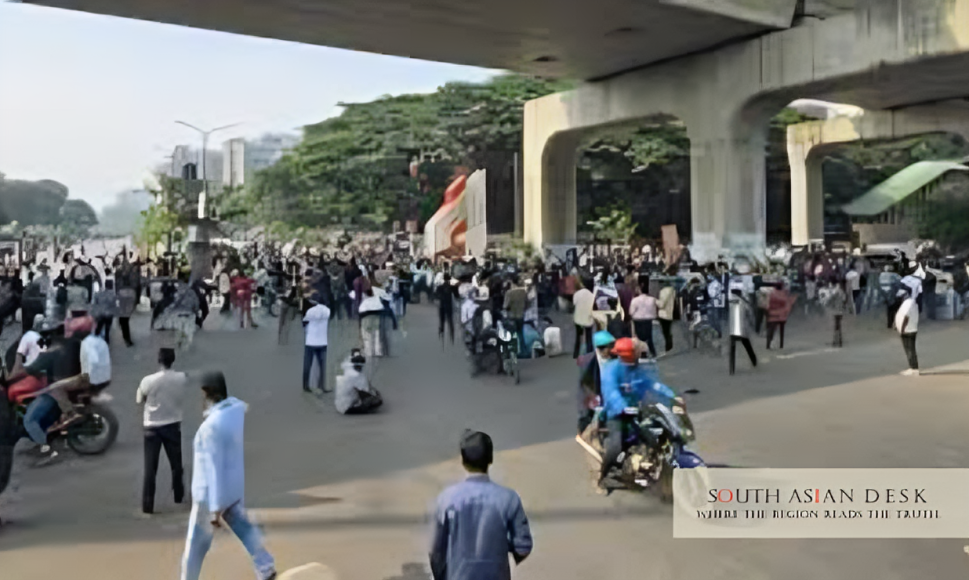
Hundreds of mobile traders protest and staged a sit-in and BTRC road blockade in Agargaon today, protesting the upcoming National Equipment Identity Register implementation. Organised by the Bangladesh Mobile Business Community, the action demands NEIR system reform to protect 20,000 shops from closure. Traffic snarled for hours as participants vowed an indefinite mobile phone shutdown Bangladesh if ignored.
The protest underscores a brewing crisis in Bangladesh’s mobile sector, where grey market dominance faces regulatory overhaul. With NEIR set to block unregistered devices from networks, traders warn of job losses rippling across South Asia’s informal trade networks. Legal imports could stabilise prices, but without reforms, millions of consumers risk higher costs and supply disruptions, echoing import policy tensions in India and Pakistan.
Mobile Traders Protest Dhaka Escalates with BTRC Road Blockade
The demonstration began at 10:30am outside the Bangladesh Telecommunication Regulatory Commission headquarters. Members of the Bangladesh Mobile Business Community carried placards reading “Reform NEIR Now” and “End the Syndicate.” They blocked the main road, halting vehicles and forcing reroutes through nearby lanes. Police monitored the site but made no arrests, citing the peaceful nature of the gathering.
Bangladesh Mobile Business Community Secretary Abu Sayeed Pias addressed the crowd. “We have appealed for discussions many times, but no one has called us even once,” Pias said. “These issues could have been resolved through dialogue. Now retail traders nationwide have been forced to announce shop closures.”
The group alleges the NEIR system, due for full rollout on December 16, favours a handful of importers while crippling small traders. Unregistered, stolen, or illegally imported phones will lose network access, they claim, pushing up prices by complicating supply chains and adding duties.
Earlier actions included a human chain on November 30 at Karwan Bazar-Panthapath, where shops closed for the day. MBCB President Mohammad Aslam joined then, stating, “We urge the government not to launch the NEIR system without addressing our concerns.” Anwar, a trader from a Dhaka shopping complex, added that “hundreds of thousands of traders and their families will suffer” if changes do not come.
Traffic impacts were immediate. Commuters reported delays of up to two hours on Sher-e-Bangla Avenue. One driver, speaking anonymously, said the blockade turned a 20-minute commute into chaos. Delivery services ground to a halt, affecting e-commerce reliant on mobile gadgets.
NEIR System Reform Demands at Core of Mobile Traders Protest Dhaka
The National Equipment Identity Register aims to curb cloned and smuggled devices, which account for nearly 60 percent of Bangladesh’s smartphones. Phones active on networks by launch date will auto-register, but second-hand, gifted, or foreign-bought units require portal submission at neir.btrc.gov.bd.
Traders argue the policy ignores their role in affordable access. MBCB estimates 20,000 businesses and two million families at risk. They seek abolition of alleged syndicates controlling imports, lower VAT rates, and open legal channels for handsets.
Government data supports partial concessions. The Ministry of Posts, Telecommunications and Information Technology announced reductions in the 61 percent import duty to boost legal flows. Officials stated this will protect investments in 13-14 local manufacturing plants and prepare for NEIR.
“No active handset will be disconnected before the NEIR system goes live on 16 December,” a ministry spokesperson clarified. “We urge the public not to be misled by rumours of sudden shutdowns.” Expatriates can use devices duty-free for 60 days, then must register.
Yet traders dismiss these as insufficient. Pias noted repeated pleas for talks yielded nothing. The Mobile Phone Industry Owners’ Association of Bangladesh (MIOB) backs NEIR, calling it essential to end grey market dominance. MIOB President and Edison Group Managing Director said local makers funded the system to foster fair competition.
Economic stakes run high. Unsold grey stock, valued at billions of taka, lingers in warehouses. Legalisation at reduced duties applies only to valid IMEI devices pre-December 16, excluding clones or refurbished units. Faiz Ahmed Taiyeb, special assistant to the chief adviser on telecommunications, affirmed, “The government will block all cloned, illegally imported and smuggled mobile phones, adding that there will be ‘no concessions’ in removing such devices.”
This stance fuels the BTRC road blockade. Protesters chanted slogans like “Fair Trade, Not Shutdown” while surrounding the office. The action echoes broader South Asian struggles, where informal sectors clash with digital regulations. In India, similar IMEI tracking sparked trader unrest in 2023, hiking prices by 15 percent. Pakistan’s PTA blocks grey phones annually, yet smuggling persists, costing PKR 50 billion yearly in lost revenue.
Impacts of Potential Mobile Phone Shutdown Bangladesh
A nationwide mobile phone shutdown Bangladesh looms if demands falter. MBCB announced indefinite closures from Sunday, halting sales of smartphones and accessories. This could idle 20,000 outlets, from Dhaka’s Bashundhara City to rural marts.
Consumers face uncertainty. Legal imports may drop prices, but short-term shortages could spike costs. The GSMA’s 2025 Telecommunications Network Licensing Policy (TNLP) aims to simplify rules and attract investment, yet traders say it conflicts with NEIR mandates.
Data from the Bangladesh Telecommunication Regulatory Commission shows 180 million active SIMs, many tied to grey devices. Blocking them risks network strain but promises security gains, curbing terrorism-linked misuse.
In Agargaon, the sit-in dispersed by 2pm after traders submitted a memorandum. No immediate BTRC response emerged, leaving the impasse.
Background: Evolution of NEIR System Reform Push
The NEIR debate traces to 2020, delayed by COVID-19 and policy shifts. Initially piloted in 2023, full enforcement targets 2025 amid rising clone threats. BTRC’s Faiz Ahmed Taiyeb highlighted mafia resistance, saying, “If NEIR is introduced, importing cloned phones will no longer be possible. That is why the mafia group is trying to stop it.”
Grey imports thrive on duty evasion, undercutting local assembly. MIOB reports 40 percent market share for branded phones, up from 20 percent pre-2020. Yet traders, handling budget models, claim syndicates inflate costs for premium lines.
South Asia watches closely. Bangladesh’s moves align with regional efforts: India’s CEIR blocks 5 million fakes yearly; Sri Lanka’s TRCSL mirrors NEIR for anti-smuggling. Cross-border trade, vital for remittances, could suffer if shutdowns spread.
What’s Next for Mobile Traders Protest Dhaka
Dialogue remains key. MBCB calls for a task force on NEIR system reform by September. Government hints at further duty cuts, but traders demand syndicate probes.
As tensions simmer, the mobile phone shutdown Bangladesh threat tests regulatory resolve. Resolution could model balanced growth; failure risks sector collapse. The mobile traders protest Dhaka highlights fragile balances in digital economies, urging swift action to avert wider fallout.
Published in SouthAsianDesk, December 7th, 2025
Follow SouthAsianDesk on X, Instagram, and Facebook for insights on business and current affairs from across South Asia.