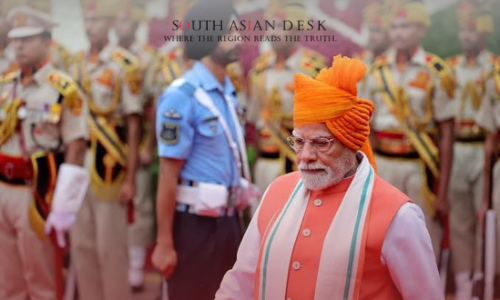
India’s proposed GST cuts after Modi tax overhaul aim to reduce taxes on shampoos, hybrid cars, and TVs, boosting affordability. Prime Minister Narendra Modi’s tax overhaul, announced on Thursday, August 15, 2025, in Delhi, proposes reducing GST on 175 products, including shampoos, hybrid cars, and TVs, to be finalised by the GST Council on September 3–4, 2025, to enhance affordability. The Modi tax overhaul could lower living costs and stimulate consumption across India, potentially influencing regional economies by setting a precedent for simplified tax structures in South Asia.
Proposed New GST After Modi Tax Overhaul
India’s government plans to reduce Goods and Services Tax (GST) rates on approximately 175 products, including daily essentials and consumer durables, as part of a significant tax reform initiative. The proposal, spearheaded by Prime Minister Narendra Modi, aims to cut GST on items like shampoos, toothpaste, and talcum powder from 18% to 5%, benefiting companies such as Hindustan Unilever and Godrej Industries.
Consumer electronics, including air conditioners and televisions, may see rates drop from 28% to 18%, impacting brands like Samsung, LG Electronics, and Sony ahead of the Diwali festive season starting in October 2025. According to the Ministry of Finance, the reforms are designed to “simplify taxes and ease the burden on households,” aligning with Modi’s Independence Day pledge.
Impact on Hybrid Cars
The Modi tax overhaul includes a proposed GST reduction on small petrol hybrid cars from 28% to 18%, a move championed by automakers like Toyota Motor and Maruti Suzuki. This reduction, which could lower car prices by 5–8%, targets vehicles with engine capacities below 1200cc for petrol and 1500cc for diesel, and lengths under 4 metres.
The reform is expected to boost sales in the price-sensitive entry-level segment, where demand has been sluggish. In June 2025, car sales dropped to an 18-month low of 0.31 million units, a 7.4% year-on-year decline, highlighting the need for such measures.
Consumer Goods and Electronics
The proposed tax cuts extend to fast-moving consumer goods (FMCG) and electronics. Items like small sachets of shampoo and toothpaste, currently taxed at 18%, could shift to the 5% slab, encouraging consumption among low-income households.
Electronics such as TVs and air conditioners, presently at 28%, may move to 18%, aligning with the festive season’s high demand. Industry experts estimate that 90% of goods in the 28% slab and 99% of items in the 12% slab could be redistributed to lower rates, simplifying the GST structure.
Background
Introduced on July 1, 2017, India’s GST system unified multiple state and central taxes into a four-slab structure (5%, 12%, 18%, and 28%), with additional cess on luxury and sin goods.
The Modi tax overhaul, dubbed GST 2.0, proposes consolidating into two primary slabs—5% for essentials and 18% for most goods—while introducing a 40% rate for sin and luxury items like tobacco and high-end cars. The reform aims to correct inverted duty structures, reduce compliance burdens, and boost economic growth, which contributes 60% of India’s GDP through consumption.
What’s Next
The GST Council, chaired by Finance Minister Nirmala Sitharaman, will meet on Tuesday, September 3, and Wednesday, September 4, 2025, in New Delhi to finalise the Modi tax overhaul. If approved, the new rates could be implemented by Diwali, potentially reducing prices and stimulating festive season sales. Discussions on including petroleum products and digital assets in the GST regime may also shape future reforms.
Published in SouthAsianDesk, September 1st, 2025
Follow SouthAsianDesk on X, Instagram, and Facebook for insights on business and current affairs from across South Asia.