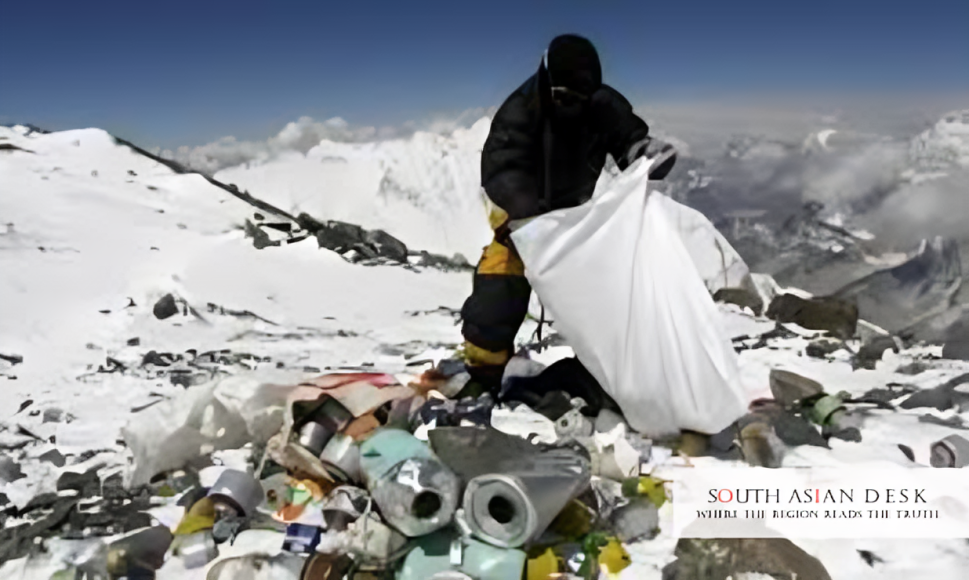
Nepal has rolled out a five-year action plan to address the Mount Everest garbage crisis, targeting waste accumulation that threatens the Himalayan ecosystem. The Ministry of Culture, Tourism and Civil Aviation approved the initiative on December 14, designed to run from 2025 to 2029. This move responds to decades of pollution from expeditions, with officials estimating thousands of tonnes of litter left behind by climbers.
The plan comes as Mount Everest pollution reaches critical levels, exposing buried trash and human remains due to melting glaciers. Government data shows over 13,000 successful summits since 1953, contributing to the Everest garbage problem through discarded oxygen cylinders, plastics, ropes and human waste.
This story matters in South Asia, where Nepal’s mountains feed major river systems affecting millions downstream. Contaminated watersheds from Mount Everest garbage could impact water quality in India, Bangladesh and beyond, underscoring the need for regional environmental cooperation.
Nepal Everest Cleanup: Key Measures in the Action Plan
The strategy introduces strict waste management rules for climbers. Expedition teams must attend mandatory briefings on clean mountain practices and submit written commitments to liaison officers. A temporary waste collection centre at Camp 2, at 6750 metres, requires climbers to return a minimum amount of garbage from higher camps.
Technology plays a role in the Nepal Everest Cleanup. Feasibility studies will explore ropeways and drones for trash removal above base camps. Drones, already tested, can transport up to 15 kilograms per flight, with plans to increase capacity to 50 kilograms by 2026. GPS tracking systems will pilot for locating human remains, addressing the over 300 bodies estimated on the peak.
Climber limits form a core element. Following a Supreme Court order, permits will cap based on the mountain’s capacity, weather and congestion. Royalty fees rose to USD 15000 per climber from September 1, 2025, up from USD 11000, with funds allocated to cleanup efforts.
Human waste management builds on 2024 rules. Poop bags remain mandatory above base camp, enforced by the Sagarmatha Pollution Control Committee (SPCC) and Khumbu Pasang Lhamu Rural Municipality. The plan proposes turning the existing USD 4000 garbage deposit into a non-refundable fee for a mountain welfare fund.
Mount Everest Pollution: Sources and Impacts
Mount Everest pollution stems from expedition gear and supplies. Common items include oxygen canisters, plastic bottles, tents, food wrappers and nylon ropes, which release microplastics as they degrade. A 2020 study found microplastics in Everest’s snow and streams, posing risks as they melt into water sources.
The Everest garbage problem worsens with climate change. Melting Khumbu Glacier reveals old waste, contaminating soil and rivers. Plastic decomposition takes up to 500 years, while burning releases toxic fumes. Buried trash affects biodiversity in Sagarmatha National Park.
Government spokesman Jayanarayan Acharya said: “This action plan addresses those issues and will help make waste management in the mountains more effective.” Department of Tourism director Himal Gautam added: “The government has decided to study whether relocating the base camp is feasible for the sustainability of the mountain.”
Background: History of the Everest Garbage Problem
Efforts to combat Mount Everest garbage date back to 2000, when Japanese climber Ken Noguchi led campaigns removing about 9000 kilograms of waste, including 400 oxygen cylinders. Between 2000 and 2007, his team collected around 90 tonnes.
In 2008, Asian Trekking launched the Eco Everest Expedition, extracting 20000 kilograms over a decade. Since 2011, climbers must return at least 8 kilograms of waste or forfeit deposits.
The 2019 cleanup, involving the Nepali Army, SPCC and local authorities, collected 10800 kilograms of garbage and four bodies. Army-led drives since 2019 have removed 119056 kilograms of waste, 12 bodies and four remains.
In 2024, SPCC cleared 85 tonnes, including 28 tonnes of human waste. Army efforts added 11 tonnes. These initiatives highlight the scale of Mount Everest pollution, but critics note lax monitoring and financial transparency issues in past campaigns.
Nepal Mountaineering Association president Fur Gelje Sherpa stated: “Increasing waste sends a negative message about Nepal’s mountains.” Mountaineer Vinayak Jaya Malla noted: “For many liaison officers, it’s like a paid holiday.”
What’s Next: Implementation and Challenges
The plan allocates NPR 308 million initially, though costs may exceed NPR 1 billion. New laws will define carrying capacities and regulate timelines. Mountain Rangers, trained climbers, will monitor sites.
A feasibility study on relocating Everest Base Camp from 5364 metres addresses overcrowding and instability. Education integrates environmental awareness into school curricula.
Challenges include enforcement at high altitudes. Drones offer promise, as Airlift Technology CEO Raj Bikram Maharjan said: “Drones are very effective in waste management, both in terms of cost and time.”
Avni Ventures director Shilshila Acharya called it a positive step: “The measures in the action plan are pointing in the right direction, and they are goal-oriented.”
Stakeholders emphasise prevention at lower altitudes to curb the Everest garbage problem. With climber numbers rising to 456 permits in 2025 the plan aims to balance tourism revenue with sustainability.
Nepal’s mountains, including eight peaks over 8000 metres, support over 6000 rivers. Effective Nepal Everest Cleanup could set a model for South Asian environmental protection.
The initiative concludes a long push against Mount Everest garbage, promising cleaner slopes for future generations.
Published in SouthAsianDesk, December 24th, 2025
Follow SouthAsianDesk on X, Instagram and Facebook for insights on business and current affairs from across South Asia.