Nepal’s Gen Z demonstrators and military officials engage in crucial discussions amid post-protest turmoil, raising questions about the nation’s political future.
In a significant development, Nepal Army talks with protesters have resumed in Kathmandu on Thursday, September 11, 2025, to select an interim leader following violent demonstrations that led to Prime Minister KP Sharma Oli’s resignation, with 30 deaths and over 1,000 injuries reported as frustrated youth demand systemic change.
Why It Matters
The Nepal Army talks with protesters highlight growing youth discontent in Nepal, a trend echoing across South Asia where economic stagnation and corruption fuel unrest, potentially influencing regional stability in neighbouring countries like India and Bangladesh.
Background on the Protests
The unrest began over a government-imposed social media ban, which was later lifted, but quickly escalated into broader demands for accountability. On Monday, September 8, 2025, clashes resulted in 19 fatalities when police used tear gas and rubber bullets against demonstrators. By Thursday, September 11, 2025, the health ministry confirmed a total of 30 deaths and 1,033 injuries.
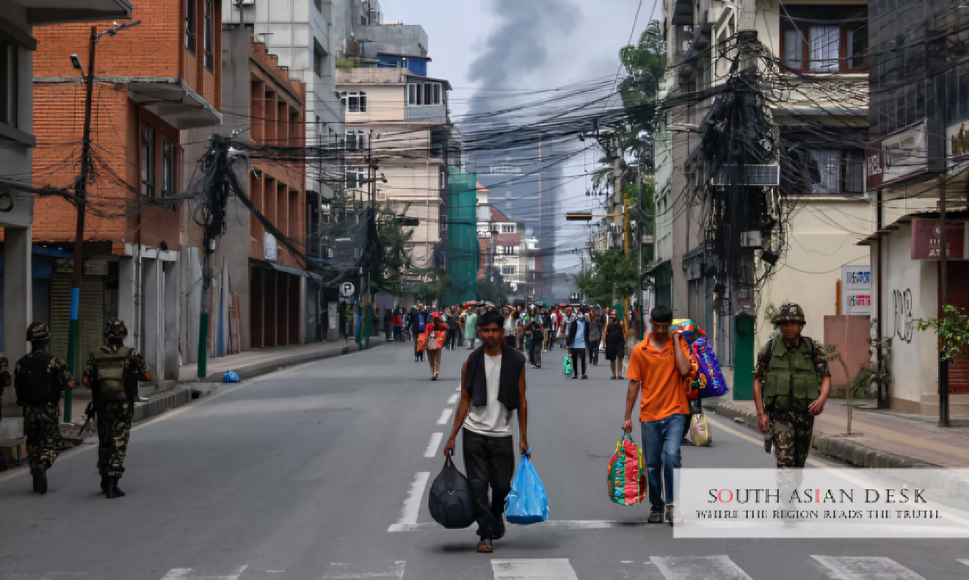
Protesters, largely from the Gen Z demographic, targeted government buildings, the Supreme Court, and ministers’ residences. In Pokhara, several hotels were attacked, while in Kathmandu, the Hilton hotel and Oli’s private home were set ablaze. The violence prompted Oli’s resignation, creating a power vacuum that has thrust the Nepal Army into a mediating role.
According to reports, the Nepal Army has deployed patrols across Kathmandu to restore order, with prohibitory orders in effect from 5:00 AM to 8:00 PM daily. International flights at Tribhuvan International Airport continue uninterrupted, signalling efforts to minimise economic disruption.
Nepal Army Talks with Protesters: Key Details
The Nepal Army talks with protesters focus on appointing an interim leader to guide the country towards elections. Initial discussions started on Wednesday, September 10, 2025, and continued into Thursday. Army spokesperson Raja Ram Basnet stated, “Initial talks are on and would continue today,” adding, “We are trying to normalise the situation slowly.”
Protesters have proposed former Chief Justice Sushila Karki as the interim leader, citing her judicial integrity. Karki, who served as Nepal’s first female Chief Justice from 2016 to 2017, confirmed her willingness in an interview with CNN-News18, saying, “When they requested me, I accepted.”
The Nepal Army talks with protesters involve consultations with legal experts, including Raman Kumar Karna, secretary of the Supreme Court Bar Association. However, some reports suggest the discussions have stalled over disagreements on the interim leader’s powers and the timeline for fresh polls.
This marks an unusual intervention by the Nepal Army, traditionally apolitical, but justified under the need to prevent further chaos. Observers note that the Nepal Army talks with protesters could set a precedent for military involvement in civilian transitions, a sensitive issue in Nepal’s post-monarchy democracy.
Push for Interim Leader Amid Uncertainty
The call for an interim leader stems from distrust in the political establishment. Gen Z protesters argue that career politicians have failed to address unemployment, which stands at 19% among youth, and rampant corruption. The proposed interim leader, Sushila Karki, is seen as a neutral figure capable of overseeing reforms.
However, not all stakeholders agree. Some political factions have voiced concerns about bypassing constitutional processes. The Nepal Army talks with protesters aim to forge a consensus, but progress remains tentative. As of 4:35 PM on Thursday, September 11, 2025, no formal announcement on the interim leader has been made.
In parallel, President Ram Chandra Paudel has urged dialogue, aligning with the Nepal Army’s efforts. The interim leader, once appointed, would likely prioritise investigations into the protest deaths and economic recovery measures.
Regional Implications
South Asia watches closely as Nepal Army talks with protesters unfold. Nepal’s instability could affect cross-border trade, with India, its largest trading partner, already expressing concern over supply chain disruptions. Tourism, a key sector contributing 7% to Nepal’s GDP, has suffered, with hotel occupancy dropping 40% in affected areas.
The Nepal Army talks with protesters also underscore a generational shift, where digital-savvy youth leverage social media—ironically, the ban’s trigger—to mobilise. This mirrors movements in Bangladesh and Sri Lanka, where similar protests toppled governments.
What’s Next
As Nepal Army talks with protesters continue, the focus remains on appointing an interim leader to stabilise the nation and pave the way for elections, potentially averting further violence in this fragile democracy.
Published in SouthAsianDesk, September 11th, 2025
Follow SouthAsianDesk on X, Instagram, and Facebook for insights on business and current affairs from across South Asia.