KATHMANDU – Nepal Gen Z protests in September 2025 triggered widespread unrest that killed 77 people and inflicted over $586 million in losses on the nation’s $42 billion economy, according to a government statement. Interim Prime Minister Sushila Karki’s office revealed the figures on Friday, highlighting damage to key infrastructure and stalled reconstruction efforts amid calls for anti-corruption reforms.
Nepal’s youth-led demonstrations, sparked by a social media ban and concerns about deep-seated graft, reshaped the political landscape in South Asia’s Himalayan nation. The events underscore a regional youth frustration with elite capture of resources, echoing similar uprisings in Sri Lanka and Bangladesh. As remittances, vital to 25% of Nepal’s GDP, face risks from global slowdowns, the protests expose vulnerabilities that could hinder the country’s recovery and influence neighbouring economies reliant on stable trade corridors.
Gen Z Protests Nepal Economy: A $586 Million Reckoning
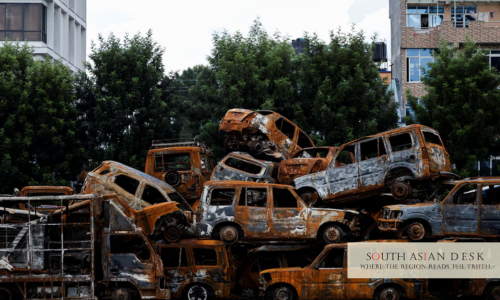
The Nepal Gen Z protests erupted on 8 September 2025, when thousands of young demonstrators gathered in Kathmandu and other cities. What began as peaceful rallies against corruption quickly escalated into violence after police fired on crowds, killing at least 19 on the first day alone. Official tallies now confirm 77 deaths and over 2,000 injuries nationwide.
A statement from Interim Prime Minister Sushila Karki’s office, released on 12 December 2025, detailed the economic toll. “The anti-graft protests in September that forced Prime Minister K.P. Sharma Oli to resign caused more than $586 million in losses to Nepal’s $42 billion economy,” the document stated. An official committee assessed the rebuilding costs at over $252 million for destroyed public and private sites, including the Singha Durbar office complex, the Prime Minister’s office, the Supreme Court, and Parliament House.
Private sector damage compounded the crisis. The Federation of Nepalese Chambers of Commerce and Industry (FNCCI) reported preliminary losses exceeding $278 million, with nearly 15,000 jobs lost in the tourism, retail, and manufacturing sectors. Bhat-Bhateni supermarkets, a major taxpayer, saw 21 of its 28 outlets vandalised or burned. The Hotel Association of Nepal estimated that Rs25 billion ($186 million) in damages would be incurred over two dozen properties, including a Hilton outlet in Pokhara. Auto dealers pegged their losses at Rs15 billion ($112 million).
Economists link the unrest to Nepal’s structural woes. Youth unemployment hovers above 20%, while remittances from migrant workers abroad account for about one-third of GDP. The World Bank revised its 2025 growth forecast to 2.1% from 5.1%, citing “recent unrest and heightened political and economic uncertainty.” Poverty rates could climb to 6.6% this fiscal year.
Kantha, a spokesperson for the interim government, told reporters: “The work for other buildings that were destroyed would begin once the required detailed reports and designs are ready.” No timelines were provided, raising concerns over prolonged disruptions to essential services.
Nepal Anti-Corruption Protests 2025: Roots in Graft and Inequality
The 2025 anti-corruption protests in Nepal drew fuel from years of public outrage over elite enrichment. In 2025 alone, over ten high-profile cases implicated former prime ministers, ministers, and bureaucrats in fund mismanagement. Demonstrators targeted symbols of nepotism, such as business complexes owned by politicians’ relatives, amid allegations of “nepo kids” flaunting unearned wealth.
Protests framed demands around transparency and accountability. Youth groups decried how a small elite controls banking, real estate, and imports, stifling opportunities for 30 million Nepalis. Since democracy was restored in 1990, Nepal has cycled through 27 prime ministers, none of whom served a full term until the upheavals. K.P. Sharma Oli’s resignation on September 9 marked a rare, swift ouster, followed by Sushila Karki’s appointment on September 12 as the nation’s first female leader.
Karki, a former chief justice and anti-corruption advocate, emerged via an online poll organised by protesters on platforms like Discord. Her swearing-in by President Ram Chandra Poudel bypassed traditional channels, drawing criticism from major parties, including the Nepali Congress and the UML, as “unconstitutional.” Oli later accused the movement of foreign interference in a speech, stating: “There is an attack on this country… on its sovereign power.”
The interim government pledged reforms. Families of protest victims receive NPR 1 million ($7,000) in compensation, the legal maximum, according to Karki’s office. A national mourning day on 17 September honoured the dead, while spared offices resumed via tents and salvaged materials.
Nepal Social Media Ban Protests: The Digital Spark
At the heart of the Nepal social media ban protests lay a 4 September 2025 decree shutting down 26 platforms, including Facebook, X, YouTube, LinkedIn, Reddit, Signal, and Snapchat. The Ministry of Communication and Information Technology cited registration failures under 2023 directives, but critics called it censorship to mute dissent.
The ban hit hardest among Gen Z, who rely on digital tools for freelancing, education, and activism. VPN registrations surged as users bypassed restrictions. Protesters rallied on 8 September near Federal Parliament, chanting against the cut-off and graft. Police response, curfews around Singha Durbar, and lethal force ignited riots, with mobs torching party offices of UML, Nepali Congress, and Maoists.
Amnesty International condemned the crackdown. In an 8 December 2025 briefing, it documented “unlawful killings and excessive use of force” on 8 September, urging accountability. “The young people killed and injured during the Gen-Z uprising deserve truth and justice,” said Director Nirajan Thapaliya. Across six days of unrest, 76 died, and over 2,000 were hurt, per official counts.
The ban’s lifting after resignation restored access, but scars linger. Gen Z leaders, operating leaderlessly through online forums, hailed the events as a “wholesale rejection of Nepal’s political class,” according to International Crisis Group adviser Ashish Pradhan.
Background: Nepal’s Cycle of Instability
Nepal’s fragility traces to the 2001 royal massacre and 2008 monarchy abolition. Following 2008, 14 governments were formed under eight prime ministers, fostering corruption and instability. COVID-19 exacerbated youth isolation and joblessness, priming digital natives for revolt. The 2025 protests parallel South Asian waves, notably Sri Lanka’s 2022 economic uprising and Bangladesh’s 2024 student-led movement. Remittances, at $1.4 billion in one month, buffered some of the fallout but highlight external dependencies.
Gen Z Protests Nepal Economy: Sectoral Fallout
Tourism, Nepal’s lifeline, reeled. Bookings for Kailash Manasarovar pilgrimages plummeted, with Indian visitors, key to inflows, scared off. Nepal Tourism Board CEO Deepak Raj Joshi noted: “The destruction is unprecedented… recovery will take years without robust intervention.”
Manufacturing and retail faced arson waves. The Chaudhary Group and Ncell Telecom reported significant losses, eroding tax revenues. Economists, such as Chandra Mani Adhikari, forecast sub-1% growth this year. The interim Cabinet rolled out relief measures, including tax breaks, low-interest loans, and payroll aid for affected firms. Austerity cuts target non-essential services to free up funds.
FNCCI President Chandra Prasad Dhakal welcomed the measures but stressed the need for implementation. “The damages are colossal,” he said. Collateral losses, including destroyed documents, equal one and a half years’ budget or half of the GDP, according to estimates.
What’s Next: Elections Amid Reforms
Reconstruction advances slowly. Singha Durbar, the president’s house, the Supreme Court, and ministries undergo partial repairs; complete work awaits the design approval. The official fund garnered under $1 million, leaving a yawning gap. The authorities developed no bridging plan.
New parliamentary elections are scheduled for 5 March 2026, testing Karki’s mandate. Major parties challenge her legitimacy, boycotting her ceremony. Gen Z voices demand inclusive polls, warning of renewed unrest without investigations into corruption. As Nepal navigates this, the Nepal Gen Z protests signal a youth pivot that could redefine South Asian governance, or deepen divides if unaddressed.
The Nepal Gen Z protests may fade, but their demand for clean leadership endures, shaping a fragile economy’s path forward.
Published in SouthAsianDesk, December 12th, 2025
Follow SouthAsianDesk on X, Instagram, and Facebook for insights on business and current affairs from across South Asia.