In a solemn ceremony, Nepal’s Gen Z martyrs honoured from the 2025 protests, marking official recognition of their sacrifices amid ongoing political reforms.
Kathmandu, Nepal – On Wednesday, September 17, 2025, the bodies of young protesters killed during the Nepal protests 2025 were cremated with full state honours at Pashupati Aryaghat, following a nationwide day of mourning declared by the government; the Gen Z-led movement, sparked by a social media ban and anti-corruption demands, resulted in at least 19 deaths during clashes in Kathmandu and other cities since early September, with the interim administration now pledging compensation and investigations.
The Nepal protests 2025 highlight a generational shift in South Asia, where youth frustration with corruption and digital restrictions echoes across borders, potentially influencing similar movements in India, Pakistan, and Bangladesh by amplifying calls for transparency and access in an increasingly connected region.
The Gen Z Movement and Its Demands
The Nepal protests 2025 erupted on or around Monday, September 8, 2025, when thousands of Generation Z demonstrators, primarily students and young citizens, took to the streets of Kathmandu and other urban centres. The immediate trigger was the government’s decision on Friday, September 4, 2025, to impose a nationwide ban on 26 social media platforms, including Facebook, X (formerly Twitter), YouTube, LinkedIn, Reddit, Signal, and Snapchat. This measure was enacted after the platforms failed to register under new regulations from the Ministry of Communication and Information Technology.
Underlying the immediate outrage was deep-seated anger over widespread corruption and nepotism among the political elite. Protesters decried the “Nepo Kid” phenomenon, where families of ruling officials flaunted ostentatious wealth on social media, contrasting sharply with Nepal’s average annual income of US$1,400. With a median population age of 25 and high social media penetration, nearly one account per two people—the ban severed a vital communication tool for Nepal’s youth, who form the bulk of the country’s digitally active demographic.
The demonstrations quickly escalated into violence. Clashes with police outside the Parliament building in Kathmandu saw the use of tear gas, water cannons, and live ammunition. Reports indicate that protesters scaled walls of official buildings, leading to arson attacks on sites including the Supreme Court, parliament, police posts, and politicians’ residences. According to the health ministry, the death toll from the Nepal protests 2025 stands at least 19, with nearly 200 injuries, though some sources cite higher figures up to 72 as recovery efforts continue. The unrest caused an estimated hundreds of millions of US dollars in damage to public and private property.
Martyrs Honoured: Nepal Gen Z Martyrs Mourning
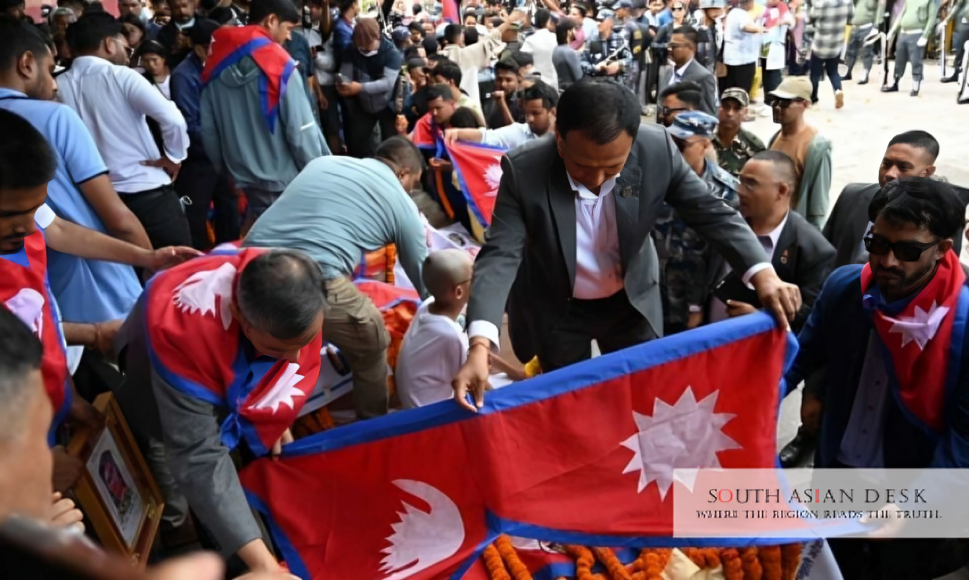
The funeral procession for the Nepal Gen Z martyrs mourning commenced at 10:00 AM on Wednesday, September 17, 2025, from Tribhuvan University Teaching Hospital in Maharajgunj, Kathmandu. The route wound through key areas such as Chabahil and Gaushala before concluding at Pashupati Aryaghat, a sacred Hindu cremation site. Each coffin, draped in the national flag, was carried amid chants and tributes from grieving families and supporters.
At Hansamandap, the Armed Police Force rendered a ceremonial salute, underscoring the official status bestowed upon the deceased. The government has recognised all those killed in the Gen Z protests as martyrs, a declaration made by Interim Prime Minister Sushila Karki in her inaugural address. In her statement, Karki pledged Rs100,000 (approximately US$750) per family for funeral expenses and Rs1.5 million (approximately US$11,200) in compensation for each bereaved household, alongside support for the injured and probes into the violence.
Prominent figures, including Home Minister Om Prakash Aryal and Energy Minister Kulman Ghising, joined the procession. Photojournalists Angad Dhakal and Hemanta Shrestha documented the event, capturing the sombre mood as national flags flew at half-mast across the country. The cabinet’s decision to observe September 17, 2025, as a day of mourning halted non-essential government operations, allowing citizens to reflect on the sacrifices of the Nepal protests 2025.
Background
The Nepal protests 2025 did not emerge in isolation. Nepal’s political landscape has been turbulent since the end of its monarchy in 2008, with frequent changes in leadership—12 prime ministers in the past 16 years—fostering perceptions of entrenched corruption. The Gen Z movement drew inspiration from virtual organising on platforms like Discord, where over 100,000 users debated reforms even after the social media ban was lifted following the unrest.
The protests forced the resignation of Prime Minister K.P. Sharma Oli on Tuesday, September 9, 2025, who cited the need for a “constitutional solution” to the crisis. The army played a pivotal role, imposing curfews and facilitating talks between protesters and officials. On Friday, September 12, 2025, Sushila Karki, Nepal’s first female prime minister and a former Chief Justice, was sworn in as interim leader for a six-month term leading to elections. Her appointment, nominated by the youth group Hami Nepal, was attended by ambassadors from the United States, China, and India, highlighting the geopolitical stakes in Nepal’s stability.
This upheaval marks one of the deadliest episodes of social unrest in Nepal since the 2006 people’s movement that abolished the monarchy. The Gen Z martyrs mourning thus symbolise not just personal losses but a broader push for accountability in a nation where youth unemployment and inequality have long simmered.
Implications for Nepal’s Youth-Led Reforms
As the nation processes the Nepal Gen Z martyrs mourning, the interim government faces mounting pressure to deliver on promises. Karki’s administration has withdrawn the social media ban and initiated anti-corruption probes, but protesters emphasise that systemic change is essential. The Nepal protests 2025 have empowered a digitally savvy generation to demand a future free from nepotism, potentially reshaping governance in the Himalayan republic.
Published in SouthAsianDesk, September 17th, 2025
Follow SouthAsianDesk on X, Instagram, and Facebook for insights on business and current affairs from across South Asia.