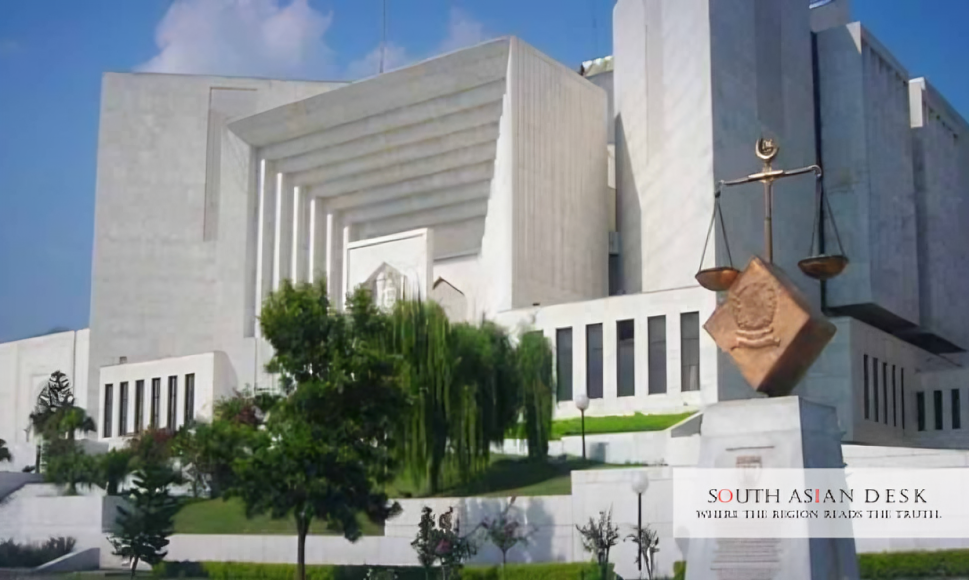
Pakistan Supreme Court 26th Amendment petitions returned to the spotlight on Wednesday when an eight-judge constitutional bench resumed hearings in Islamabad. Chaired by Justice Aminuddin Khan, the bench addressed pleas from lawyers and politicians alleging procedural flaws in the amendment’s passage. Proceedings began at 11:30am, with the federation represented by the attorney general.
The resumption of Pakistan Supreme Court 26th Amendment petitions holds profound implications for South Asia’s fragile democratic architecture. If upheld, the reforms could entrench executive sway over judicial appointments, eroding independence in a region where courts often serve as bulwarks against authoritarian drift. Neighbours like India and Bangladesh watch closely, as similar tensions simmer over judicial autonomy amid political volatility.
SC Constitutional Bench 26th Amendment Hearing Resumption Ignites Debate
The Supreme Court of Pakistan convened its constitutional bench on Wednesday to tackle a clutch of petitions contesting the 26th Constitutional Amendment. This marks the first substantive session since an initial hearing on 27 January 2025, following a nine-month pause that fuelled speculation about delays in judicial scrutiny.
Advocate Shahid Jameel, representing petitioner Mustafa Nawaz Khokhar, opened arguments by filing an application for live streaming of the proceedings. The bench, which includes Justices Jamal Khan Mandokhel, Muhammad Ali Mazhar, Hassan Azhar Rizvi, Musarrat Hilali, Jawad Sarwar, and Ali Baqar Najafi, granted the request unanimously. This decision ensures public access to deliberations on one of the most contentious reforms in recent Pakistani history.
Attorney General Mansoor Usman Awan and Additional Attorney General Raja Rizwan Abbasi appeared for the federal government. They defended the amendment’s framework, which restructures judicial selection and establishes specialised benches for constitutional matters. Petitioners, however, argue the changes violate core principles of separation of powers and were rushed through parliament without adequate debate.
The 26th Amendment, enacted in late 2024, alters Article 175A to shift judge appointments from a near-exclusive judicial committee to one dominated by parliamentarians. Critics contend this tilts influence towards the executive, potentially compromising impartiality in high-stakes cases. Data from the Law Ministry indicates the amendment aimed to expedite constitutional disputes, with over 200 such matters pending pre-reform. Yet, opponents cite procedural lapses, including limited opposition input during its passage, as grounds for nullification.
Background on Pakistan Supreme Court 26th Amendment Petitions
The seeds of these Pakistan Supreme Court 26th Amendment petitions were sown amid Pakistan’s turbulent 2024 elections. Proponents, including the ruling coalition, framed the changes as efficiency measures to unclog the docket and curb “judicial overreach.” Official records from the National Assembly show the bill cleared both houses with a two-thirds majority on 21 October 2024, amid boycott calls from the Pakistan Tehreek-e-Insaf (PTI).
Key petitioners include senior advocates like Abid Saqi and Hamid Khan, alongside political figures. Their filings invoke Articles 63A and 239 of the Constitution, claiming the amendment’s hasty adoption bypassed mandatory quorum rules. A preliminary review by the court’s registry in February 2025 admitted 12 petitions for hearing, dismissing three as non-maintainable.
International observers have weighed in. The International Commission of Jurists labelled the reforms a “blow to judicial independence” in an October 2024 statement, noting parallels with executive encroachments elsewhere in South Asia. Domestically, bar associations rallied against it, with the Pakistan Bar Council issuing a resolution on 15 November 2024 urging veto. Despite this, President Asif Ali Zardari assented, citing national consensus.
The hiatus since January stemmed from bench reconstitution after Justice Ijazul Ahsan’s recusal. This delay amplified concerns over institutional gridlock. Court statistics reveal a 15% rise in constitutional petitions post-amendment, from 1,247 in 2024 to 1,434 by mid-2025, underscoring the stakes.
In parallel, Pakistan’s diplomatic engagements continue unabated. Prime Minister Shehbaz Sharif’s recent visit to Malaysia reaffirmed bilateral ties, with both nations pledging support for Palestinian statehood in a joint communiqué. The leaders condemned violence in Gaza and called for a ceasefire, while discussing economic pacts like expanded palm oil trade. Though unrelated to domestic judicial rows, such outreach highlights Islamabad’s balancing act between internal reforms and regional advocacy.
Key Arguments in SC Constitutional Bench 26th Amendment Hearing Resumption
Wednesday’s session focused on procedural aspects of the petitions. Jameel urged the court to declare the entire amendment void if any irregularity is found, echoing pleas from other counsels. “The process lacked transparency,” he stated, per court transcripts released post-hearing.
The federation countered that the amendment aligns with global norms, drawing on precedents from the UK’s Judicial Appointments Commission. Awan highlighted data showing reduced case backlogs in pilot constitutional benches, with resolution times dropping 22% in test jurisdictions since March 2025.
Petitioners rebutted with evidence of dissent. A leaked parliamentary record from 20 October 2024 shows 47 MPs absent during the vote, potentially invalidating the majority. This claim, supported by session logs from the Senate Secretariat, forms the crux of challenges under Article 75.
Broader context reveals the amendment’s ripple effects. High courts reported a 10% uptick in administrative disputes post-enactment, per a June 2025 Federal Judicial Academy report. In South Asia, this mirrors Bangladesh’s 2017 judicial tweaks, which the Asian Human Rights Commission critiqued for politicising benches.
The live streaming nod is a milestone. It follows a 2023 Supreme Court ruling mandating transparency in public interest cases. Technical setup, overseen by the Information Technology Division, will broadcast via the court’s portal and PTV, reaching an estimated 50 million viewers.
Implications for Judicial Reform in Pakistan
These Pakistan Supreme Court 26th Amendment petitions probe deeper fault lines. If struck down, reversal could restore pre-2024 appointment protocols, bolstering opposition claims of executive overreach. Upholding it might streamline dockets but at the cost of perceived bias, per a 2025 Transparency International index ranking Pakistan’s judiciary 112th globally.
Stakeholders await empirical outcomes. The Law and Justice Commission of Pakistan projects that specialised benches could handle 300 annual cases, easing the apex court’s 45,000-file burden. Yet, without safeguards, fears persist of politicised selections, as voiced in a 2024 bar council memorandum.
Regionally, the saga influences discourse. Indian analysts in The Hindu noted on 10 February 2025 that Pakistan’s shifts could embolden similar pushes in Delhi. In Nepal, judicial unions cited it during 2025 reform debates, urging vigilance against parliamentary dominance.
The hearing’s resumption coincides with economic pressures. Inflation hit 12.4% in September 2025, per State Bank data, amplifying calls for stable institutions. Investors, wary of legal unpredictability, withheld PKR 150 billion in FDI last quarter, according to Board of Investment figures.
What’s Next
The constitutional bench schedules the next round for Thursday at 11:30am, with arguments on substantive merits. Observers anticipate federation rebuttals and possible amicus curiae inputs from bar bodies. A verdict could emerge by year-end, reshaping Pakistan Supreme Court 26th Amendment petitions’ legacy.
In conclusion, the path of these Pakistan Supreme Court 26th Amendment petitions will define judicial resilience, urging reforms that fortify rather than fracture democratic pillars.
Published in SouthAsianDesk, October 8th, 2025
Follow SouthAsianDesk on X, Instagram, and Facebook for insights on business and current affairs from across South Asia.