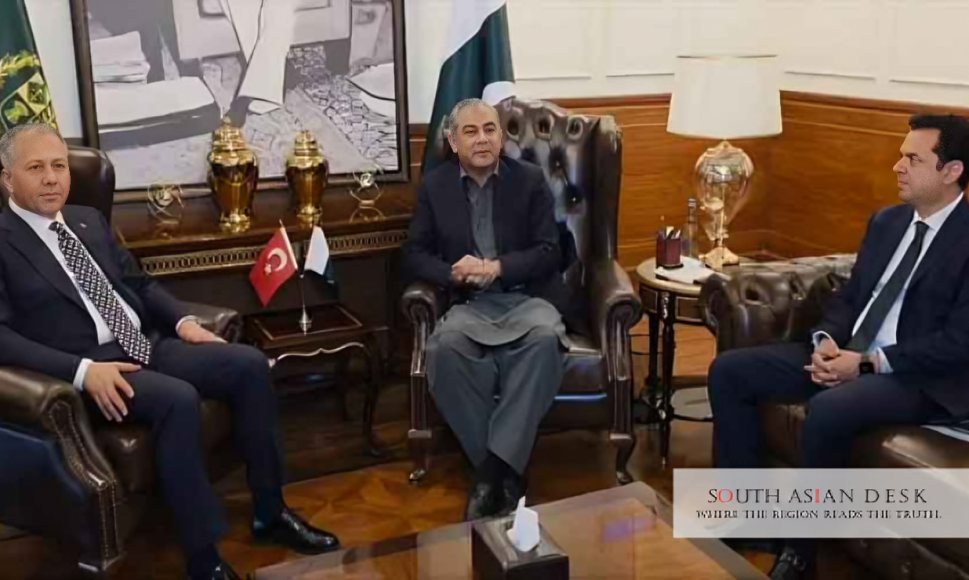
Pakistan Turkiye security cooperation deepend on Thursday, November 6, 2025, when Interior Ministers Mohsin Naqvi and Ali Yerlikaya met in Islamabad to launch a joint working group focused on counterterrorism and border security. The pact aims to tackle shared challenges like narcotics and human trafficking, with meetings set four times yearly.
This alliance bolsters South Asia’s fragile security landscape, where cross-border terrorism and organised crime threaten stability from Afghanistan to the Arabian Sea. By linking Pakistan Turkiye security cooperation, the nations counter extremist networks that exploit porous frontiers, fostering regional resilience amid escalating geopolitical tensions.
Ali Yerlikaya Mohsin Naqvi Meeting Seals Pakistan Turkiye Inseparable Security Ties
The Ali Yerlikaya Mohsin Naqvi meeting unfolded amid warm diplomatic exchanges, underscoring Pakistan Turkiye inseparable security ties rooted in centuries-old brotherhood. Held at the Interior Ministry in Islamabad, the talks drew in senior delegations from both sides. Prime Minister Shehbaz Sharif hosted Yerlikaya earlier that day, reaffirming commitments to multifaceted collaboration.
Yerlikaya, on his first official visit as Interior Minister, praised Pakistan’s frontline role in global counterterrorism efforts. “Turkiye attaches great importance to its brotherly relations with Pakistan and is keen to expand cooperation in all fields,” he stated during the bilateral huddle. Naqvi echoed this sentiment, highlighting how such partnerships address transnational perils that know no borders.
Discussions spanned critical domains. On counterterrorism, both ministers reviewed intelligence-sharing protocols and joint operations against militant outfits operating across Eurasia. Pakistan’s Anti-Narcotics Force (ANF) received commendation for zero reported drug smuggling cases to Turkiye over the past five years, a statistic Yerlikaya lauded as exemplary despite resource constraints. Naqvi noted, “Human trafficking and illegal immigration are global issues that require joint efforts for elimination.”
Border security emerged as a priority, with plans to synchronise patrols along shared maritime routes in the Indian Ocean. Cybercrime consultations focused on defensive frameworks against state-sponsored hacks, while coast guard synergies aim to curb smuggling networks. Police training exchanges will see officers from both countries rotate programmes, drawing on Turkiye’s expertise in urban policing and Pakistan’s counter-insurgency tactics.
The centrepiece was the Joint working group Pakistan Turkiye counterterrorism initiative. This body, comprising interior ministry officials, will convene quarterly to monitor progress and adapt strategies. “The establishment of the joint working group will help further strengthen bilateral collaboration,” Yerlikaya affirmed. Naqvi added that it symbolises a proactive stance on emerging threats like drone-enabled attacks and online radicalisation.
Post-meeting, Yerlikaya joined Naqvi for a symbolic visit to the Pakistan Monument in Shakarparian. Accompanied by Minister of State for Interior Talal Chaudhry, Yerlikaya laid a wreath at the Martyrs’ Memorial and recited Fateha for fallen security personnel. From the vantage point, he admired Islamabad’s skyline and the Margalla Hills, calling the capital a beacon of resilience.
Earlier, Yerlikaya attended the graduation ceremony at the National Police Academy, where he addressed cadets on shared values. In a post on X, he wrote: “Turkiye and Pakistan; two brother nations sharing faith and spirit. Today, with the same belief; from the fight against terrorism to cyber security, from transnational crimes to the fight against drugs, we walk together for the same goal. One’s security is the peace of the other.” The message, accompanied by photos of the event, garnered over 700 likes within hours, reflecting public enthusiasm for Pakistan Turkiye security cooperation.
Historical Context of Pakistan Turkiye Security Cooperation
Pakistan Turkiye security cooperation traces back to the 1950s, when both joined the Central Treaty Organisation to counter Soviet influence. Post-Cold War, ties evolved into robust defence pacts, including joint military drills like Anatolian Eagle. In recent years, amid rising ISIS-Khorasan threats, intelligence fusion has prevented multiple plots targeting urban centres in Lahore and Istanbul.
Data from the South Asian Terrorism Portal indicates over 1,200 terror incidents in Pakistan since 2020, many linked to Afghan-based groups that Turkiye monitors via its NATO obligations. Conversely, Turkiye’s battle against PKK affiliates benefits from Pakistan’s border management insights. This reciprocity underpins Pakistan Turkiye inseparable security ties, with trade in defence tech reaching USD 500 million annually.
The current push aligns with broader High-Level Strategic Cooperation Council outcomes. Last year’s sixth session pledged deeper counterterrorism avenues, now operationalised through the new group. Pakistan’s support for Turkiye in upcoming Interpol elections, announced during the talks, further cements electoral backing in Vienna.
Expanding Horizons: Counter-Narcotics and Beyond
Beyond counterterrorism, the Ali Yerlikaya Mohsin Naqvi meeting spotlighted narcotics interdiction. Pakistan’s ANF seized 45 tonnes of heroin in 2024 alone, much destined for Europe via Turkish routes. Joint operations will target precursor chemicals from the Golden Crescent, with shared satellite surveillance.
Human trafficking controls will integrate biometric databases, reducing irregular migration flows estimated at 50,000 annually between the nations. Cybercrime units plan hackathons to simulate ransomware attacks, while coast guard exchanges focus on Arabian Sea patrols against piracy.
Police cooperation includes scholarships: 20 Pakistani officers will train in Ankara next quarter, reciprocated by Turkish cadets in Islamabad. These initiatives, under the Joint working group Pakistan Turkiye counterterrorism umbrella, promise tangible outcomes by mid-2026.
Why Pakistan Turkiye Security Cooperation Matters Regionally
In South Asia, where Belt and Road corridors intersect with migration routes, fortified Pakistan Turkiye security cooperation deters hybrid threats. It signals to adversaries that Islamabad and Ankara stand united, potentially influencing dynamics with India and Iran. Economically, secure supply chains boost bilateral trade, projected to hit USD 10 billion by 2030.
For citizens, it means safer remittances and tourism. Over 200,000 Pakistanis reside in Turkiye, relying on streamlined visa protocols discussed. Yerlikaya’s assurance on repatriating three Pakistani prisoners on humanitarian grounds exemplifies this people-centric approach.
Background: Fraternal Bonds in Action
The visit follows a pattern of high-level engagements. In 2024, Naqvi attended the Saha International Expo in Istanbul, reciprocating Yerlikaya’s invitation to Islamabad. Historical aid, like Pakistani collections for Turkiye’s 1920s War of Independence, fuels today’s reciprocity. Both nations, OIC stalwarts, advocate for Palestinian security, linking domestic policies to global advocacy.
What’s Next for Joint Working Group Pakistan Turkiye Counterterrorism
The inaugural Joint working group Pakistan Turkiye counterterrorism session is slated for December 2025 in Ankara. Agenda items include AI-driven threat analytics and drone defence protocols. Naqvi plans a return visit in early 2026, eyeing expansions into disaster management. As Yerlikaya departed, he quipped to reporters: “Our paths converge not just in security, but in destiny.” This pact heralds a fortified era of Pakistan Turkiye security cooperation, ensuring enduring vigilance against shadows that loom large.
Published in SouthAsianDesk, November 7th, 2025
Follow SouthAsianDesk on X, Instagram, and Facebook for insights on business and current affairs from across South Asia.