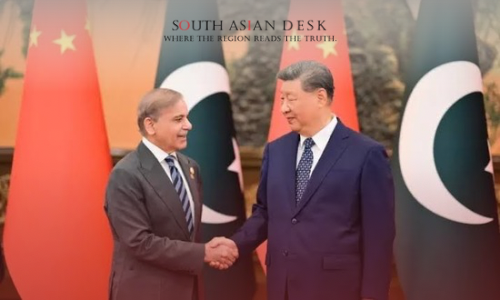
Pakistan and China pledge to deepen their strategic partnership at the SCO Summit, focusing on enhanced cooperation and CPEC’s next phase.
On Tuesday, September 2, 2025, Prime Minister Shehbaz Sharif and Chinese President Xi Jinping met in Tianjin, China, on the sidelines of the Shanghai Cooperation Organisation (SCO) Summit, reaffirming their commitment to deepen the all-weather strategic cooperative partnership between Pakistan and China.
This renewed commitment strengthens Pakistan-China relations, a cornerstone of regional stability and economic cooperation in South Asia, particularly through the China-Pakistan Economic Corridor (CPEC), a flagship project of China’s Belt and Road Initiative (BRI).
Strengthening Bilateral Ties
During the meeting at the Great Hall of the People, both leaders emphasised the unique and robust nature of Pakistan-China relations. They agreed to enhance cooperation across various sectors to reflect their “iron-clad” partnership. According to the Associated Press of Pakistan (APP), the leaders discussed regional and global developments, pledging to maintain close coordination on international issues.
Prime Minister Sharif congratulated President Xi on the successful hosting of the SCO Summit, held from Saturday, August 31, to Sunday, September 1, 2025, in Tianjin. He also extended felicitations on the 80th anniversary of the World Anti-Fascist War, lauding China’s contributions to global peace.
Advancing CPEC’s Next Phase
A key focus of the discussions was the China-Pakistan Economic Corridor, which Sharif described as a transformative project for Pakistan’s socio-economic development. The prime minister expressed Pakistan’s commitment to implementing the second phase of CPEC, which includes five new corridors aimed at boosting key economic sectors. President Xi reiterated China’s support for Pakistan’s economic growth, particularly through CPEC, which he said would focus on critical industries to drive development.
The CPEC, valued at over USD 60 billion, has already facilitated infrastructure projects, energy initiatives, and connectivity enhancements in Pakistan. The next phase is expected to prioritise industrial cooperation, agriculture, and technology, though specific details remain under discussion. Five new economic corridors under CPEC Phase II have been identified—namely the Growth (or Job Creation) Corridor, Livelihood (or Livelihood Enhancing) Corridor, Innovation Corridor, Green Energy Corridor, and Regional (or Inclusive Regional Development) Connectivity Corridor. These corridors are aligned with Pakistan’s 5Es development framework: Export, Energy, Equity, E-Pakistan, and Environment.
Support for Global Initiatives
Sharif voiced Pakistan’s support for China’s global initiatives, including the Global Governance Initiative, Global Development Initiative, Global Security Initiative, and Global Civilisation Initiative. He stated that these efforts contribute to regional and global stability, aligning with Pakistan’s vision for multilateralism. The prime minister highlighted China’s role in fostering peace and development, noting that Pakistan takes pride in Beijing’s modernisation achievements.
President Xi, in turn, reaffirmed China’s commitment to supporting Pakistan’s territorial integrity and sovereignty. The leaders also discussed the importance of building a stronger Pakistan and China community with a shared future, a concept rooted in their long-standing diplomatic ties.
Diplomatic Milestones Ahead
Prime Minister Sharif extended a formal invitation to President Xi to visit Pakistan in 2026, coinciding with the 75th anniversary of Pakistan and China diplomatic relations. President Xi reaffirmed China’s commitment to support Pakistan in its economic development and the second phase of CPEC. He has not publicly confirmed whether he will accept the invitation. The exchange underscores the deep-rooted friendship between the two nations, which have maintained close ties since 1950.
Regional and Global Context
The SCO Summit provided a platform for both leaders to address shared concerns, including regional security and economic challenges. Pakistan and China, as key SCO members, aim to leverage the organisation’s framework to promote cooperation in trade, security, and counter-terrorism. The summit’s outcomes are expected to enhance connectivity and economic integration across member states, with CPEC serving as a model for regional collaboration.
Pakistan’s participation in the SCO reflects its growing role in regional diplomacy, while China’s leadership in the organisation underscores its global influence. The reaffirmed partnership is likely to have ripple effects across South Asia, particularly in countering security threats and fostering economic resilience.
Looking Ahead
As Pakistan and China move forward with their strategic partnership, the focus on CPEC’s second phase and multilateral cooperation will be critical. The deepening of Pakistan-China relations is expected to bolster economic stability and regional connectivity, positioning both nations as key players in South Asia’s geopolitical landscape.
Published in SouthAsianDesk, September 2nd, 2025
Follow SouthAsianDesk on X, Instagram, and Facebook for insights on business and current affairs from across South Asia.