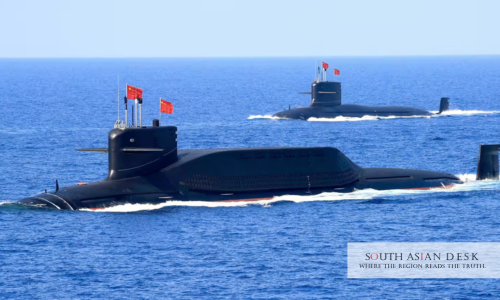
Pakistan will commission its inaugural Hangor-class submarine in 2026 as part of the Pakistan China submarine deal 2026, Chief of Naval Staff Admiral Naveed Ashraf announced in an exclusive interview. The $5 billion arms pact with China covers eight diesel-electric attack vessels, with the first four constructed abroad. This move bolsters Islamabad’s maritime security amid rising tensions in the Indian Ocean.
Strategic Implications for South Asia
The 2026 Pakistan-China submarine deal underscores the deepening military ties between Islamabad and Beijing, enhancing Pakistan’s deterrence against India while supporting China’s Belt and Road Initiative. In South Asia, where naval rivalries significantly impact regional stability, these submarines will patrol vital sea lanes, safeguard energy routes via the China-Pakistan Economic Corridor (CPEC), and maintain equilibrium in the Northern Arabian Sea. This infusion of advanced Chinese technology could deter aggression and promote cooperative security, though it risks escalating arms competitions across the subcontinent.
Progress in Pakistan Navy Chinese Subs Launch
The Pakistan Navy’s Chinese subs launch programme advances steadily, with three vessels already afloat in China’s Yangtze River. Admiral Ashraf confirmed that the initiative is progressing smoothly, marking a milestone in bilateral naval collaboration. Under the 2015 contract, valued at up to $5 billion, Pakistan acquires eight Hangor-class submarines to modernise its fleet. The first four units were built in a shipyard in Hubei Province, while the latter four were assembled at Karachi Shipyard and Engineering Works Limited (KS&EW) through a technology transfer process.
This split ensures that Pakistan gains indigenous expertise, thereby reducing its long-term reliance on imports. The diesel-electric design equips the submarines for stealthy operations, ideal for the Arabian Sea’s contested waters. The delivery span extends from 2022 to 2028, with the lead vessel scheduled to enter service next year. Admiral Ashraf praised the partnership, noting that “Chinese-origin platforms and equipment have been reliable, technologically advanced, and well-suited to Pakistan Navy’s operational requirements.”
Third Hangor-Class Vessel Takes to Water
A key highlight in the Pakistan Navy’s Chinese submarine launch came in August 2025, when the third submarine, designated PNS/M Mangro, was launched at the Wuchang Shipbuilding Industry Group in Wuhan. Vice Admiral Abdul Samad, Deputy Chief of Naval Staff Project-2, attended as the chief guest and addressed the ceremony. He emphasised the vessels’ role in maritime defence: “The Hangor-class submarines’ cutting-edge weaponry and advanced sensors would be instrumental in sustaining regional power equilibrium and ensuring maritime stability.”
The event followed launches of the first submarine in April 2024 and the second in March 2025. These steps validate the project’s timeline, with sea trials slated soon for the initial batch. Chinese experts, including Zhang Junshe, hailed the design for its stealth, mobility, endurance, and firepower, noting it reflects “high strategic mutual trust and deep friendship” between the nations. The submarines feature air-independent propulsion (AIP) systems, which extend their underwater endurance beyond the limits of traditional diesel propulsion.
Hangor Class Submarine Pakistan: Capabilities and Role
The Hangor class submarine program in Pakistan introduces vessels tailored for offensive patrols in the Indian Ocean and the North Arabian Sea. Each 2,800-tonne submarine is equipped with torpedoes, anti-ship missiles, and mines, enabling it to strike both surface threats and underwater targets. Their low acoustic signature enhances survivability against sonar detection, a critical edge in asymmetric naval scenarios.
Admiral Ashraf highlighted the fleet’s projection power: “These platforms are playing a key role in ensuring maritime security in the North Arabian Sea and the broader Indian Ocean region, which is critical for the global economy.” Linked to CPEC’s Gwadar port, the Hangor class submarine Pakistan units will secure trade corridors from Xinjiang to the Arabian Sea, protecting $100 billion in annual investments. This aligns with Pakistan’s multi-domain strategy, integrating unmanned systems and AI for future operations.
In service, the fleet will double Pakistan’s submarine strength, countering India’s growing blue-water navy. Beijing, as Pakistan’s largest arms supplier—accounting for over 60% of exports from 2020 to 2024—supplies 80% of Islamabad’s primary weapons. The Hangor-class submarine, Pakistan, thus symbolises self-reliance, with KS&EW targeting full local production by 2028.
$5 Billion Pakistan China Submarine Deal: Deepening Ties
The $5 billion Pakistan arms deal with China encompasses more than just hardware; it also fosters joint training and interoperability. Recent Sea Guardians exercises focused on anti-piracy, replenishment, and search-and-rescue operations, building tactical synergy. Admiral Ashraf noted: “This cooperation goes beyond hardware; it reflects a shared strategic outlook, mutual trust, and a long-standing partnership.”
Complementing the Hangor effort, Type 054A/P frigates already serve in anti-submarine roles, proving Chinese reliability. Future focus includes electronic warfare and marine research. China’s Ministry of National Defence spokesperson Jiang Bin affirmed: “The China-Pakistan defense and security cooperation is not targeted at any third party and is committed to maintaining international and regional security and stability.”
This pact follows Pakistan’s use of Chinese J-10 jets against Indian Rafales in May 2025, underscoring battlefield trust. Economically, it ties into CPEC’s 3,000 km infrastructure, securing oil routes and encircling rivals.
Background: Legacy of the Hangor Name
The Hangor moniker honours PNS Hangor, which sank the Indian frigate INS Khukri in 1971—the only conventional submarine success since World War II. That victory crippled INS Kirpan and bottled Indian forces, shaping naval lore. Today’s programme revives that spirit, blending history with high-tech.
What’s Next for the Pakistan-China Submarine Deal 2026
Full induction by 2028 will equip Pakistan with a balanced fleet, including locally built units. Ongoing PIMEC activities in Karachi promote blue economy investments, showcasing opportunities in Gwadar. Admiral Ashraf envisions expanded collaboration: “In the coming decade, we expect this relationship to grow stronger, encompassing not only shipbuilding and training, but also enhanced interoperability, research, technology sharing, and industrial collaboration.”
Challenges persist, from sea trials to integration, but milestones affirm viability. Regional watchers anticipate ripple effects on Indo-Pak dynamics. The Pakistan-China submarine deal of 2026 marks a strengthened maritime frontier, solidifying alliances that will safeguard South Asia’s seas for years to come.
Published in SouthAsianDesk, November 3rd, 2025
Follow SouthAsianDesk on X, Instagram, and Facebook for insights on business and current affairs from across South Asia.