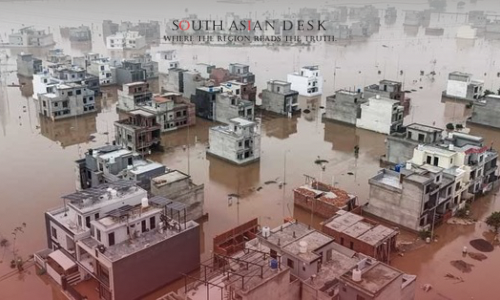
Punjab’s worst floods in decades have killed 30, and Pakistan flood victims count crossed over 1.5 million, with Senior Minister Marriyum Aurangzeb overseeing relief efforts. On Saturday, August 30, 2025, Punjab Senior Minister Marriyum Aurangzeb reported that floods in Pakistan’s eastern province have killed 30 people and affected 1.5 million, triggered by heavy monsoon rains and water releases from Indian dams, overwhelming the Ravi, Sutlej, and Chenab rivers.
Impact on Pakistan Flood Victims
On the same day, the Punjab Provincial Disaster Management Authority reported that 2,038 settlements were inundated—1,169 along the Chenab, 462 along the Ravi, and 391 along the Sutlej. According to the PDMA on X, 1,501,603 people were affected and 481,000 evacuated to safe locations. The floods—described as the worst in four decades—submerged grain crops and damaged 200 km of roads, severely impacting Punjab’s agricultural heartland. No verified estimate is yet available for total crop damage in PKR.
Relief and Rescue Operations
Senior Minister Marriyum Aurangzeb detailed extensive relief efforts, with 511 relief camps and 351 medical camps providing 24-hour assistance. Over 68,477 people were rescued in the last 36 hours, and 405,000 livestock were relocated, supported by 321 veterinary camps. “The floods have affected 15,016,603 people [while] more than 481,000 people have been evacuated,” Aurangzeb stated, emphasising that 808 boats are aiding rescue missions. Punjab Chief Minister Maryam Nawaz Sharif credited “timely evacuations” for averting larger casualties, noting the demolition of illegal structures along waterways as a preventive measure. She urged officials to ensure “no displaced person is without food and medical help” to curb waterborne diseases.
The Pakistan Army, alongside Rescue 1122, has been deployed in districts like Jhang, Faisalabad, and Chiniot, using helicopters and boats. According to @PakistanFauj on X, army operations have evacuated thousands, with relief efforts ongoing despite challenging conditions.
Regional Tensions and Causes
Pakistan’s Federal Planning Minister Ahsan Iqbal accused India of releasing excessive water from the Thein and Madhopur dams without adequate warning, exacerbating the flooding. He claimed New Delhi violated the Indus Waters Treaty, which India suspended earlier in 2025 following an incident in Indian-administered Kashmir. According to Reuters, India shared warnings on humanitarian grounds, but Pakistan’s PDMA noted the Thein Dam was 97 percent full, prompting urgent evacuations. Punjab Irrigation Minister Kazim Raza Pirzada attributed the intense flooding to climate change, noting heavier rainfall patterns.
Background
Pakistan has faced recurrent flooding since the 2022 super floods, which killed over 1,700 people. The 2025 monsoon season, starting in late June, has claimed 840 lives nationwide, with Punjab and Khyber Pakhtunkhwa hardest hit. The Ravi, Sutlej, and Chenab rivers, flowing from India into Pakistan, are prone to flooding due to shared river systems established during the 1947 partition. The Indus Water Treaty, meant to regulate water sharing, has been a point of contention, with Pakistan alleging India’s dam releases worsen its flood crises.
What’s Next
With floodwaters expected to reach Sindh by September 3, 2025, relief efforts will intensify to support Pakistan flood victims. The Punjab government’s focus on rehabilitation and compensation for losses will be critical, as will diplomatic efforts to address cross-border water management.
Published in SouthAsianDesk, August 30th, 2025
Follow SouthAsianDesk on X, Instagram, and Facebook for insights on business and current affairs from across South Asia.