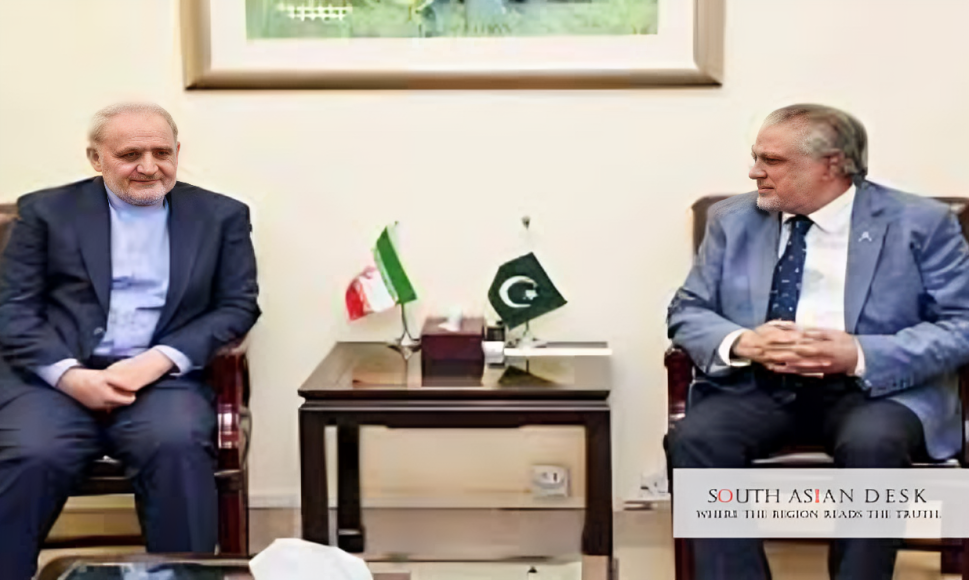
Deputy Prime Minister Ishaq Dar met Iranian Ambassador Raza Amiri Moghaddam in Islamabad on Saturday, February 7, 2026, to discuss bilateral cooperation. Dar reiterated Pakistan’s commitment to Iran amid regional challenges, following a deadly blast.
In a region marked by security threats and economic potential, this engagement underscores the role of Pakistan Iran relations in fostering stability and trade growth across South Asia.
Ishaq Dar Iranian Ambassador Meeting Highlights
Deputy Prime Minister and Foreign Minister Senator Mohammad Ishaq Dar hosted Iranian Ambassador Raza Amiri Moghaddam at the Ministry of Foreign Affairs in Islamabad. The meeting focused on advancing Pakistan Iran relations through established mechanisms.
Ambassador Moghaddam extended condolences for the suicide bombing at an imambargah in Islamabad on Friday, February 6, 2026, which claimed over 30 lives. Dar condemned the attack and affirmed Pakistan’s resolve to eradicate terrorism.
The ambassador updated Dar on advancements in bilateral institutional frameworks aimed at enhancing cooperation in various sectors. Dar emphasised Pakistan’s dedication to deepening ties with Iran, highlighting shared interests in trade, energy, and security.
This Ishaq Dar Iranian ambassador meeting builds on recent diplomatic exchanges. Prime Minister Shehbaz Sharif recently spoke with Iranian President Masoud Pezeshkian, while Dar held discussions with Iranian Foreign Minister Abbas Araghchi.
Dar Reiterates Bilateral Ties Commitment
Dar reiterated bilateral ties during the session, stressing the need for sustained collaboration. He noted that Pakistan Iran relations remain vital for addressing mutual challenges like border security and economic integration.
Official statements indicate both nations aim to expand engagement. Dar’s remarks align with Pakistan’s commitment to Iran, prioritising dialogue over conflict.
The meeting occurred against a backdrop of regional tensions, including terrorism threats. Pakistan has faced multiple attacks, and Iran shares concerns over cross-border instability.
Background On Pakistan Iran Relations
Pakistan and Iran share a 909-kilometre border and historical cultural links. Diplomatic relations date back to 1947, with both countries being members of organisations like the Organisation of Islamic Cooperation.
In April 2024, Iranian President Ebrahim Raisi visited Pakistan, where leaders vowed to increase bilateral trade to USD 10 billion annually. Current trade stands at around USD 2 billion, with potential in energy sectors like gas pipelines.
Tensions arose in January 2024 after cross-border strikes, but ambassadors returned by January 26, 2024, restoring full ties. A joint statement emphasised peaceful resolution.
Recent interactions include Dar’s phone call with Araghchi on January 24, 2026, discussing regional developments. Another call on January 17, 2026, focused on stability.
On January 6, 2026, Dar met Ambassador Moghaddam to review progress in key areas. A December 21, 2025, call between Dar and Araghchi reinforced trade and connectivity.
An inter-ministerial meeting on December 17, 2025, chaired by Dar, evaluated Pakistan Iran relations, identifying opportunities in petroleum and commerce.
Data from Pakistan’s Ministry of Commerce shows exports to Iran reached USD 1.2 billion in 2025, mainly rice and textiles. Imports included petroleum products worth USD 800 million.
Both nations have signed agreements on border management and anti-smuggling. The 13th round of bilateral political consultations occurred in November 2025, agreeing to future sessions in Tehran.
Iran’s role in regional forums, like the Astana process on Syria, intersects with Pakistan’s interests in Afghanistan stability.
Pakistan commitment to Iran extends to nuclear issues. In 2025, Pakistan supported peaceful resolution of Iran’s nuclear programme through dialogue.
These elements highlight the depth of Pakistan Iran relations, essential for South Asian geopolitics.
Challenges in Bilateral Cooperation
Border incidents have strained ties, but mechanisms like the High Border Commission address them. In 2019, leaders agreed to open new crossings like Gabd-Reemdan.
Economic barriers include sanctions on Iran, affecting projects like the Iran-Pakistan gas pipeline. Pakistan seeks waivers to proceed.
Despite challenges, Dar reiterates bilateral ties as a pathway to mutual prosperity.
What’s Next for Pakistan Iran Relations
Future steps may include high-level visits. Iranian Foreign Minister Araghchi’s potential trip could advance trade goals.
Both sides plan to convene the next bilateral consultations soon. Focus areas include energy cooperation and people-to-people exchanges.
Pakistan commitment to Iran will likely feature in upcoming regional summits, promoting peace.
In conclusion, this engagement reaffirms the enduring strength of Pakistan Iran relations, paving the way for enhanced partnership.
Published in SouthAsianDesk, February 7th, 2026
Follow SouthAsianDesk on X, Instagram and Facebook for insights on business and current affairs from across South Asia.