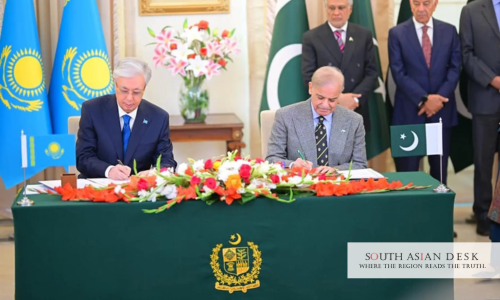
Pakistan-Kazakhstan relations: Pakistan and Kazakhstan have agreed to elevate their bilateral relations to a Strategic Partnership during the visit of Kazakh President Kassym-Jomart Tokayev to Pakistan from February 3-4, 2026. This significant diplomatic milestone was sealed with a Joint Declaration signed in Islamabad, marking President Tokayev’s first visit to Pakistan in 23 years.
The leaders, including Prime Minister Shehbaz Sharif, hailed the visit as historic, emphasizing the deep-rooted cultural and fraternal ties between the two nations. They reaffirmed commitments to sovereignty, territorial integrity, and non-interference, highlighting Pakistan’s early recognition of Kazakhstan’s independence in 1991.
Under this new Strategic Partnership, both countries aim to enhance cooperation across eight priority areas: political dialogue, security, bilateral trade and investment, transport and logistics, education, culture, climate change, and international collaboration. A key goal is to boost bilateral trade to $1 billion within a year, supported by a multi-country transport corridor linking Central and South Asia.
Prime Minister Sharif announced the Belarus-Russia-Kazakhstan-Uzbekistan-Afghanistan-Pakistan transport corridor to improve regional connectivity. He urged business communities to invest in joint ventures, noting that the current trade volume of $250 million does not reflect the partnership’s potential. Thirty-seven memorandums of understanding were exchanged, covering sectors like finance, transport, energy, and technology.
President Tokayev emphasized the importance of transport and logistics, considering Pakistan’s ports as gateways for Central Asian trade. Both nations also agreed to explore direct air connections to enhance business and tourism. A working committee will be established to expand economic cooperation over the next five years, with confidence that these efforts will open new avenues for collaboration.
Published in SouthAsianDesk, February 5th, 2026
Follow SouthAsianDesk on X, Instagram and Facebook for insights on business and current affairs from across South Asia.