Pakistan’s NA passes 27th Amendment Bill on Monday, creating a Chief of Defence Forces and reforming judicial structures in a session fraught with disorder. Lawmakers voted 234 in favour and four against, following Senate approval. The move, tabled by Law Minister Azam Nazeer Tarar, addresses post-war defence needs and constitutional court promises. When: 12 November 2025. Where: Islamabad. Why: To enhance command and judicial clarity. How: Clause-by-clause amid walkouts.
Reshaping Power in a Tense Region
The 27th Amendment bolsters Pakistan’s defence hierarchy after recent conflicts, while advancing civilian-led judicial reforms. In South Asia, where military influence often sways politics, this shift could stabilise Islamabad’s role against terrorism and border threats from India and Afghanistan. Yet opposition fury highlights risks to democratic checks, potentially fuelling protests that ripple across the neighbourhood.
NA Chaotic Session 27th Amendment Passage
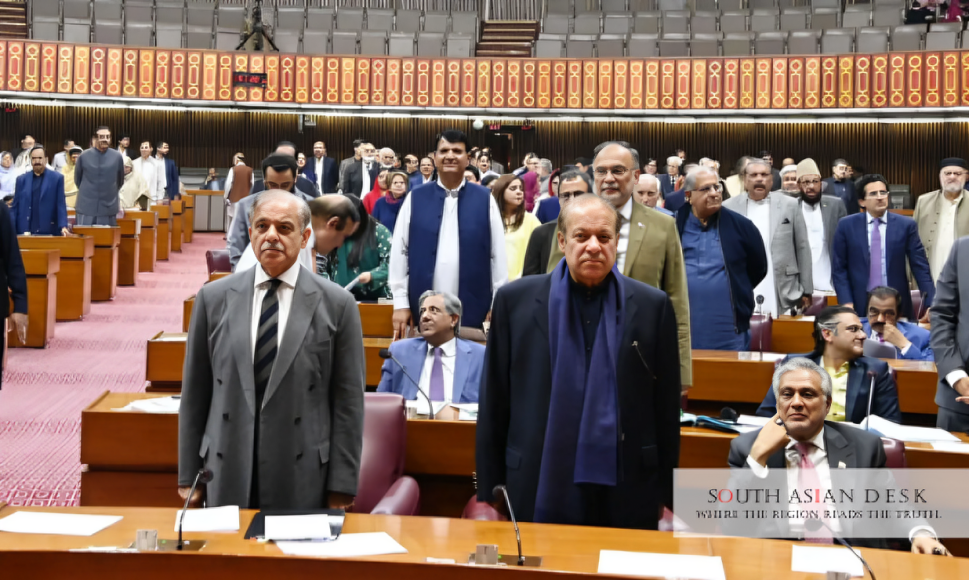
The National Assembly chamber erupted into pandemonium as the 27th Amendment Bill reached its final vote. Prime Minister Shehbaz Sharif and PML-N leader Nawaz Sharif entered to cheers from allies, but Pakistan Tehreek-e-Insaf (PTI) members responded by ripping up bill copies and hurling them towards the front benches. Ruling coalition parliamentarians quickly formed a protective cordon around the Sharifs.
Speaker Ayaz Sadiq struggled to maintain order. PTI lawmakers clustered near the dais, chanting slogans for jailed former premier Imran Khan and waving his portraits. The live broadcast on the assembly’s YouTube channel cut out repeatedly, with later uploads showing edited segments of speeches. One notable omission involved Pashtunkhwa Milli Awami Party’s Mehmood Khan Achakzai, whose full address appeared truncated.
Despite the turmoil, the government mustered its two-thirds majority in the 336-seat house. PML-N holds 125 seats, PPP 74, MQM-P 22, PML-Q five, Istehkam-e-Pakistan Party four, PML-Z one, Balochistan Awami Party one, and National Peoples Party one. Opposition forces, mainly PTI with 103 seats, boycotted key moments.
Law Minister Tarar introduced the bill earlier, stressing consultations with legal experts to clarify judicial tenures and treason clauses. “This removes ambiguities from prior reforms,” he stated. The session, lasting over six hours, ended with division voting confirming the tally.
Opposition Walkout 27th Amendment Pakistan
Tensions peaked when PPP Chairman Bilawal Bhutto-Zardari rose to speak. Opposition members tore more documents and stormed the floor, prompting a full walkout by PTI and allies. Barrister Gohar Ali Khan, PTI chairman, later condemned the process outside. “This sinks the ship of democracy and judicial independence,” he said.
Shehryar Khan Afridi of PTI called the haste a “mockery,” questioning provisions on presidential immunity. Amir Dogar warned of a “paralysed judiciary.” Achakzai labelled the amendments “undemocratic,” alleging stolen mandates block Khan’s return. Jamiat Ulema-e-Islam-Fazl and Balochistan National Party-Mangal also voiced dissent in earlier debates.
Government benches hit back. Information Minister Attaullah Tarar accused PTI of “selective morality” and past constitutional violations. “They refused dialogue,” he noted. PPP’s Nafisa Shah defended exclusions of divisive clauses, like limits on National Finance Commission awards. “We protect the 18th Amendment’s spirit,” she affirmed.
The walkout echoed Senate proceedings two days prior, where 64 votes passed the bill amid similar boycotts. Two opposition senators unexpectedly supported it, tipping the balance.
27th Amendment Creates Chief of Defence Forces
At its core, the 27th Amendment introduces structural shifts in defence and judiciary. Article 243 gains protections for the field marshal rank, awarded to the army chief after May’s India conflict. Reforms enhance command consultations, establishing a Chief of Defence Forces to streamline operations against rising terrorism.
Prime Minister Sharif linked this to recent successes. “Our forces defeated aggression and boosted our global standing,” he said, Crediting negotiations with Afghanistan on counter-terrorism. The amendment shields such ranks from treason probes under Article 6, alongside the new Federal Constitutional Court (FCC).
Judicial changes define “Chief Justice of Pakistan” as the senior-most judge between Supreme Court and FCC heads. Article 260 adds a clarifying clause. The FCC, drawn from all provinces, realises 2006 Charter of Democracy pledges for a dedicated constitutional bench.
Bilawal Bhutto-Zardari endorsed defence tweaks in wartime contexts. “It fulfils promises without eroding provincial powers,” he remarked. Excluded were proposals curbing executive overreach, dual nationality rules, and chief election commissioner picks. Defence Minister Khawaja Asif and MQM-P’s Syed Mustafa Kamal praised local governance boosts tied to these reforms. The bill now returns to Senate for tweaks before presidential assent from Asif Ali Zardari.
Background: Roots in Charter of Democracy
This amendment builds on the 2006 Charter of Democracy, signed by Benazir Bhutto and Nawaz Sharif. It aimed for constitutional courts to curb judicial overreach, like the 1950s doctrine of necessity. The 18th Amendment of 2010 devolved powers, but gaps persisted.
Recent triggers include the 26th Amendment in October 2024, which added environmental rights. Terror attacks in Wana and Islamabad last week, blamed on Afghan and Indian elements, underscored urgency. Sharif paid tribute to slain PML-N senator Irfan Siddiqui amid these threats.
What’s Next after NA Passes 27th Amendment
Senate reconvenes soon to ratify changes. Protests loom, with PTI’s Tehreek Tahafuz Ayeen-e-Pakistan planning nationwide action. Legal challenges may test the FCC’s setup. Analysts watch if this cements military-civilian balance or invites instability.
The passage of the 27th Amendment by Pakistan NA marks a pivotal, if contested, evolution in governance, with eyes on its regional fallout.
Published in SouthAsianDesk, November 13th, 2025
Follow SouthAsianDesk on X, Instagram, and Facebook for insights on business and current affairs from across South Asia.