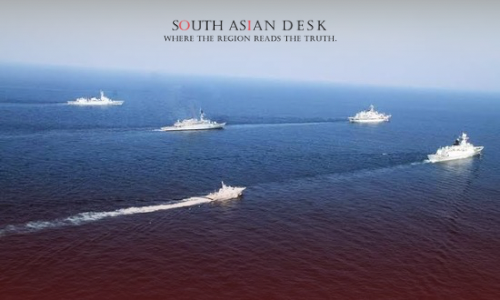
A joint survey between the Pakistan Navy and China reveals vast deep-sea gas reserves under the Arabian Sea—could reshape Pakistan’s energy future.
Pakistan Navy deep-sea gas reserves discovery China: The Pakistan Navy, in collaboration with China, detected significant deep-sea gas deposits beneath the Arabian Sea on Monday, 8 September 2025, during a seabed survey under the Chief of Naval Staff’s direction.
Why It Matters
In the energy-hungry region of South Asia, the discovery of deep-sea gas reserves by the Pakistan Navy in collaboration with China represents a strategic opportunity to strengthen national energy self-sufficiency and enhance economic stability. This development comes at a critical time when Pakistan continues to grapple with long-standing energy shortages that have hampered industrial growth and burdened households. By tapping into these newly identified reserves, Pakistan could reduce its reliance on costly energy imports, stabilise domestic supply, and create a stronger foundation for sustainable economic development, while also reinforcing its energy partnership with China.
Survey Findings and Strategic Implications
A retired naval officer, Rear Admiral (Retd) Fawad Amin Baig, revealed the results on Pakistan Navy Day—8 September 2025—that Pakistan’s seabed holds vast gas reserves detected through a detailed joint survey with Chinese technical assistance.
He emphasised: “The country’s waters are not only rich in minerals but also home to a treasure trove of marine resources that could change the economic outlook if tapped wisely.”
Attracting Investment and Overcoming Challenges
Baig stressed that realising the value of this discovery rests on securing investment and technology: with proper funding, this hidden wealth could drive national development.
However, he also cautioned that “hostile fifth-generation warfare tactics” frequently discourage investors whenever Pakistan moves towards progress.
Institutional Enablers and Strategic Alignment
He underlined the Special Investment Facilitation Council (SIFC) and coordinated military-political efforts as crucial to creating a resilient defence and economic strategy, reinforcing Pakistan’s position to realise this opportunity.
Furthermore, the discovery aligns with broader Pakistan–China cooperation, especially following a joint statement last year promoting development of offshore oil and gas blocks, marine oil and gas resources, and natural gas hydrates.
Background
Under the China-Pakistan Economic Corridor (CPEC) and related frameworks, China has consistently invested in Pakistan’s mining and fossil fuel sectors. In June 2024, both countries agreed to bolster mining, oil, and gas cooperation, encouraging Chinese firms to participate in Pakistan’s offshore oil and gas development.
What’s Next
Pakistan’s newly discovered gas reserves must be approached with precision and foresight. First, agencies should conduct thorough autopsy-style assessments and geological verifications to accurately determine the extent of the reserves and evaluate their environmental impact.
Alongside this, an investment drive is essential, mobilising both domestic and international capital, particularly through the Special Investment Facilitation Council (SIFC), to strengthen infrastructure and deploy advanced extraction technologies. Equally important is strategic diplomacy, where Pakistan can leverage its close ties with China to attract technical partners while also mitigating geopolitical risks, including those linked to fifth-generation warfare tactics.
Conclusion
The Pakistan Navy deep-sea gas reserves discovery China could herald a transformative era for Pakistan’s energy security and economic resilience. With strategic investment and partnership, these deep-sea resources may soon emerge as pillars of national development.
Published in SouthAsianDesk, September 9th, 2025
Follow SouthAsianDesk on X, Instagram, and Facebook for insights on business and current affairs from across South Asia.