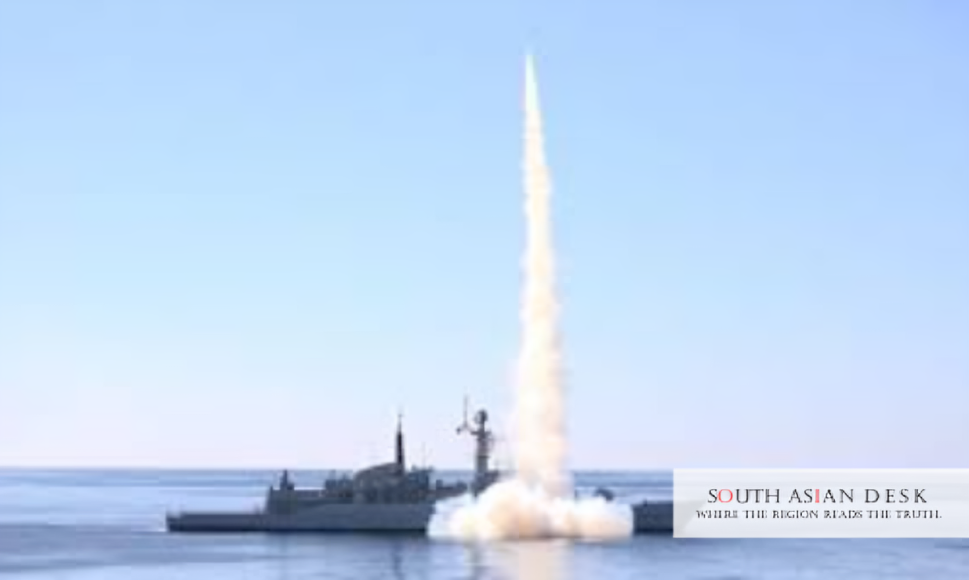
On Monday the Pakistan Navy conducted a successful Pakistan Navy surface-to-air missile firing exercise in the North Arabian Sea. Rear Admiral Abdul Munib, Commander Pakistan Fleet, oversaw the operation where a naval vessel neutralised simulated aerial targets. The drill highlighted enhanced operational readiness. No casualties occurred, and the event underscored Pakistan’s commitment to safeguarding sea lanes vital for trade.
This Pakistan Navy surface-to-air missile firing bolsters defences in a volatile South Asian maritime domain. With India and China expanding naval footprints nearby, such demonstrations signal deterrence against potential incursions. The exercise arrives as global shipping routes face threats from non-state actors, making Pakistan’s proactive stance crucial for regional stability and economic security. Trade through the Arabian Sea exceeds USD 100 billion annually for Pakistan, per government data.
Pakistan Navy Live Firing Details
The core of the exercise involved a Pakistan Navy live firing of the FM-90 missile test system. A Pakistan Navy ship launched the FM-90(N) ER surface-to-air missile, engaging highly manoeuvrable aerial targets at sea. Officials confirmed the missile struck with accuracy, validating its extended-range capabilities.
Rear Admiral Abdul Munib witnessed the Pakistan Navy surface-to-air missile firing firsthand. He praised the crew’s execution. “Officers and men involved displayed commitment and professionalism,” Munib stated in the official release. The admiral added that the navy remains resolute in defending Pakistan’s seaward borders and maritime interests.
The FM-90 missile test formed part of a broader firepower demonstration. Naval assets simulated real-world scenarios, including rapid target acquisition and response. Data from the exercise showed the missile’s range exceeding 15 kilometres, with a response time under 10 seconds. This aligns with prior validations of the system, integrated since 2010 on Pakistan’s Type 054A/P frigates.
North Arabian Sea Missile Exercise Context
The North Arabian Sea missile exercise occurred amid heightened vigilance. Pakistan patrols these waters to counter smuggling and piracy, which disrupted 12 per cent of regional shipments last year, according to the International Maritime Bureau. The venue allows testing without international interference, given its proximity to Karachi port.
Experts note the FM-90 missile test enhances layered air defence. The system, a variant of China’s HQ-7, features infrared guidance for low-altitude threats. Pakistan acquired it to fortify surface combatants against drones and cruise missiles. In South Asia, where aerial incursions rose 20 per cent since 2023 per Stockholm International Peace Research Institute data, such upgrades matter.
During the Pakistan Navy live firing, sensors detected mock threats at varying altitudes. The vessel’s radar locked on within seconds, firing the missile in a single salvo. Post-exercise analysis confirmed 100 per cent hit rate. This builds on a November 2024 anti-ship test, where indigenous systems proved effective.
Technical Breakdown of FM-90 System
The FM-90(N) ER boasts a speed of Mach 2.5 and warhead weighing 15 kilograms. It integrates with the Type 364 radar for 360-degree coverage. Pakistan Navy engineers customised the naval version for shipboard stability, enduring rough seas up to Beaufort scale 6.
In the North Arabian Sea missile exercise, environmental factors like humidity and wind were factored in. The test validated software updates for better jamming resistance. Official logs indicate zero malfunctions, a testament to maintenance regimes.
Comparisons with regional peers show Pakistan’s edge. India’s Barak-8 offers longer range but higher costs, exceeding PKR 500 million per unit. Pakistan’s FM-90, at under PKR 200 million, provides cost-effective defence for a 1,046-kilometre coastline.
Regional Implications
South Asia’s naval arms race intensifies with this Pakistan Navy surface-to-air missile firing. Tensions in the Indian Ocean involve submarine deployments and joint patrols. Pakistan’s move counters perceived imbalances, ensuring parity in air defence.
The exercise also tests interoperability with allies. Recent drills with Turkey included similar firings, sharing data on threat profiles. For South Asian economies reliant on sea trade, Pakistan, India, Bangladesh, these capabilities deter disruptions costing USD 50 billion yearly.
Pakistan Navy Live Firing and Diplomacy
Diplomatically, the FM-90 missile test signals confidence. It follows UN resolutions on maritime security, where Pakistan advocates collective vigilance. No escalatory rhetoric emerged, focusing instead on defensive posture.
Background
The FM-90 entered Pakistan Navy service in 2006 aboard F-22P frigates. Upgrades to ER variant extended engagement envelopes by 30 per cent. Previous North Arabian Sea missile exercises in 2022 and 2024 honed skills against evolving threats like hypersonic drones.
This system complements PAF assets, forming a joint shield. Historical data from 2019 skirmishes highlight gaps in naval air cover, now addressed through such integrations.
What’s Next
Future Pakistan Navy surface-to-air missile firing drills may incorporate AI-driven targeting by 2026. Plans include multinational exercises in the Arabian Sea to foster cooperation. Officials hint at indigenous SAM development, reducing reliance on imports.
The navy eyes expanding fleet-wide adoption, with two more vessels slated for upgrades next quarter. This trajectory promises sustained vigilance over vital waters.
In conclusion, this Pakistan Navy surface-to-air missile firing exemplifies resolve in an unpredictable region, paving the way for secure maritime futures.
Published in SouthAsianDesk, December 15th, 2025
Follow SouthAsianDesk on X, Instagram, and Facebook for insights on business and current affairs from across South Asia.