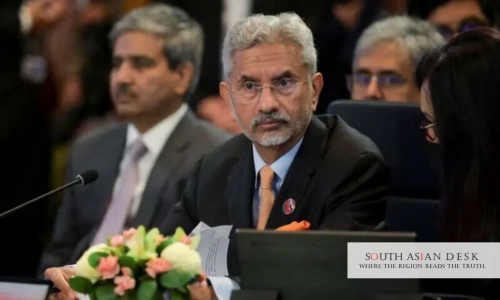
Pakistan rejects Jaishankar’s irresponsible assertions on Saturday, January 3, 2026. The Foreign Office issued a statement in Islamabad. Jaishankar made the remarks during a speech in Chennai on Friday. He called Pakistan a bad neighbour for persistent terrorism and linked it to the Indus Water Treaty dispute.
This episode of Pakistan rejecting Jaishankar’s remarks heightens bilateral frictions in South Asia. It risks further straining water-sharing agreements and security cooperation.
Pakistan Rejects Jaishankar’s Remarks: Official Response
The Foreign Office released a statement rejecting Jaishankar’s claims. It described them as irresponsible assertions. The statement said: “Pakistan firmly rejects the irresponsible assertions made by the Indian external affairs minister. Once again, India seeks to deflect attention from its own troubling record as a neighbour that promotes terrorism and contributes to regional instability.”
The response highlighted India’s involvement in terrorism. It cited the Kulbhushan Jadhav case as evidence. Jadhav, an Indian naval officer, was arrested in Balochistan in March 2016. He confessed to espionage and terrorism activities linked to India’s Research and Analysis Wing.
The statement added: “India’s documented involvement in promoting terrorist activities in the region, particularly in Pakistan, is a matter of grave concern. The arrest and confession of Commander Kulbhushan Jadhav serve as a stark example of organised, state-sponsored terrorism directed against Pakistan.”
Pakistan accused India of extraterritorial killings and sabotage. It linked these to Hindutva ideology. The Foreign Office urged India to cease such actions.
The Bad Neighbours Jibe Explained
Jaishankar delivered the ‘bad neighbours’ jibe during an address at the Indian Institute of Technology, Madras. He stated: “You can also have bad neighbours … unfortunately, we do. When you have bad neighbours … if you look to the one to the West, if a country decides that they will deliberately, persistently, unrepentantly continue with terrorism, we have a right to defend our people against terrorism.”
This came after an attack on tourists in occupied Kashmir’s Pahalgam on April 22, 2025. India blamed Pakistan without providing evidence. Jaishankar used the incident to justify defensive measures.
The bad neighbours jibe reflects India’s narrative on cross-border terrorism. Pakistan denies these allegations. It claims India uses them to divert from the Kashmir issues.
Indus Water Treaty Dispute Intensifies
Jaishankar connected terrorism to the Indus Water Treaty dispute. He said: “Many years ago we agreed to a water-sharing arrangement, the belief was it was gesture of goodwill, because of good neighbourliness we were doing it … but if you have decades of terrorism there is no good neighbourliness and you don’t get the benefit of good neighbourliness.”
He added: “You can’t say … Please share water with me but I will continue terrorism – that’s not reconcilable.”
The Indus Water Treaty, signed in 1960, allocates water from six rivers. India controls the eastern rivers: Ravi, Beas, and Sutlej. Pakistan receives the western rivers: Indus, Jhelum, and Chenab. The World Bank brokered the agreement.
Pakistan’s Foreign Office defended the treaty. It stated: “The treaty is an international agreement concluded in good faith and at considerable cost. Any unilateral violation of the treaty by India would undermine regional stability and call into question its credibility as a state that claims to respect international legal obligations. Pakistan will take all necessary measures to safeguard its legitimate rights under the treaty.”
The Indus Water Treaty dispute has escalated in recent years. India issued notices in 2023 and 2025 over the Kishanganga and Ratle projects. Pakistan seeks neutral arbitration.
India Pakistan Terrorism Accusations
Terrorism remains a core issue. India accuses Pakistan of supporting militants in Kashmir. Pakistan counters with claims of Indian interference in Balochistan.
The Jadhav case exemplifies India-Pakistan disputes. Jadhav’s trial occurred in a military court. The International Court of Justice ruled in 2019 that Pakistan must review the conviction. Pakistan granted consular access but maintains the death sentence.
Pakistan’s statement referenced recurring extraterritorial actions. It mentioned killings of Sikh activists abroad, allegedly by Indian agents. Canada and the United States raised similar concerns in 2023.
On Kashmir, the Foreign Office said: “India continues its illegal and violent military occupation of Jammu and Kashmir. Pakistan remains steadfast in its commitment to extend full political, moral, and diplomatic support to the Kashmiri people in their just struggle to realise their right to self-determination, as enshrined in relevant UN Security Council resolutions.”
Kashmir has seen over 700,000 Indian troops deployed. Article 370’s revocation in 2019 altered its status. Pakistan views this as illegal. Exchanges often follow incidents. The 2019 Pulwama attack led to airstrikes. A 2025 clash in Ladakh heightened tensions.
Background
Pakistan-India relations date back to the partition of 1947. Three wars occurred: 1948, 1965, and 1971. The 1999 Kargil conflict added strain. Nuclear tests in 1998 made both nuclear powers. This deters full-scale war but raises the stakes.
The Indus Water Treaty survived wars. It allocates 80 percent of the water to Pakistan. Disputes go to the Permanent Indus Commission. The recent Indus Water Treaty dispute involves India’s projects on the western rivers. Pakistan fears water diversion.
The bad neighbours jibe fits a pattern. Jaishankar often critiques Pakistan in speeches. A 2024 Brussels remark drew similar rejection. Kulbhushan Jadhav’s case spotlighted espionage. His video confession detailed sabotage plans.
UN resolutions on Kashmir date to 1948. They call for a plebiscite. India argues that circumstances have changed. Trade between nations halted in 2019. It once reached USD 2 billion annually. Ceasefire agreements, such as those in 2021, hold sporadically.
What’s Next
Diplomatic channels may reopen. A recent handshake between officials in Dhaka suggests a potential for dialogue. Pakistan could approach the World Bank on the Indus Water Treaty dispute. India Pakistan talks might resume under backchannels. International pressure from the US and China could serve as a mediator. The region watches for escalation.
Pakistan rejects Jaishankar’s remarks, highlighting enduring rivalries.
Published in SouthAsianDesk, January 3rd, 2026
Follow SouthAsianDesk on X, Instagram and Facebook for insights on business and current affairs from across South Asia.