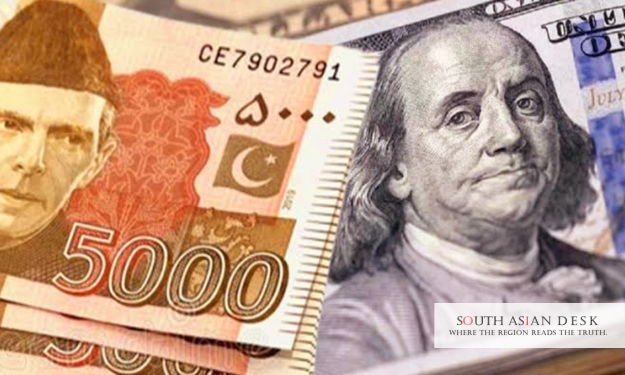
ISLAMABAD, Monday, August 25, 2025 – Pakistani rupee devaluation demands intensify as the nation’s trade imbalance deepens, with the USD to PKR rate today at 281.87 threatening the rupee 280 barrier. Officials report a $2.87 billion Pakistan trade deficit for August, driven by falling exports and rising imports, fuelling debates on currency adjustment to aid recovery.
This surge in the Pakistan trade deficit underscores broader economic strains in South Asia, where currency volatility affects regional trade flows and investor confidence. A weaker Pakistani rupee could ease export pressures but risks higher inflation, impacting neighbouring economies through cross-border remittances and supply chains.
Current USD to PKR Rate Today Signals Volatility
The State Bank of Pakistan sets the USD to PKR rate today at 281.8728 for mark-to-market revaluation, up from 280.42 earlier in the month. This marks a slight depreciation from July’s peak of 284.27, yet analysts warn of further slides if trade woes persist.
Market operators note steady dollar demand amid import needs. “The rupee holds firm, but external pressures build,” a currency dealer said. Data from the SBP’s weighted average rates show bids at 280.20 and offers at 280.63 as of recent trading, reflecting caution.
Pakistani rupee devaluation talks gain traction as exporters cite uncompetitive pricing. The current rate exposes vulnerabilities, with imports costing more in local terms. August’s figures highlight this: goods imports hit $5.285 billion, up 6.42% year-on-year.
Pakistan Trade Deficit Widens to $2.87 Billion in August
Pakistan’s trade deficit ballooned to $2.868 billion in August, per provisional data from the Trade Development Authority of Pakistan. Exports dropped 12.49% to $2.417 billion, while imports climbed to $5.285 billion.
Cumulative for July-August, the gap reached $6.013 billion, a 29.01% increase from last year. Goods exports totalled $5.102 billion, barely up 0.65%, against $11.115 billion in imports.
The Ministry of Finance’s Monthly Economic Outlook for August confirms a $2.7 billion deficit, aligning closely with TDAP estimates. “Imports rose due to oil and essentials,” the report states, attributing the hike to global prices.
Services offered some relief, with a $125.92 million deficit, improved 48.91% year-on-year. Yet overall, the Pakistan trade deficit strains reserves, now at $14.57 billion per SBP.
Exporters blame high production costs and soft global demand. Textiles, a key sector, saw declines, pushing calls for Pakistani rupee devaluation to restore edges.
Rupee 280 Barrier Tests Economic Resilience
The rupee 280 barrier looms large as the USD to PKR rate today edges higher. Traders predict a breach if September trends mirror August’s import surge.
SBP’s Monetary Policy Report for August holds the policy rate at 11%, targeting 5-7% inflation. “Stability remains priority,” it notes, without endorsing devaluation.
Past Pakistani rupee devaluation episodes, from 180 to 300 over two years, failed to spark export booms. Instead, imports compressed only via SBP controls, per expert analysis.
Faisal Mamsa, CEO of Tresmark, warns: “A rupee below 280 risks export industries, but mild depreciation aids balance.” Atif Ahmed, a dealer, adds: “Sentiment drives moves; end-month dips may occur briefly.”
The $3 billion Saudi rollover bolsters inflows, yet trade gaps erode gains. Regional peers like India’s rupee at 90 per dollar highlight disparities.
Background: Legacy of Pakistani Rupee Devaluation
Pakistan’s currency has swung wildly. From 2023-2025, sharp Pakistani rupee devaluation aimed to curb deficits but yielded mixed results. Exports stagnated despite adjustments, as real effective exchange rates (REER) stayed above 100.
IMF reviews since 2018 downplay REER as sole guide, focusing on reserves. August’s Pakistan trade deficit revival echoes July’s $379 million current account shortfall, per SBP.
Global factors weigh in: US dollar strength against majors eased local pressures, but oil imports at $5.4 billion in August amplified costs.
What’s Next: Policy Responses to Trade Pressures
Authorities eye measures to narrow the Pakistan trade deficit. SBP may tweak interventions, while fiscal incentives target exports.
A mild Pakistani rupee devaluation could feature in September’s policy, balancing growth and stability. Exporters urge action before the rupee 280 barrier breaks decisively.
Monitoring USD to PKR rate today remains key, with reserves covering three months of imports.
In conclusion, Pakistani rupee devaluation pressures persist, demanding swift reforms to safeguard South Asia’s trade dynamics.
Published in SouthAsianDesk, December 7th, 2025
Follow SouthAsianDesk on X, Instagram, and Facebook for insights on business and current affairs from across South Asia.