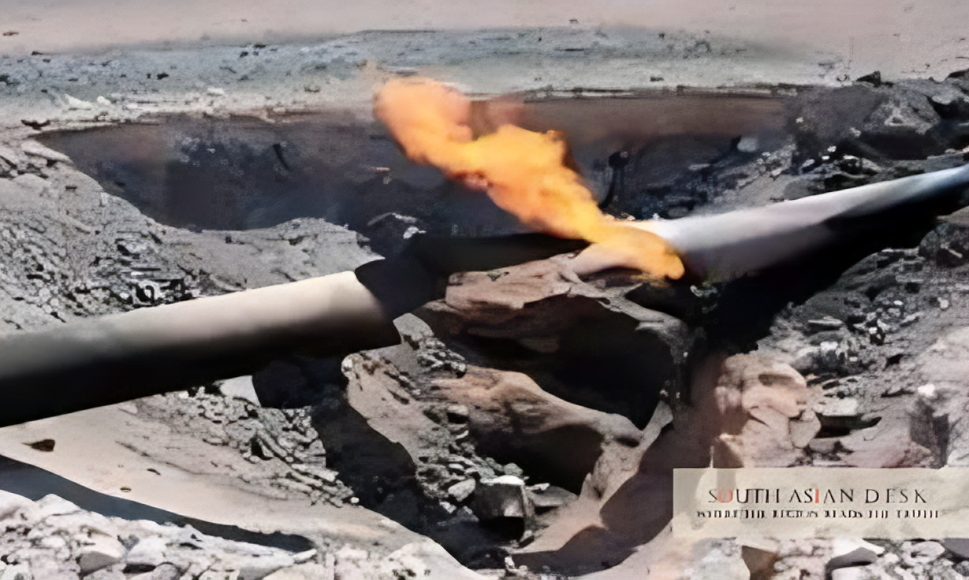
Peshawar Gas Pipeline Blast occurred late Sunday night when unidentified militants detonated explosives on a 24-inch transmission line in Hasankhel, triggering a fierce blaze that forced authorities to halt supply across five districts. Officials from Sui Northern Gas Pipelines Limited (SNGPL) and local police responded swiftly, but repairs could take days. Who is behind the Peshawar pipeline sabotage suspects remain under investigation as terror links emerge.
This incident underscores the fragility of Pakistan’s energy infrastructure against militant threats, amplifying risks to economic stability and daily life across South Asia’s volatile border regions. As Khyber Pakhtunkhwa grapples with renewed insurgent activity, such attacks highlight broader challenges to regional energy security and counter-terrorism efforts that could ripple into neighbouring countries’ supply chains.
Incident Details: Explosion Rocks Hasankhel Outskirts
The Peshawar gas pipeline blast unfolded, in the Hameed Khan Machine area of Hasankhel, on Peshawar’s fringes. Local residents reported a thunderous detonation followed by flames shooting high into the night sky. The targeted pipeline, a critical 24-inch conduit stretching from Karak district to a major junction in Nowshera, carries natural gas vital for households, industries, and compressed natural gas (CNG) stations throughout Khyber Pakhtunkhwa (KP).
Station House Officer (SHO) Mattani police station, Wajid Khan, confirmed the initial alert. “We received reports of a massive explosion and rushed a team to the site,” Khan stated. Firefighting units from Peshawar’s Rescue 1122 arrived within 30 minutes, battling the inferno for over two hours before containing it. No casualties occurred, but the blast site sustained significant structural damage, with a 10-metre section of the pipeline ruptured.
SNGPL General Manager Waqas Shinwari detailed the immediate fallout. “Emergency teams from Kohat and Nowshera were dispatched to isolate the damaged section,” Shinwari said. He emphasised the precautionary shutdown to prevent further leaks or secondary blasts. Gas flow ceased entirely along the affected route, impacting an estimated 1.2 million consumers.
TTP Targets Gas Line in Hasankhel, Peshawar
Security forces point to sabotage as the likely cause of the Peshawar gas pipeline blast. A police official, speaking on condition of anonymity, noted parallels to a similar attack two years prior. “The same pipeline was blown up by terrorists in 2023, causing widespread outages,” the official said. Preliminary investigations reveal traces of high-grade explosives consistent with improvised explosive devices (IEDs) used by militant groups.
While no group has claimed responsibility, intelligence sources and media reports suggest TTP involvement in this instance of TTP targets gas line Hasankhel Peshawar. The outlawed faction has a history of striking energy assets to disrupt government operations and economic activity. In the past 18 months, TTP claimed four similar assaults on pipelines in KP, according to government data from the Khyber Pakhtunkhwa Counter-Terrorism Department.
Police have launched a manhunt for Peshawar pipeline sabotage suspects, deploying checkpoints and unmanned aerial vehicles (UAVs) across Hasankhel and adjacent tribal areas. “We are not ruling out terror activity,” a senior KP police spokesperson added during a briefing at 9:00 AM on Monday. Forensic teams combed the site, recovering detonator remnants and shrapnel embedded in nearby scrubland.
This marks the third reported sabotage attempt on KP’s gas network in 2025, up from two in 2024. Official records from SNGPL indicate such incidents cost the utility PKR 150 million in repairs last year alone, excluding lost revenue from downtime.
Gas Supply Disruption from KP Pipeline Explosion
The Peshawar gas pipeline blast triggered immediate gas supply disruption KP pipeline explosion effects rippled across the province. SNGPL announced a full suspension to Peshawar, Charsadda, Nowshera, Mardan, and Swat districts, affecting 45% of KP’s total gas demand. Households faced cold showers and unlit stoves, while factories in Peshawar’s industrial hubs halted production, idling 5,000 workers by midday Monday.
CNG stations shuttered province-wide, stranding commuters and spiking transport costs by 20%. “We have rationed remaining stocks, but shortages will persist until repairs complete,” said an official from the KP Transport Department. Data from SNGPL’s operations centre shows daily gas consumption in the region averages 200 million cubic feet; the outage equates to a PKR 50 million daily economic hit.
Authorities urged conservation measures. “Residents should minimise usage and report leaks promptly,” Shinwari advised in a public notice issued at 11:00 AM. Alternative fuel vendors reported a 300% surge in demand for liquefied petroleum gas (LPG) cylinders, priced at PKR 2,800 each.
Broader Implications: Energy Security Under Siege
The Peshawar gas pipeline blast exposes vulnerabilities in Pakistan’s 12,000-kilometre gas transmission network, managed largely by SNGPL. KP, contributing 15% of national gas output, relies on pipelines snaking through restive border zones prone to militant incursions. This attack follows a 25% uptick in infrastructure sabotage since early 2025, per Interior Ministry figures released last month.
In South Asia, such disruptions threaten cross-border energy ties. Pakistan’s gas imports from Turkmenistan via the upcoming TAPI pipeline could face similar risks, potentially destabilising supplies to India and Afghanistan. Economists estimate nationwide ripple effects could add PKR 500 million to import bills if outages extend beyond 72 hours.
Government response includes bolstering patrols. KP Chief Minister Ali Amin Gandapur convened an emergency cabinet meeting at 2:00 PM on Monday, allocating PKR 100 million for expedited repairs and enhanced security. “We will not allow saboteurs to hold our people hostage,” Gandapur declared.
Background: A Pattern of Pipeline Sabotage
KP’s gas infrastructure has endured repeated assaults since the TTP resurgence in 2021. The 2023 Karak incident, mirroring Sunday’s event, severed supply for 10 days and cost PKR 200 million. SNGPL data logs 18 sabotage cases since then, with 70% linked to TTP affiliates aiming to strain state resources.
Hasankhel, a peri-urban enclave 15 kilometres from Peshawar’s core, borders former tribal agencies rife with unexploded ordnance from past conflicts. Local elders report sporadic militant sightings, complicating civilian access. This backdrop fuels the narrative of TTP targets gas line Hasankhel Peshawar as a tactical escalation.
Federal analysts attribute the upsurge to cross-border dynamics, though Islamabad denies Afghan complicity. Enhanced fencing along the Durand Line, completed in 80% of KP sectors, aims to curb infiltration.
What’s Next: Repair Timeline and Security Overhaul
Repair crews expect to weld the breached section by thursday, November 27, weather permitting. SNGPL forecasts partial restoration to Charsadda and Nowshera by Tuesday evening, with full resumption in Swat lagging 48 hours. Monitoring stations will track pressure levels post-repair to avert leaks.
On the security front, the KP Inspector General of Police ordered 200 additional personnel to pipeline routes. A joint task force with SNGPL engineers will audit 500 kilometres of vulnerable lines. Long-term, the government eyes drone surveillance and AI-based anomaly detection, budgeted at PKR 300 million for 2026.
As investigations into Peshawar pipeline sabotage suspects intensify, communities brace for potential reprisals. Yet, resilience defines KP: markets reopened at dawn Monday, and volunteers distributed water heaters to affected homes.
The Peshawar gas pipeline blast serves as a stark reminder that energy stability hinges on unyielding vigilance against those who seek to sow chaos.
Published in SouthAsianDesk, November 27th, 2025
Follow SouthAsianDesk on X, Instagram, and Facebook for insights on business and current affairs from across South Asia.