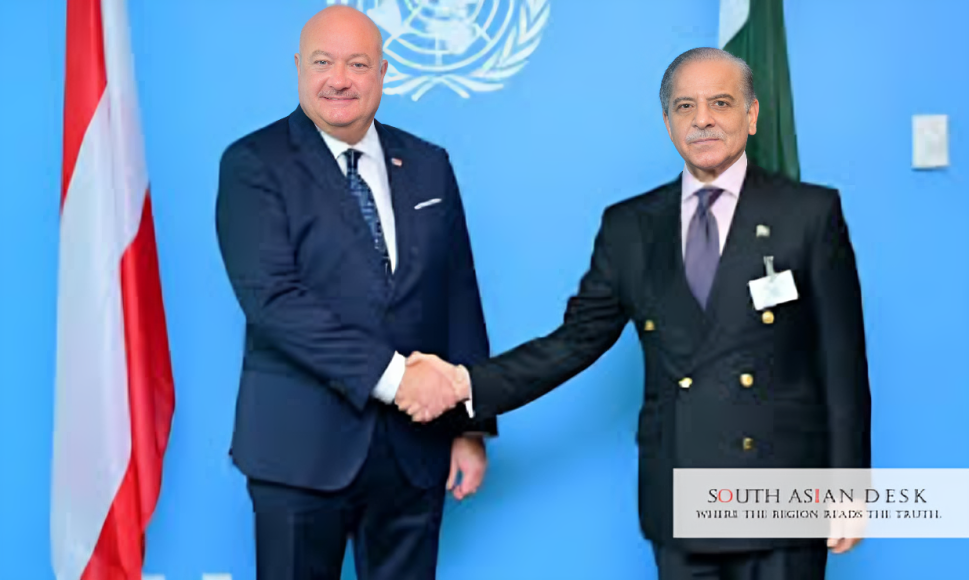
Prime Minister Shehbaz Sharif arrived in Vienna for a two-day official visit, strengthening economic and diplomatic bonds with Austria after over three decades.
Prime Minister Shehbaz Sharif landed in Vienna on 15 February 2026 for a two-day PM Shehbaz Austria visit, invited by Chancellor Christian Stocker. Accompanied by key ministers, he aims to hold bilateral talks, address business forums, and meet IAEA leaders to enhance cooperation.
This PM Shehbaz Austria visit holds significance for South Asia as it revives high-level dialogue with Europe, potentially unlocking trade opportunities for Pakistan amid economic challenges. Stronger Pakistan Austria relations could foster investment in renewable energy and textiles, benefiting regional stability through multilateral engagements.
Shehbaz Sharif Vienna Arrival Details
Prime Minister Shehbaz Sharif reached Vienna International Airport on 15 February 2026, where Austrian Armed Forces presented a salute. The delegation includes Deputy Prime Minister Ishaq Dar, Information Minister Attaullah Tarar, aide Tariq Fatemi, and Foreign Secretary Amna Baloch.
In a post on X, Shehbaz Sharif described Vienna as a city of history, culture, and global diplomacy. He expressed eagerness for discussions on trade, investment, and economic ties during the PM Shehbaz Austria visit.
The trip coincides with 70 years of diplomatic relations between Pakistan and Austria, established in 1956. Austria opened a legation in Karachi in 1954, upgrading it to an embassy in 1959.
Pakistan Austria Relations Overview
Pakistan Austria relations are cordial, based on dialogue, cooperation, and adherence to the UN Charter. The Foreign Office highlighted shared values of multilateralism and international law.
Trade forms a core of Pakistan Austria relations. In 2024, Austria imported goods worth €315.5 million from Pakistan, up 33 percent, mainly textiles, leather, and footwear. Exports from Austria to Pakistan reached €93 million, up 24 percent, including machinery, synthetic fibres, and wood products.
Bilateral agreements include an Air Services Agreement. A Joint Working Group on Trade and Economic Cooperation, set up in 1994, meets every three to four years. Potential areas for growth in Pakistan Austria relations include railway technology, hydropower, and environmental solutions.
The PM Shehbaz Austria visit aims to expand these ties. Leaders will review the full spectrum of relations during talks at the Federal Chancellery.
Business and Economic Focus
Shehbaz Sharif will co-chair a meeting of business leaders to boost investments. He will address the Pakistan-Austria Business Forum, organised by the Austrian Economic Chamber.
This aligns with efforts to enhance economic cooperation in Pakistan Austria relations. In the first half of 2025, imports from Pakistan to Austria rose 14 percent to €173 million, while exports grew 10 percent to €51 million.
Shehbaz Sharif IAEA Meeting Agenda
A key highlight is the Shehbaz Sharif IAEA meeting with Director General Rafael Mariano Grossi. Discussions will focus on peaceful nuclear energy and Pakistan’s cooperation with the agency.
In September 2025, Grossi acknowledged Pakistan’s nuclear power programme progress. The Shehbaz Sharif IAEA meeting seeks to deepen ties in health, agriculture, and sustainable development.
Shehbaz Sharif will also engage with the United Nations Office on Drugs and Crime and the United Nations Industrial Development Organisation. These aim at counter-narcotics, crime control, and industrial growth.
The PM Shehbaz Austria visit includes addressing a UN event on sustainable development for global peace and prosperity.
Background
Pakistan Austria relations date back to 1956, with steady growth despite limited high-level visits. The last Pakistani prime minister’s trip was by Nawaz Sharif in 1992.
Earlier interactions include a September 2025 meeting between Shehbaz Sharif and Chancellor Stocker on UNGA sidelines. Pakistan has collaborated with IAEA since the 1950s, contributing to global nuclear safety.
Trade imbalances favour Pakistan, with exports dominated by manufactured goods. Austria’s expertise in machinery supports Pakistan’s textile sector, a pillar of its economy.
Challenges include global economic shifts, but opportunities in renewable energy could align with Pakistan’s climate goals.
What’s Next
Outcomes of the PM Shehbaz Austria visit may include new agreements on trade and technology.
Follow-up could involve increased business delegations and joint projects in hydropower and waste management.
The PM Shehbaz Austria visit concludes with potential announcements on enhanced Pakistan Austria relations, paving the way for future collaborations.
Published in SouthAsianDesk, February 16th, 2026
Follow SouthAsianDesk on X, Instagram and Facebook for insights on business and current affairs from across South Asia.