Russian President Vladimir Putin and Indian Prime Minister Narendra Modi held the 23rd annual Putin Modi summit in Delhi on Friday. The talks focused on trade growth, Ukraine peace efforts, and energy cooperation amid US tariffs. A joint statement and multiple agreements followed the two-day Putin India visit 2025.
Putin Modi Summit Kicks Off with Ceremonial Welcome
Russian President Vladimir Putin arrived in New Delhi on Thursday evening for the Putin India visit 2025. Indian Prime Minister Narendra Modi greeted him at Palam Air Force Station with a handshake and embrace. The leaders then shared a private dinner at Modi’s residence on 7 Lok Kalyan Marg. This marked Putin’s first state visit to India in four years.
On Friday morning, Putin paid floral tributes at Raj Ghat to Mahatma Gandhi. He received a 21-gun salute at Rashtrapati Bhavan during a ceremonial reception hosted by President Droupadi Murmu and Modi. The events underscored the enduring partnership between the two nations.
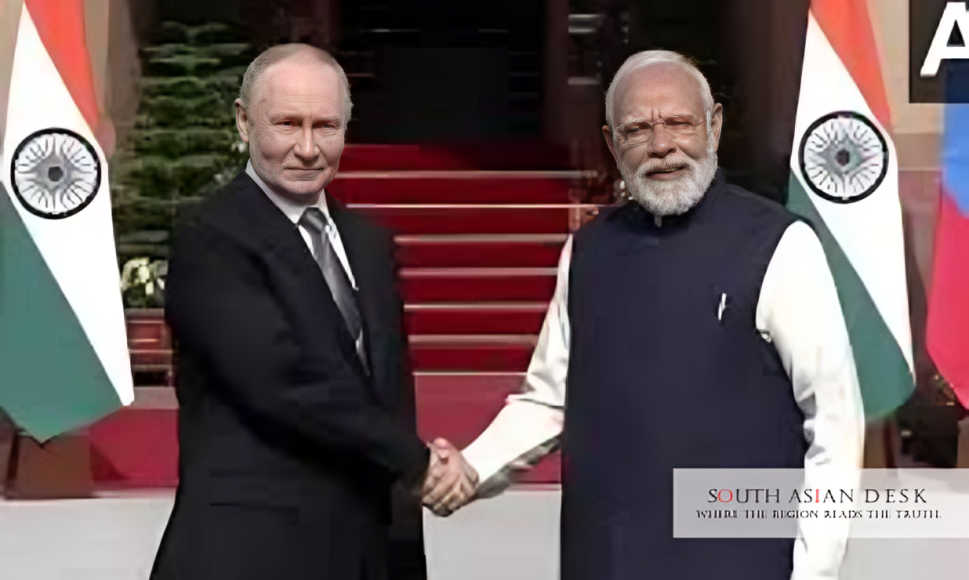
The Putin Modi summit began at 11:50 a.m. at Hyderabad House. The leaders shook hands and posed for photographs before entering closed-door talks. A large Russian delegation accompanied Putin, including Defence Minister Andrei Belousov. Belousov met Indian Defence Minister Rajnath Singh on Thursday to discuss joint projects.
Modi opened the session by reaffirming India’s stance on global conflicts. “India is not neutral. India has a position, and that position is for peace. We support every effort for peace, and we stand shoulder to shoulder with every initiative taken for peace,” Modi said.
Putin responded by thanking Modi for the hospitality. He detailed ongoing efforts on the Ukraine track. “We had the opportunity to speak in detail about what is happening on the Ukrainian track and about the steps we are taking jointly with some other partners, including the United States, toward a possible peaceful settlement of this crisis,” Putin stated.
The talks addressed key bilateral issues. Russia remains India’s top arms supplier for decades. India also leads as the largest buyer of Russian seaborne oil. These ties face challenges from Western sanctions imposed after Russia’s invasion of Ukraine nearly four years ago.
Modi Putin Delhi Talks Target Trade Imbalance
The Modi Putin Delhi talks centred on expanding economic cooperation. Bilateral trade reached $68.72 billion by March 2025, up from $8.1 billion in 2020. However, a minor dip occurred in the first nine months of 2025. Energy imports skew the balance in Russia’s favour.
Both leaders aimed to diversify the trade basket. Russia seeks more Indian exports to achieve balance. Putin highlighted growth opportunities. “As our countries and economies grow, the opportunities for cooperation expand. New areas are emerging: high technologies, joint work in aviation, space, and artificial intelligence,” he said.
Expected outcomes include agreements on labour mobility. Indian skilled workers will gain easier access to Russian markets. Russian banks Gazprombank and Alfa Bank seek approval to operate branches in India. Indian firms plan a joint venture with Uralchem for potash and ammonium nitrate production.
Energy discussions focused on oil and civil nuclear cooperation. India ramped up discounted Russian crude purchases post-2022. Recent US tariffs of 50% on Indian goods, imposed in August 2025, prompted reductions. These tariffs target India’s Russian oil buys. Putin questioned the disparity. “If the US has the right to buy our fuel, why shouldn’t India have the same privilege? This question deserves thorough examination, and we stand ready to discuss it, including with President Trump.”
The US and EU continue importing billions in Russian liquefied natural gas and enriched uranium. India views the tariffs as unjustified. The Modi Putin Delhi talks seek ways to insulate trade from external pressures.
Following the session, Modi and Putin addressed the media. They announced a joint statement on the partnership. Over 10 intergovernmental and commercial documents were signed. These cover trade, investment, and technology transfers.
India Russia Defence Deals Strengthen Strategic Ties
India Russia defence deals formed a core of the Putin Modi summit. Russia supports India’s self-reliance in defence production. Belousov met Singh to advance military-technical cooperation. “The Russian defence industry is ready to support India towards becoming self-reliant in the field of defence production,” Belousov said.
Key pacts include supplies of S-400 air defence systems and Sukhoi Su-57 fighter aircraft. Joint ventures in high-technology areas like aviation and artificial intelligence were pledged. The leaders intend to deepen trust-based relations in this sector.
Defence Secretary Rajesh Kumar Singh noted India’s diversification efforts. “We are not going to stop our defence cooperation with them anytime soon, but we increasingly spend the bulk of our money within the country,” Singh said at an industry event.
The India Russia defence deals align with New Delhi’s multi-alignment policy. They provide strategic autonomy amid regional tensions. For South Asia, these ties enhance security against shared threats. Pakistan and other neighbours monitor the developments closely, as they impact regional power dynamics.
The Putin Modi summit also touched on broader geopolitics. India resists condemning Russia over Ukraine. Modi advocates dialogue for resolution. Putin appreciated India’s attention to the issue. The talks signal Moscow’s reduced isolation through partnerships like this.
Background: Enduring India-Russia Partnership
The Putin India visit 2025 revives a tradition of annual summits since 2000. Ties date to the Soviet era, spanning defence, energy, and space. The 22nd summit in Moscow last year set a $30 billion trade target by 2025, already surpassed.
Previous meetings yielded roadmaps for hydrocarbons and education. Over 60 Russian universities joined an India-hosted Education Summit in April 2024. Regional cooperation, including Russia’s Far East development, draws Indian investors.
Ukraine’s war tested the partnership. India maintained neutrality, buying Russian oil while facing Western scrutiny. The current Putin Modi summit occurs amid stalled peace talks. US President Donald Trump’s envoys met Putin recently, but no compromise emerged.
For South Asia, the partnership matters deeply. It bolsters India’s energy security and military edge. Stable oil flows curb inflation in import-dependent economies like Pakistan and Bangladesh. Defence deals deter aggression in volatile borders.
Trade growth aids regional supply chains. Fertiliser supplies from Russia support agriculture across the subcontinent. Labour pacts open jobs for South Asian migrants, easing unemployment pressures.
The summit reinforces multipolarity. India balances ties with the US, its largest trading partner, against historical Russian alliances. This navigation influences South Asian foreign policies, promoting autonomy over alignment.
What’s Next for Putin Modi Summit Outcomes
Implementation of the 10 new deals will follow. Trade targets aim for $100 billion by 2030. Monitoring committees will track progress on energy and defence.
Follow-up visits are planned. The next annual summit could host Modi in Russia. Joint working groups on artificial intelligence and space will convene soon.
The Putin Modi summit sets a tone for 2026. It prioritises peace in Ukraine through joint initiatives. Regional forums like SCO will build on these gains.
Ongoing US tariff reviews may ease pressures. India pushes for exemptions, citing its role in global stability. The partnership evolves to meet new challenges.
In conclusion, the Putin Modi summit cements a resilient alliance. It promises mutual benefits amid global shifts, ensuring steady progress for both nations.
Published in SouthAsianDesk, December 5th, 2025
Follow SouthAsianDesk on X, Instagram, and Facebook for insights on business and current affairs from across South Asia.