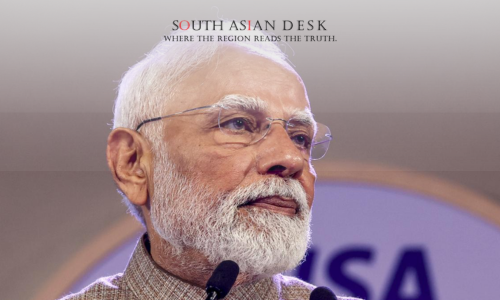
PM Modi highlights India’s reforms as key to lifting the global economy from slow growth at the ET World Leaders Forum. Prime Minister Narendra Modi, addressing the Economic Times World Leaders Forum in New Delhi on Saturday, August 23, 2025, stated that India’s reforms, guided by the mantra “Reform, Perform, Transform,” position it to help lift the world out of slow economic growth. He outlined plans to bolster India’s economy through next-generation reforms.
Why It Matters for South Asia
India’s economic reforms are pivotal for South Asia, as its growth as the world’s fastest-growing major economy sets a precedent for regional stability and development. By driving global growth, India’s policies could enhance trade, investment, and technological collaboration across the region, fostering prosperity and resilience.
Reforms Fuel Economic Resilience
Speaking at the forum, Modi emphasised that India’s economic strength stems from a decade of macroeconomic stability. “Today, India is the world’s fastest-growing major economy,” he said, noting that the country is poised to become the third-largest economy globally soon. Experts predict India’s contribution to global growth will reach 20% in the coming years, driven by reforms in taxation, manufacturing, and technology. The fiscal deficit is expected to decline to 4.4%, with robust forex reserves and controlled inflation, according to Modi.
The Prime Minister highlighted the impact of reforms during the recent monsoon session of Parliament, despite opposition disruptions. The Jan Vishwas 2.0 initiative decriminalised over 300 minor offences, building on 200 previously decriminalised, fostering trust-based governance. Additionally, the Income Tax law, unchanged for six decades, was simplified to be more accessible to taxpayers, reflecting the government’s commitment to citizen-centric reforms.
Next-Generation GST Reforms
A significant focus of Modi’s address was the ongoing overhaul of the Goods and Services Tax (GST) system. He announced that the next-generation GST reform process, aimed at simplifying the tax structure, will be completed before Diwali (October 29, 2025), potentially reducing prices. The Central government proposes scrapping the 12% and 28% tax slabs, shifting most products to 5% and 18% brackets, with a new 40% slab for ‘sin goods’ like tobacco, as reported by Livemint. The GST Council is set to meet on September 3–4, 2025, to finalise these changes, benefiting consumers during the festive season.
Boosting Private Sector R&D
Modi urged the private sector to increase investment in research and development (R&D) in sectors like clean energy, quantum technology, battery storage, advanced materials, and biotechnology. “This will strengthen the resolve of a developed India,” he said, noting that R&D spending has doubled since 2014, with a 17-fold increase in patents filed. A INR 50,000 crore National Research Foundation and a INR 1 lakh crore Research, Development, and Innovation Scheme support these efforts, alongside the ‘One Nation, One Subscription’ initiative for global journal access.
Technological and Industrial Advancements
Modi contrasted past missed opportunities with current progress, using the metaphor of “missing the bus.” He highlighted that pre-2014 governments failed to capitalise on technological advancements, leaving India reliant on foreign 2G, 3G, and 4G technologies. Since 2014, India has developed its 5G stack domestically and is now working on 6G technology. By year-end, the first Made-in-India semiconductor chip will hit the market, marking a significant step in technological self-reliance.
In industry, India’s automobile exports have risen from INR 50,000 crore annually in 2014 to INR 1.2 lakh crore today. Modi announced that India will begin exporting electric vehicles to 100 countries, with a major event planned for Monday, August 26, 2025, reinforcing India’s role in global green mobility.
Background
India’s economic trajectory has been shaped by Modi’s “Reform, Perform, Transform” mantra since 2014, focusing on macroeconomic stability and self-reliance (Atmanirbhar Bharat). The country’s fiscal discipline, with a projected 4.4% deficit, robust forex reserves, and low inflation, has bolstered its global standing. S&P Global Ratings upgraded India’s credit rating in 2025, the first such upgrade in nearly two decades, reflecting confidence in its reforms. The push for a developed India by 2047 aligns with initiatives like the Gaganyaan Mission and an INR 1,000 crore venture capital fund for space startups, which have grown from one in 2014 to over 300 today.
What’s Next
The upcoming GST Council meeting and the electric vehicle export event on August 26, 2025, will be critical milestones in India’s reform agenda. Continued private sector engagement in R&D and sustained reforms will ensure India remains a global economic powerhouse, driving growth through transformative policies.
Published in SouthAsianDesk, August 24th, 2025
Follow SouthAsianDesk on X, Instagram, and Facebook for insights on business and current affairs from across South Asia.