Rising sea levels in Bangladesh accelerate at 3.8 to 5.8mm per year, outpacing the global average. This surge, driven by climate change, floods coastal homes and erodes farmlands in districts like Khulna and Satkhira. Government data warns of 13.3 million internal migrants by 2055. Officials urge immediate adaptation as saltwater intrudes further inland. Reported on Monday, August 25, 2025, at 4:35 PM.
Sea Level Rise Impact Bangladesh: A Growing Crisis
Rising sea levels in Bangladesh have doubled in pace since the early 1990s. Tide gauges and satellite data confirm this trend. The World Bank Climate Change Knowledge Portal reports the acceleration underscores extreme risks for coastal inundation. Bangladesh loses 10,000 hectares of land annually to erosion and flooding.
Government scientists link the rise to thermal expansion of ocean waters and melting glaciers. The Ministry of Environment, Forest and Climate Change states sea levels climb faster here than the global 3.7mm yearly rate. This sea level rise impact Bangladesh feels most acutely in its southern deltas.
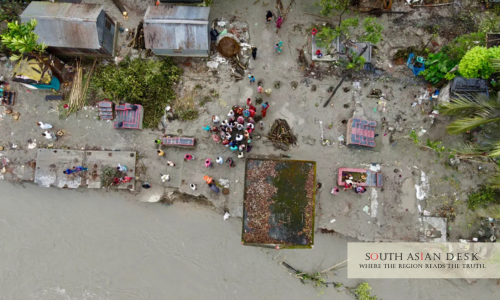
In Khulna district, villages like Parshemari face daily tidal floods. Residents build homes on bamboo stilts. Children collect yellow saline water for bathing. Wells turn brackish, forcing families to trek hours for fresh supplies. Cyclone Aila in 2009 breached embankments, salinizing soils and cracking earth.
The Bangladesh Delta Plan 2100 projects up to 0.30m rise by 2050. This could displace 0.9 million people. By 2100, a 0.74m increase may force 2.1 million from homes. IPCC projections align, forecasting 0.28 to 0.55m globally by century’s end, but local factors amplify threats in Bangladesh.
Climate Change Flooding Bangladesh: Storms and Surges Intensify
Climate change flooding Bangladesh stems from stronger cyclones and prolonged monsoons. Rainfall may surge 10% to 15% by 2030 and 27% by 2075. This exacerbates sea level rise impact Bangladesh endures yearly.
The World Bank estimates severe floods could slash GDP by 9%. In 2024, Cyclone Remal amplified storm surges, flooding 11% of coastal populations. Salinity intrusion contaminates 20% of groundwater in affected zones.
Dr Farhina Ahmed, Secretary of the Ministry of Environment, Forest and Climate Change, notes in a UNDP statement: “As sea levels rise and weather patterns shift due to climate change, agriculture, water resources, and coastal communities in Bangladesh bear the brunt.” This highlights the interconnected sea level rise impact Bangladesh faces.
Coastal areas host 30 million people. Floods displace thousands annually. Women and children suffer most, walking parched lands for water. Charities supply rainwater tanks, but stocks last only until monsoons.
Bangladesh Coastal Erosion Sea Rise: Losing Ground Daily
Bangladesh coastal erosion sea rise claims fertile lands at alarming rates. Mangrove forests in the Sundarbans shrink by 17% due to submersion. This ecosystem buffers storms but succumbs to saltwater advance.
The Department of Environment projects 120,000 sq km inundation by 2050. Erosion rates hit 1.0cm per year in some spots, per government studies. Upstream dams reduce sediment flow, worsening the loss.
In Satkhira, riverbanks crumble, swallowing schools and homes. Men migrate seasonally for work, leaving families vulnerable. The Ministry’s 2024 study warns salinity threatens rice yields, down 2.94 to 53.06 tons per degree Celsius temperature hike.
IPCC data supports this: 40% of southern productive land vanishes with 65cm rise by 2080s. Bangladesh coastal erosion sea rise thus imperils food security for 85% rural households.
Daily Struggles in Flooded Villages
Villagers in low-lying areas ration water from charity tanks holding thousands of litres. Saline intrusion kills crops, pushing prices up 20%. Health risks rise with mosquito habitats expanding.
A 2025 Forest Department project, funded by JICA at BDT 35.97 crore, targets mangrove restoration. It uses GIS for decision-making and trains foresters. Officials say it aligns with the Bangladesh Climate Change Strategy and Action Plan.
Why This Matters in South Asia
Rising sea levels in Bangladesh signal broader threats across South Asia. The delta shares rivers with India, where similar floods displace millions. UN warnings flag 900 million at risk in low-lying zones.
Economic ties amplify impacts. Bangladesh supplies garments worth USD 40 billion yearly. Disruptions from climate change flooding Bangladesh ripple to neighbours. Migration pressures strain borders, with 19 million potential internal movers by 2050.
South Asia loses 1.5% GDP annually to climate events. Adaptation costs hit USD 12.5 billion medium-term. Regional cooperation, like shared early warnings, proves essential.
Background: Historical Vulnerabilities
Bangladesh tops the 2024 World Risk Index for climate vulnerability. Past cyclones like Sidr in 2007 killed thousands. Embankments, built post-1970, often fail under intensified storms.
The 2009 Climate Change Strategy pioneered community-led resilience. Yet, 70% of land sits below 1m above sea level. Upstream Himalayan melt alters flows, compounding sea level rise impact Bangladesh battles.
What’s Next: Adaptation Imperatives
The National Adaptation Plan 2023-2050 integrates resilience into development. It eyes USD 1 billion private climate finance by 2025. Mangrove planting and elevated crops lead efforts.
Experts call for global emission cuts. Local measures, like saline-tolerant rice, show promise. Rising sea levels Bangladesh confronts demand urgent funding and tech transfers.
Forward, rising sea levels Bangladesh must counter through delta management. Success hinges on international aid and local innovation to safeguard 174 million lives.
Published in SouthAsianDesk, November 25th, 2025
Follow SouthAsianDesk on X, Instagram, and Facebook for insights on business and current affairs from across South Asia.